

Financial compliance is one of those areas that rarely gets attention until something goes wrong. A missed filing, a mismatched tax return, or an incomplete audit can quietly build up in the background of a growing company, and by the time it surfaces, the cost of fixing it is usually much higher than the cost of staying on top of it in the first place. For foreign businesses operating in Thailand, this is a particularly common blind spot, since the compliance calendar here does not always match what founders are used to from other markets.
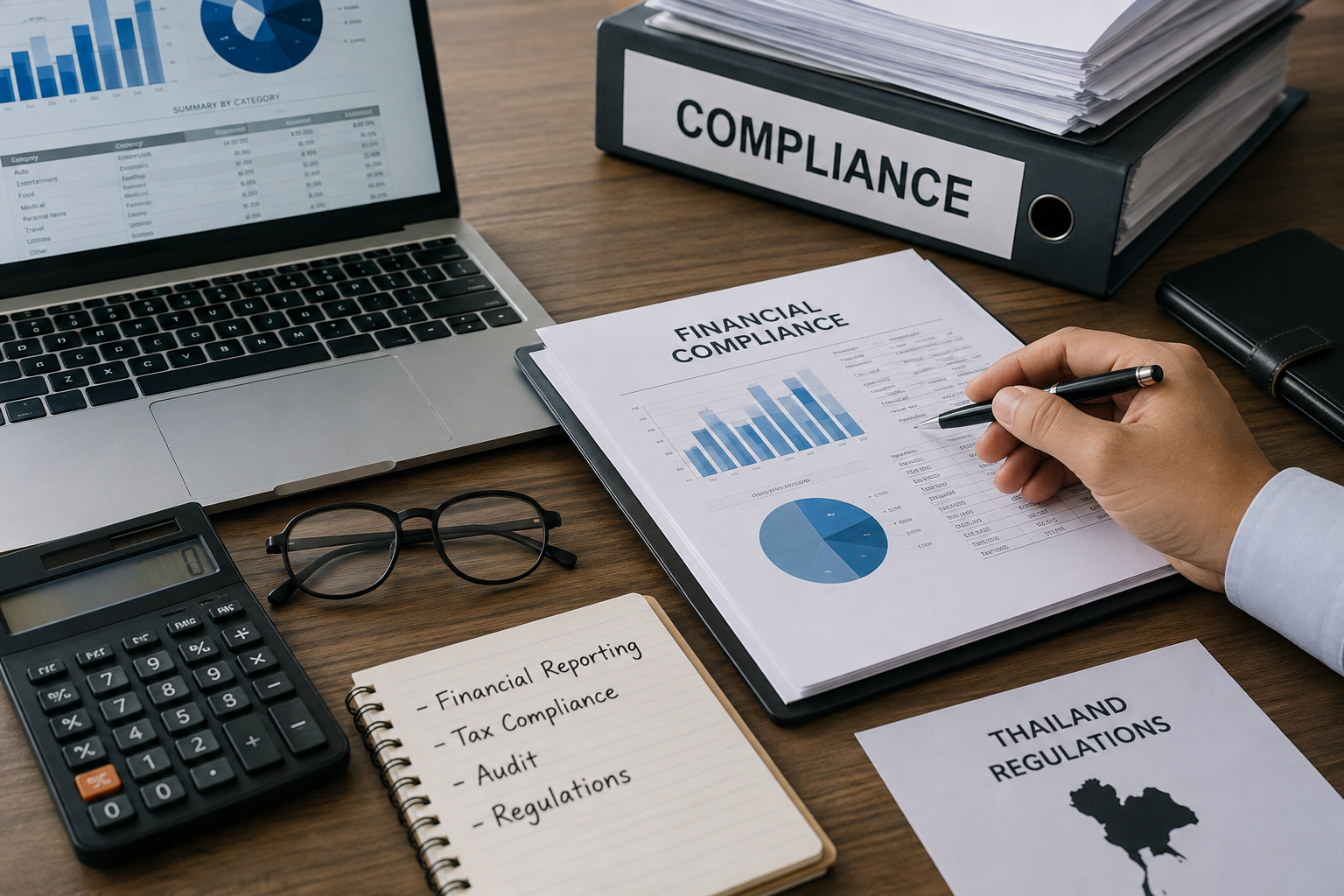
Anyone researching doing business in Thailand 2026 will quickly notice that the regulatory environment keeps shifting in small but meaningful ways, from updated BOI reporting expectations to adjustments in how certain tax filings are processed. Staying financially compliant is not a one time task completed at incorporation. It is an ongoing responsibility that touches nearly every part of how a company operates, and understanding the basics goes a long way toward avoiding preventable problems.
The Filings That Repeat Every Month
Every Thai limited company has recurring obligations that do not pause once the business is running smoothly. Withholding tax filings are typically due monthly, and companies registered for VAT need to submit those returns on a similarly regular schedule. Social security contributions for employees also follow a monthly cycle, and missing any of these deadlines can result in penalties and interest charges that accumulate quickly if left unaddressed.
What makes this tricky for many foreign founders is that there is no single unified reminder system covering all of these obligations. Each filing sits with a different government body, and the responsibility for tracking them usually falls on whoever handles finance internally, whether that is a founder wearing multiple hats or a dedicated accounting team.
Annual Requirements Carry Their Own Weight
Beyond the monthly cycle, every Thai company must submit audited annual financial statements to the Department of Business Development. This is not optional, even for small companies with limited activity during the year. The audit needs to be conducted by a licensed Thai auditor, and the resulting financial statements need to accurately reflect the company's transactions throughout the year, which means bookkeeping needs to stay current rather than being reconstructed at the last minute before the deadline.
Companies that let their books fall behind during the year often find the annual audit far more stressful and expensive than it needs to be, simply because reconstructing a year's worth of transactions under time pressure takes considerably more effort than maintaining records consistently from month to month.
Structure Changes What Compliance Looks Like
Not every company faces identical obligations. A standard Thai Limited Company follows one set of rules, while a BOI promoted company takes on additional reporting requirements to the Board of Investment in exchange for the tax incentives and relaxed ownership terms that come with promotion status. Companies structured under the US Treaty of Amity, or those operating in regulated sectors like finance, carry their own layers of oversight on top of the standard requirements.
This is worth understanding early, since assuming that compliance obligations are the same across different company structures is a common source of confusion. A business that copies its compliance approach from a competitor with a different corporate structure may end up either over filing unnecessarily or, more seriously, missing something the competitor's structure did not require but theirs does.
Why Reactive Compliance Costs More
Companies that only pay close attention to financial compliance after receiving a penalty notice or facing a rejected filing tend to spend considerably more time and money fixing the situation than they would have spent staying current from the start. Reconstructing missing documentation, responding to inquiries from tax authorities, and untangling inconsistent filing histories all take longer than simply maintaining accurate records on an ongoing basis.
There is also a knock on effect worth considering. Clean financial compliance supports smoother work permit renewals, since labour officers review payroll and social security records as part of that process. It also matters for companies planning to raise capital or bring on investors, since a clean compliance history is typically part of due diligence, and gaps discovered late in that process can slow down or derail deals that were otherwise moving forward.
Building Habits That Actually Hold Up
The businesses that manage this well tend to share a few common practices. They keep a single, clear record of every filing deadline relevant to their specific structure. They revisit their compliance obligations whenever the company changes, whether that means new hires, a shift in revenue, or a change in ownership. And they lean on people with current, local knowledge rather than relying solely on general international business experience, since Thai regulation does not always mirror what works elsewhere.
Final Thoughts
Financial compliance in Thailand is manageable, but it requires consistency rather than occasional attention. Understanding the recurring filings, the annual audit requirement, and how company structure affects specific obligations puts foreign businesses in a much stronger position heading into 2026.
Comments
Log in or sign up to join the conversation.