

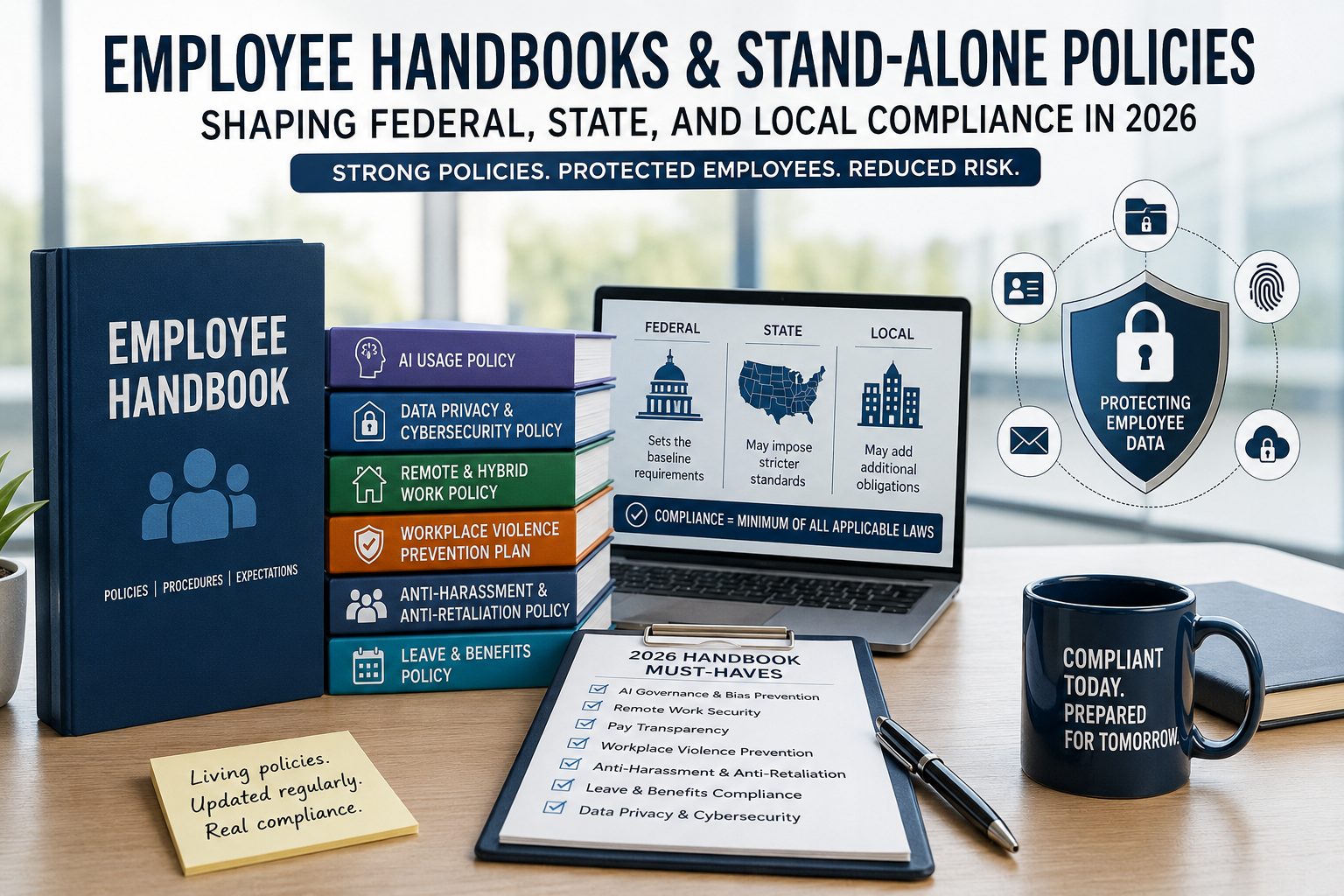
Employee handbooks have survived decades of legal upheaval, economic shifts, and changing workplace norms — and in 2026, they remain one of the most powerful risk management tools an organization has. But the handbook of today looks nothing like the one-size-fits-all documents companies relied on even five years ago. As federal, state, and local requirements multiply and diverge, employers are discovering that a static handbook is no longer enough. Instead, HR and compliance teams are turning to a combination of core handbooks and targeted stand-alone policies to keep pace with regulatory change while protecting one of their most sensitive assets: employee data.
Why the Handbook Still Matters
A well-drafted handbook does more than communicate expectations — it establishes a documented, consistent standard of conduct that can shield an organization from fines, penalties, and even criminal sanctions when regulators come calling. Courts and agencies alike look to handbooks as evidence of an employer's good-faith effort to comply with the law. That's precisely why understanding which regulations supersede others — and how state rules interact with federal baselines — has become essential knowledge for anyone responsible for policy development.
The challenge is that federal, state, and local requirements don't always align. A policy that satisfies federal law may fall short of a state's stricter standard, and a growing number of cities and counties are layering their own ordinances on top of both. Employers who fail to track these distinctions risk building a handbook that looks compliant on paper but leaves significant gaps in practice.
The Rise of Stand-Alone Policies
This is where stand-alone policies come in. Rather than cramming every new requirement into the general handbook, many organizations now maintain separate, focused policies for fast-moving or highly technical areas — leave laws, workplace violence prevention, and especially the handling of employee data. Stand-alone policies allow companies to update a single, targeted document when a state passes a new law, without having to revise and redistribute the entire handbook.
Employee data protection has become one of the clearest examples of why this approach matters. As remote and hybrid work arrangements remain the norm, employers are collecting and storing more employee data than ever — from banking and Social Security information to health records tied to leave requests and biometric data used for timekeeping or system access. Strict policies covering employee data, along with protections for customer information, are no longer optional extras; they're becoming a compliance requirement in their own right, particularly as more states enact their own data privacy and security laws.
Key Trends Driving 2026 Handbook Updates
Several forces are converging to reshape what a compliant handbook must include this year:
Artificial Intelligence Usage: Policies must now define acceptable use of generative AI tools, address how employee data is collected and processed by AI systems, and ensure transparency when AI plays a role in hiring or performance decisions — all to guard against unintended discrimination.
Remote and Hybrid Work Security: Handbooks need detailed protocols for securing employee data outside the traditional office, along with clear guidance on home-office expense reimbursement and communication expectations.
Pay Transparency: As more jurisdictions require salary ranges in job postings, handbooks must spell out compensation philosophies and procedures for handling pay-related questions.
Workplace Violence Prevention: General anti-violence language is no longer sufficient in many states, which now mandate specific, documented prevention plans.
Anti-Harassment and Anti-Retaliation: Reporting procedures must extend to electronic communications, including Slack and Teams messages, and off-site interactions, with strong safeguards against retaliation.
Leave and Benefits: With 17 states and the District of Columbia now requiring paid sick leave, and states like Illinois, Maine, and Nevada mandating paid leave for any reason, handbooks increasingly rely on state-specific addenda rather than a single national policy.
Data Privacy and Cybersecurity: Perhaps the fastest-growing category, this covers everything from how employee data is stored and transmitted to how quickly a breach must be disclosed under state law.
Building an Effective Risk Management Strategy
For employers, payroll administrators, business owners, and compliance professionals, the task ahead is clear: assess how state regulations compare to federal minimums, identify where stand-alone policies can supplement the core handbook, and build a documented framework that demonstrates genuine compliance effort — not just a policy on paper. Special attention to employee data protection is particularly urgent, given how many overlapping laws now govern its collection, storage, and disclosure.
Organizations that treat their handbook and stand-alone policies as a living, regularly updated system — rather than a document drafted once and filed away — will be far better positioned to avoid fines, penalties, and legal exposure as federal, state, and local requirements continue to evolve throughout 2026 and beyond.
FAQs
1. What's the difference between an employee handbook and a stand-alone policy?
A handbook covers general workplace conduct and expectations in one document, while a stand-alone policy addresses a specific, fast-changing area — like employee data protection or leave laws — separately, so it can be updated quickly without revising the entire handbook.
2. Why is employee data protection becoming a bigger part of handbook compliance?
Employers now collect more employee data than ever, from banking details to biometric timekeeping information. As more states pass their own privacy and security laws, clear policies on how this data is collected, stored, and disclosed are increasingly required, not optional.
3. Can a policy be compliant with federal law but still violate state law?
Yes. Federal requirements often set a baseline, but many states impose stricter standards. A handbook that only meets federal minimums may still expose an employer to penalties under state or local law.
4. How often should companies update their handbooks and policies?
Handbooks and stand-alone policies should be treated as living documents and reviewed regularly, especially as new state or local laws around pay transparency, AI use, leave, and employee data continue to emerge throughout the year.
Comments
Log in or sign up to join the conversation.