

Quick Answer
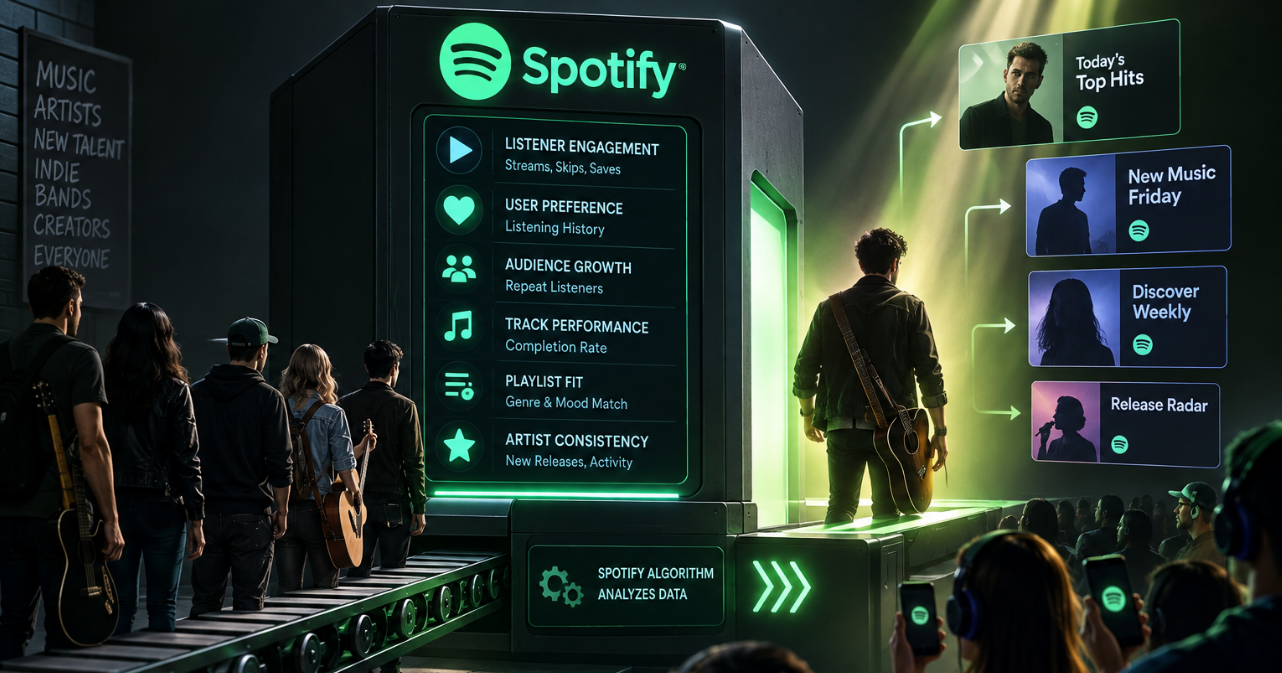
Spotify does not use one simple “artist score” to decide who gets more exposure. Its recommendation ecosystem combines many signals, including what listeners play, skip, save, add to playlists, and how they engage with artists, alongside similarities between listeners and editorial input. The goal is to match relevant music with relevant listeners at the right moment.
For artists, this means Spotify music promotion should focus on more than generating streams. Organic Spotify growth, relevant audience targeting, Spotify playlist promotion, listener engagement, and consistent artist development all matter when building sustainable exposure.
Spotify exposure is largely personalized to the listener rather than awarded to artists through a single ranking system. Personalized recommendations such as Discover Weekly, Release Radar, Radio, and other recommendation experiences use many signals about listening behavior and taste. Editorial playlists involve human curation, while listener-created playlists provide additional discovery pathways.
The practical takeaway is simple:
Spotify doesn't just need more people to hear your music. It needs evidence about which listeners are likely to enjoy it.
Introduction
Every independent artist eventually asks the same question:
“Why is Spotify giving some artists more exposure than me?”
You release a song.
You promote it.
You get streams.
Another artist releases a song around the same time and suddenly their track starts appearing in Discover Weekly, Radio, personalized playlists, and other Spotify discovery environments.
So what happened?
Did Spotify choose them?
Did they trigger the algorithm?
Do they have a secret Spotify promotion strategy?
Is there a certain number of streams required before Spotify starts recommending an artist?
The reality is considerably more sophisticated.
Spotify's recommendation systems use many different signals to personalize what individual listeners hear. Spotify has described these systems as considering thousands of types of signals, including what someone listens to and when, songs they add to playlists, and the listening behavior of people with similar tastes.
That means there isn't one universal formula called “Spotify exposure.”
There are multiple discovery pathways.
There are multiple audiences.
And there are multiple ways an artist can become relevant to a listener.
This is why a strong music marketing strategy shouldn't focus solely on chasing streams.
It should focus on creating the right conditions for real listeners to find, engage with, and continue listening to your music.
How Does Spotify Exposure Actually Work?
Spotify describes music discovery through several major pathways.
These include:
Personalized algorithmic recommendations
Spotify editorial playlists
Listener-created playlists
Artist profiles
Search and other active listening
Promotional tools
Radio and Autoplay
Other personalized listening experiences
Spotify's own artist resources describe three broad discovery pathways as Made by Editors, Made for You, and fan-led streaming.
Understanding these pathways is essential because artists often treat every Spotify stream as if it came from the same mechanism.
It doesn't.
A listener who searches for your artist is behaving differently from someone who encounters your song in Discover Weekly.
A listener who adds your track to a personal playlist is behaving differently from someone who hears it once through Radio.
That context matters.
Does Spotify Have a Single Algorithm That Ranks Artists?
Not exactly.
Spotify has multiple recommendation systems and personalized experiences.
For example, Spotify says personalized playlists are unique to each listener and can use factors such as what that person listens to and when, which songs they add to playlists, and the listening habits of people with similar tastes.
Spotify's Vice President of Personalization has also described the platform as using machine learning with thousands of inputs to produce recommendations.
So instead of imagining:
Artist A = Score 95
Artist B = Score 72
think of it more like:
Listener A → Music recommendations based on Listener A
Listener B → Music recommendations based on Listener B
Listener C → Music recommendations based on Listener C
The same artist may therefore receive substantial exposure to one audience while receiving relatively little exposure to another.
This is why audience fit is so important.
What Signals Can Influence Spotify Recommendations?
Spotify has publicly discussed several types of listener signals.
These include behavior such as:
What someone listens to
When they listen
Songs they add to playlists
Whether they skip songs
Whether they listen to an entire song
How they engage with artists
What listeners with similar tastes listen to
Spotify has specifically explained that actions such as adding songs to playlists, listening through a song, skipping, and engaging with an artist can provide signals used in personalization.
This is important for artists because it changes the way you should think about Spotify algorithm growth.
The question isn't:
“How many streams do I need?”
A more useful question is:
“What happens when the right listeners hear my music?”
Why Listener Relevance Matters More Than Raw Exposure
Imagine two campaigns.
Campaign A
100,000 people encounter your song.
But most of them:
Skip quickly
Don't save
Don't follow
Don't listen again
Don't explore your catalog
Campaign B
20,000 relevant listeners encounter your song.
A meaningful portion:
Listen deeply
Save the track
Add it to playlists
Return later
Follow the artist
Explore other releases
Which campaign tells you more about your actual audience?
The answer isn't necessarily determined by one metric.
But Campaign B provides much stronger evidence about who your music resonates with.
This is why effective organic music promotion should prioritize audience relevance instead of simply maximizing exposure.
What Role Does a Save Play?
Saves can be an important listener-engagement signal.
When someone saves your song, they are taking an additional action beyond simply playing it.
But be careful with the common claim:
“More saves automatically trigger the Spotify algorithm.”
That's too simplistic.
Spotify has not published a universal save-rate threshold that guarantees recommendation exposure.
Instead, saves should be viewed as one piece of the larger listener-behavior picture.
For example:
Listen
↓
Save
↓
Return
↓
Follow
↓
Explore catalog
This sequence tells a much richer story than the initial stream alone.
For artists, this is why tracking engagement alongside streams can make Spotify for Artists analytics much more useful.
What Happens When Listeners Skip Your Song?
Skipping is also part of the listener experience.
Spotify has publicly stated that it considers signals such as whether users skip a song when shaping recommendations.
This doesn't mean:
“One skip = bad.”
People skip songs for countless reasons.
Maybe the listener isn't in the mood.
Maybe they want something faster.
Maybe they're commuting.
Maybe they're looking for a different genre.
Personalization exists precisely because different listeners have different tastes.
The broader pattern is more useful than an isolated action.
If a song repeatedly reaches audiences that aren't interested in it, that may indicate an audience-targeting problem.
If it consistently performs well with a specific audience, that's valuable information.
Why Spotify Doesn't Recommend Every Song to Everyone
Spotify's objective is not simply to maximize exposure for every artist.
Its recommendation systems are designed around the listener.
Spotify says personalized recommendations aim to match listeners with relevant content while also creating opportunities for artist and creator discovery.
That means the same track can be:
Highly relevant to Listener A
but
Completely irrelevant to Listener B.
This is actually good news for independent artists.
You don't necessarily need everyone to like your music.
You need to identify who is most likely to connect with it.
That's the foundation of effective music audience growth.
What Is the Difference Between Editorial and Algorithmic Exposure?
This distinction is critical.
Editorial Exposure
Spotify editorial playlists are curated by Spotify's editorial teams.
Spotify says its editors specialize across genres, lifestyles, and cultures, and artists can pitch unreleased music through Spotify for Artists.
Editorial playlist placement is therefore a human-curated pathway.
Algorithmic Exposure
Personalized recommendations are generated for individual listeners.
Examples include:
Discover Weekly
Release Radar
Radio
Autoplay
Personalized mixes
Other personalized experiences
These use listener-specific signals and recommendation systems.
Fan-Led Exposure
Listeners also create playlists.
When fans add your music to their own playlists, those actions can contribute to discovery.
Spotify explicitly notes that listener playlists provide insight into how music resonates with fans and that adding music to playlists tells Spotify what listeners like and what to recommend.
This is why playlist promotion for artists should not only focus on getting a track onto a playlist.
The audience inside the playlist matters.
Does Having More Streams Automatically Give You More Exposure?
No.
Streams are an important measurement of listening activity, but they don't function as a simple leaderboard where the artist with the highest stream count automatically receives all future recommendations.
Spotify's recommendation systems use many signals.
This creates an important distinction:
Streams measure activity.
Listener behavior provides context.
For example, 100,000 streams could come from:
A large number of one-time listeners
A smaller number of highly engaged listeners
Repeat listening from existing fans
Playlist exposure
Active artist searches
Personalized recommendations
The number alone doesn't tell you which scenario occurred.
That's why Spotify music marketing should examine the source and behavior behind the stream.
Why Some Smaller Artists Can Suddenly Get More Exposure
This is one of the most interesting parts of Spotify's ecosystem.
An artist doesn't necessarily need a massive global audience before becoming relevant to a specific group of listeners.
Suppose Spotify identifies a group of listeners who consistently enjoy:
Alternative R&B
A particular production style
Similar vocal characteristics
A specific mood
A cluster of related artists
If your song appears to fit that listening environment, it may become relevant to those listeners.
This doesn't mean Spotify has declared the artist “important.”
It means the music may be a useful recommendation for that particular audience.
That's an important distinction.
Can Playlist Promotion Increase Your Spotify Exposure?
It can create opportunities for discovery, but playlist placement should not be treated as a guaranteed algorithmic shortcut.
Relevant playlist exposure can introduce your music to listeners who already consume similar music.
That can be valuable.
But the quality of the audience matters.
Imagine two playlists:
Playlist A
100,000 followers
Low relevance to your genre
Playlist B
15,000 followers
Highly aligned with your audience
The follower count alone doesn't determine which opportunity is more useful.
The second playlist may expose you to listeners who are more likely to engage with the song.
That's why professional Spotify playlist promotion should be built around relevance rather than vanity metrics.
Can You Buy Your Way Into Spotify's Algorithm?
This is where artists need to be extremely careful.
Some services promise:
Guaranteed Discover Weekly placement
Guaranteed algorithmic boosts
Guaranteed streams
Guaranteed saves
Instant Spotify growth
These claims should be approached with caution.
Spotify itself states that Discovery Mode increases the likelihood of selected songs being recommended but does not guarantee recommendation, and that listener engagement still matters.
The lesson is important:
Even an official Spotify promotional tool does not guarantee recommendation exposure.
So be skeptical of third-party services claiming they can guarantee it.
What Is Spotify Discovery Mode?
Discovery Mode is an official Spotify for Artists tool that allows artists and labels to identify songs they want prioritized for discovery.
Spotify says its system adds that signal to the algorithms powering personalized playlists, increasing the likelihood that selected tracks will be recommended but it does not guarantee recommendations. Spotify also says it accounts for when listeners aren't engaging with a song.
This is a useful example of how Spotify's ecosystem works.
Artist input can influence the system.
But listener response still matters.
That distinction should be at the center of any responsible Spotify promotion strategy.
What About Spotify Marquee?
Marquee is another official Spotify promotional tool.
Spotify describes it as a sponsored recommendation for new releases, allowing artists and teams to target listeners based on listening history and measure listening and fan engagement.
Again, this demonstrates an important principle:
Targeting matters.
Spotify itself uses listening behavior to help determine which listeners may be more likely to respond to a release.
For independent artists, this reinforces the value of building campaigns around audience fit rather than generic reach.
How Important Is Your Artist Profile?
Your artist profile is part of the journey after someone discovers your music.
Spotify describes artist profiles as a place where new listeners can learn more about an artist and existing fans can explore their music and other offerings. Spotify also reports that millions of fans visit artist profiles each day and that 90% interact with the page in some way.
That means exposure isn't the end of the funnel.
Imagine:
Listener discovers song
↓
Listener visits artist profile
↓
Listener explores catalog
↓
Listener follows artist
↓
Listener returns for future releases
A strong artist profile can help support that journey.
GPM Findings
From a music-marketing perspective, several practical findings emerge from the way Spotify describes discovery and personalization.
GPM Finding #1: Spotify Exposure Is Listener-Centric
The most important shift is moving away from:
“How do I make Spotify push my artist?”
Toward:
“How do I become relevant to more of the right listeners?”
Spotify's recommendation systems are built around individual listener preferences and behavior.
GPM Finding #2: More Streams Are Not the Entire Strategy
Streams matter.
But streams without context don't tell you enough.
You should also examine:
Source of streams
Saves
Repeat listening
Follows
Playlist activity
Catalog engagement
Audience geography
Listener segments
Spotify for Artists provides source-of-streams and audience data specifically to help artists understand how people find and respond to their music.
GPM Finding #3: Audience Targeting Can Improve Your Marketing Decisions
If a particular audience responds strongly to your music, that information can help shape future campaigns.
Instead of asking:
“Where can I get the most streams?”
Ask:
“Where are my strongest listeners coming from?”
That is a much more actionable question.
GPM Finding #4: Exposure Should Lead Somewhere
A listener hearing your song once is not the final objective.
You want to create a path:
→ Discovery
→ Engagement
→ Follow
→ Repeat listening
→ Catalog exploration
→ Fan
This is the difference between temporary exposure and long-term music audience growth.
What Should Artists Do to Increase Their Chances of Meaningful Exposure?
You cannot directly control Spotify's recommendation systems.
But you can control many aspects of your artist strategy.
1. Make Strong, Distinctive Music
No marketing system can replace the underlying product.
Your music has to give people a reason to continue listening.
2. Understand Your Audience
Use Spotify for Artists to study:
Locations
Audience segments
Similar artists
Source of streams
Listener behavior
Release performance
Spotify specifically positions its analytics as a way for artists to understand who is listening and which songs connect most strongly.
3. Pitch Your Releases Properly
Spotify allows artists to pitch unreleased songs to playlist editors through Spotify for Artists.
Spotify recommends pitching at least seven days before release so editors have time to consider the song.
Use accurate information about:
Genre
Mood
Culture
Instrumentation
Song context
Don't treat the pitch as a place to exaggerate.
Give Spotify useful information about the release.
4. Build Real Listener Engagement
Encourage people to actually listen.
Don't make your campaign solely about getting them to click.
The stronger objective is:
Listen → connect → save → return → follow.
5. Build Your Catalog
One song can introduce you.
A catalog gives listeners somewhere to go next.
If someone discovers your newest release and likes it, make sure your older music gives them additional reasons to stay.
6. Use Legitimate Promotion
Organic music promotion doesn't mean refusing to market your music.
It means focusing on genuine listeners rather than artificial activity.
You can use:
Social media
Content marketing
Legitimate playlist outreach
Audience-targeted advertising
Artist collaborations
Influencer campaigns
Spotify's own promotional tools where available
Music marketing services
The objective is to create authentic discovery opportunities.
How Can GPM's Spotify Targeted Integration System Fit Into This?
GPM Music Group's Spotify Targeted Integration System can be positioned as part of a broader audience-development strategy rather than a promise of guaranteed algorithmic exposure.
The concept is:
Identify relevant audiences
↓
Create targeted music exposure
↓
Drive genuine listeners
↓
Analyze engagement
↓
Identify stronger audience segments
↓
Refine future promotion
↓
Build long-term artist growth
The important part is the feedback loop.
If a campaign generates exposure but weak engagement, investigate the audience.
If a campaign produces stronger saves and repeat listening, investigate why.
If one geographic market consistently responds better, study that market.
If listeners discover one song and then explore your catalog, build around that behavior.
That's how data-driven music marketing becomes useful.
What Should You Track in Spotify for Artists?
Instead of watching only your stream count, create a broader dashboard.
Track Your Reach
Listeners
Streams
New listeners
Source of streams
Track Engagement
Saves
Playlist additions
Repeat listening
Follows
Track Audience
Top countries
Top cities
Audience segments
Similar artists
Listener behavior
Track Catalog Depth
Streams on older songs
New listeners exploring previous releases
Profile activity
Artist follows
Spotify for Artists provides several of these audience and source insights specifically to help artists make informed marketing decisions.
What Should You Avoid?
Avoid Buying Fake Streams
Artificial streams don't create the same thing as genuine audience development.
A large number in your dashboard isn't useful if you don't have real listeners behind it.
Avoid Guaranteed Algorithm Promises
No legitimate marketer can guarantee that Spotify will place your song into Discover Weekly, Radio, or another personalized recommendation environment.
Spotify's own Discovery Mode documentation explicitly says recommendation is not guaranteed.
Avoid Obsessing Over One Metric
Don't make every strategic decision based on:
Streams alone
Saves alone
Monthly listeners alone
Discover Weekly alone
Look for patterns across multiple metrics
Avoid Chasing Every Playlist
A playlist isn't automatically valuable because it has a large follower count.
Ask whether the audience actually fits your music.
Myth vs Fact
Myth: Spotify Has a Secret Score for Every Artist
Fact: Spotify describes recommendation as a system using many signals and personalization inputs rather than a simple public artist ranking.
Myth: More Streams Automatically Mean More Algorithmic Exposure
Fact: Streams are only one part of the overall listening picture. Spotify considers many signals when personalizing recommendations.
Myth: You Need Millions of Streams Before Spotify Notices You
Fact: Spotify's personalized systems are designed to match music with individual listener tastes. Discovery can happen at different stages of an artist's career.
Myth: Playlist Placement Automatically Creates Long-Term Growth
Fact: Playlist exposure creates an opportunity for discovery, but the listener's subsequent behavior determines what happens next.
Myth: A Spotify Promotion Service Can Guarantee Discover Weekly
Fact: Spotify itself states that its Discovery Mode increases the likelihood of recommendations but does not guarantee them.
The Real Difference Between Exposure and Growth
This distinction is critical.
Exposure
Someone hears your music.
Engagement
They listen more deeply, save, add it to a playlist, or interact with your artist profile.
Retention
They return later.
Conversion
They follow you.
Audience Development
They explore your catalog and become a recurring listener.
Fan Growth
They continue following your music beyond one release.
A serious independent artist promotion strategy should try to move listeners through this journey.
Not simply maximize the first step.
Best Solution Summary
If you want more meaningful Spotify exposure, don't spend all your time trying to decode a secret algorithm.
Instead, build the fundamentals that make your music easier to match with the right listeners.
Focus on:
1. Strong music
Give listeners a reason to stay.
2. Audience fit
Reach people who are genuinely interested in your sound.
3. Legitimate promotion
Create real discovery opportunities.
4. Listener engagement
Study saves, repeat listening, follows, and playlist activity.
5. Catalog depth
Give new listeners more music to explore.
6. Data analysis
Understand where your best listeners come from.
7. Consistency
Build momentum across multiple releases rather than expecting one song to carry your career.
Key Takeaways
Spotify does not appear to use one simple public score to decide which artists receive exposure.
Personalized recommendations are based on many listener and music signals.
Listening behavior, skips, playlist additions, and artist engagement can contribute to personalization.
Spotify discovery can come through editorial, personalized, and fan-led pathways.
Audience relevance matters more than simply maximizing exposure.
Streams should be analyzed alongside saves, follows, repeat listening, and source of streams.
Playlist promotion can create discovery opportunities but should not be treated as a guaranteed algorithmic shortcut.
Spotify's official promotional tools can influence exposure, but even Discovery Mode does not guarantee recommendations.
A strong artist profile can help convert discovery into deeper fan engagement.
The goal of organic Spotify growth should be long-term audience development rather than temporary stream spikes.
Frequently Asked Questions
How does Spotify decide which artists get more exposure?
Spotify uses multiple recommendation systems and signals to personalize music for individual listeners. These can include listening behavior, playlist activity, skips, engagement with artists, and the behavior of listeners with similar tastes.
Does Spotify favor artists with more streams?
There is no public rule saying that having more streams automatically guarantees more recommendation exposure. Spotify's personalization systems use many signals rather than a single stream threshold.
How do I get more Spotify algorithm exposure?
Focus on relevant audience targeting, strong music, genuine listener engagement, consistent releases, legitimate promotion, and analyzing your Spotify for Artists data.
Does Spotify playlist promotion help?
Relevant playlist exposure can introduce your music to new listeners. However, playlist placement should not be treated as a guarantee of algorithmic recommendation or long-term growth.
Can I guarantee Discover Weekly placement?
No. Spotify's own Discovery Mode documentation says it can increase the likelihood of selected songs being recommended but does not guarantee recommendation.
What matters more: streams or saves?
They measure different things. Streams show listening volume, while saves provide additional information about listener engagement. Neither should be evaluated in isolation.
How important is audience targeting?
Very important from a marketing perspective. Reaching listeners whose existing tastes align with your music can create more relevant discovery opportunities and provide better information for future campaigns.
Can independent artists get algorithmic exposure?
Yes. Spotify's personalized discovery systems are designed to match music with individual listeners, and Spotify describes personalized recommendations as an important pathway for artist discovery.
Should I focus on Discover Weekly?
Discover Weekly can be valuable, but it should not become your entire marketing strategy. Build a broader ecosystem involving your catalog, audience, profile, content, promotion, and fan relationships.
GPM Music Group: Build Exposure That Leads Somewhere
Getting someone to hear your song is only the beginning.
At GPM Music Group, the objective of Spotify music promotion is to help independent artists build meaningful connections with relevant listeners.
Our approach combines:
Audience Targeting
→ Spotify Playlist Promotion
→ Organic Music Promotion
→ Data Analysis
→ Audience Growth
→ Long-Term Artist Development
The goal isn't to promise a secret algorithm hack.
It's to create a smarter system around your music so that every release teaches you more about your audience.
Explore Spotify Playlist Promotion with GPM Music Group
Final Thoughts
Spotify exposure isn't a popularity contest with one giant scoreboard.
It's a personalized ecosystem.
A listener hears something.
They respond.
Spotify learns from that behavior.
The system looks for other listeners whose tastes may align.
The cycle continues.
That is why the most important question for an independent artist isn't:
“How do I make Spotify promote me?”
It's:
“How do I make my music relevant to more of the right listeners?”
That shift changes your entire music marketing strategy.
You stop chasing arbitrary stream targets.
You start analyzing audience fit.
You stop looking for algorithm hacks.
You start building genuine engagement.
You stop treating playlist placement as the destination.
You start treating it as one potential entry point into a larger fan journey.
And most importantly, you start building an artist career that doesn't depend on one playlist, one release, or one recommendation surface.
Create music people want to hear.
Reach listeners who are likely to care.
Give them more reasons to stay.
Then use the data to get smarter with every release.
That is the foundation of sustainable Spotify growth.
Comments
Log in or sign up to join the conversation.