

A cardiologist working at a mid-sized hospital in Dallas said that during the first 40 minutes of her work, she needs to find patient documents, thus being unable to treat patients. This problem that she faced is not related to a shortage of personnel. It’s a systems problem that makes hospitals cost much more than just their employees’ time.
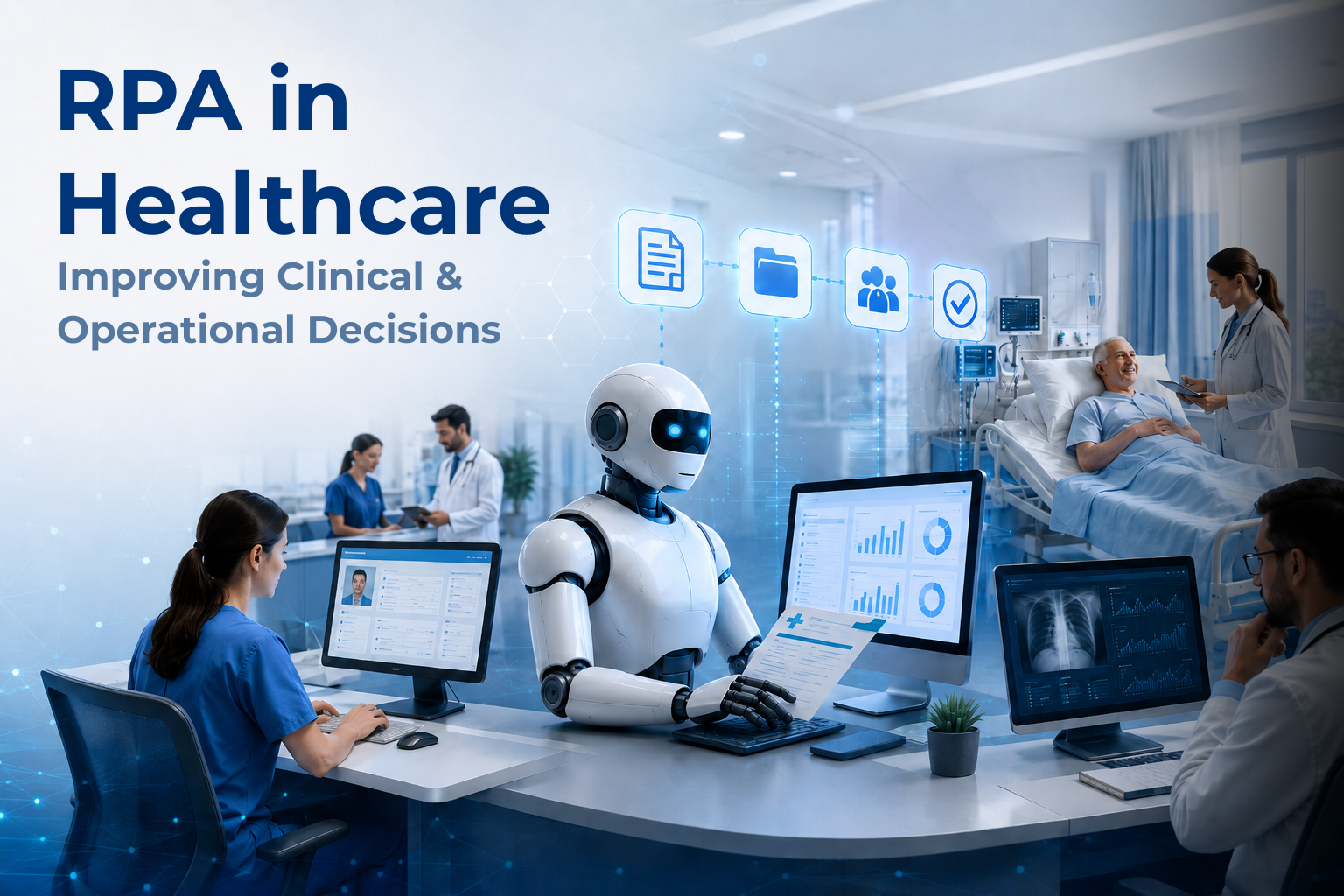
Robotic Process Automation in healthcare industry is a technology that can change all this. Just as people deal with electronic data – retrieving, entering, checking, routing, verifying, and so on; software bots do the same things but with zero errors.
RPA in healthcare process automation has now become essential for hospitals because it can handle a huge amount of administrative and clinical tasks that humans cannot.
The Robotic Process Automation market in healthcare was assessed at USD 2.28 billion in 2024, while this value will likely reach USD 10 billion by 2032.
There is an understandable reason behind the rapid growth of this industry: manual processing has reached its limit.
What is RPA in Healthcare, and What Does It Do?
What Does an RPA Bot Do in a Hospital?
An RPA bot is like any other human operator, but without the need for breaks or mistakes while handling data. It logs in, views the screen, inputs or extracts information, proceeds to the next application, and finishes the process within seconds. For instance, the bot can extract the insurance details of a patient, perform the verification process, authorize, and return the information back to the EHR.
There is also no need for RPA bots to use different software from that of the hospital. They work perfectly with the existing one, which is why healthcare organizations are able to adopt them with great ease.
Is RPA the Same as AI in healthcare?
RPA and AI in healthcare are not the same because the working principles of both are very different. RPA works following specific rules, and processes structured data precisely as expected. Contrary to that, an AI model deals with data and uses it as input from sources like handwritten notes, pictures, or even audio messages. They are completely complementary even though they do not share any similarities.
Take the case where the RPA bot retrieves patients’ records from the EHR database system at the hospital and at the same time, the AI will analyze the handwritten note in the referral note to understand the urgency. Some complicated situations might still be sent to the doctor.
This is an excellent example of how AI and RPA in healthcare go hand in hand, resulting in an increase of speed by 50-70 percent.
How does RPA help Hospitals make Better Decisions?
How does RPA improve patient data accuracy for doctors?
The doctor who makes a clinical decision isn’t different from the information available to him or her at the moment. He or she will never be perfect if there is an obsolete note about the patient's allergy, or the wrong lab test results, or lack of data regarding what medications the patient had.
This can be overcome by integrating RPA in healthcare processes. The bots automatically collect all data needed and update EHRs without any human involvement. They do not forget to enter any details just because they were engaged elsewhere. The automated clinical workflow offers such reliability.
How does RPA speed up treatment approvals?
One of the top reasons for delays in a patient’s treatment is the prior authorization process. After prescribing the procedure, the doctor spends days waiting for hospital staff members to finish documentation, submit it to the health insurance company, and receive a response from it.
Automation saves time on all those steps. Bots analyze the patient's information, find out whether all conditions are met, collect required documentation, and send out authorization requests. All those doctors who used to handle documentation now have the time to see their patients.
What hospital tasks can RPA automate?
Short Answer: Hospitals with any kind of task where data transfer takes place according to a standard protocol. RPA for operational efficiency in healthcare covers a large proportion of the activities carried out in hospitals. These are those tasks that take up employees' time but have nothing to do with providing medical treatment to any patients.
Appointments scheduling: The software checks if the doctors are available, schedules their appointments, and sends reminders to the patients
Patient registration: University Hospitals Birmingham has introduced RPA-assisted kiosks to register patients and save time and make less errors
Billing & claims: The bots check the data of the claims, file the claims with the insurers, follows up on them, and drastically cut down the denial rates
Distribution of lab results: The test results are automatically shared with the concerned doctor once they become available
Management of clinical trials: At Pfizer, bots prepare clinical studies reports and FDA documentation within just a few days
None of these are administrative tasks which are irrelevant to medical assistance provided to patients.
Does RPA help hospitals stay HIPAA compliant?
Yes, and it achieves that with consistency that no human process can match.
Robotic Process Automation bots always follow the defined parameters throughout the processes. It is impossible for them to get distracted and deviate from the course of the data flow. These bots never fail to log an event in case they’re busy with other tasks.
Compliance monitoring, which was once a full-time job, can be done continuously, highlighting the slightest deviation from the right course of action.
Reports have shown that application of RPA in healthcare will save more than USD 17.6 billion in the US alone.
The trouble with the cardiologist chasing through papers to get ready for the day ahead wasn’t that she lacked necessary facts needed to help her patients; the trouble was that processes failed to supply her with means of making decisions efficiently. RPA in healthcare doesn’t bring changes to the knowledge base of doctors; what it does is make accurate information available to them at the right time.
Cinntra works with healthcare organizations to design and implement automation frameworks that close exactly this gap: from data integration to compliance workflows, so that clinical teams can focus on what they were trained to do.
Comments
Log in or sign up to join the conversation.