

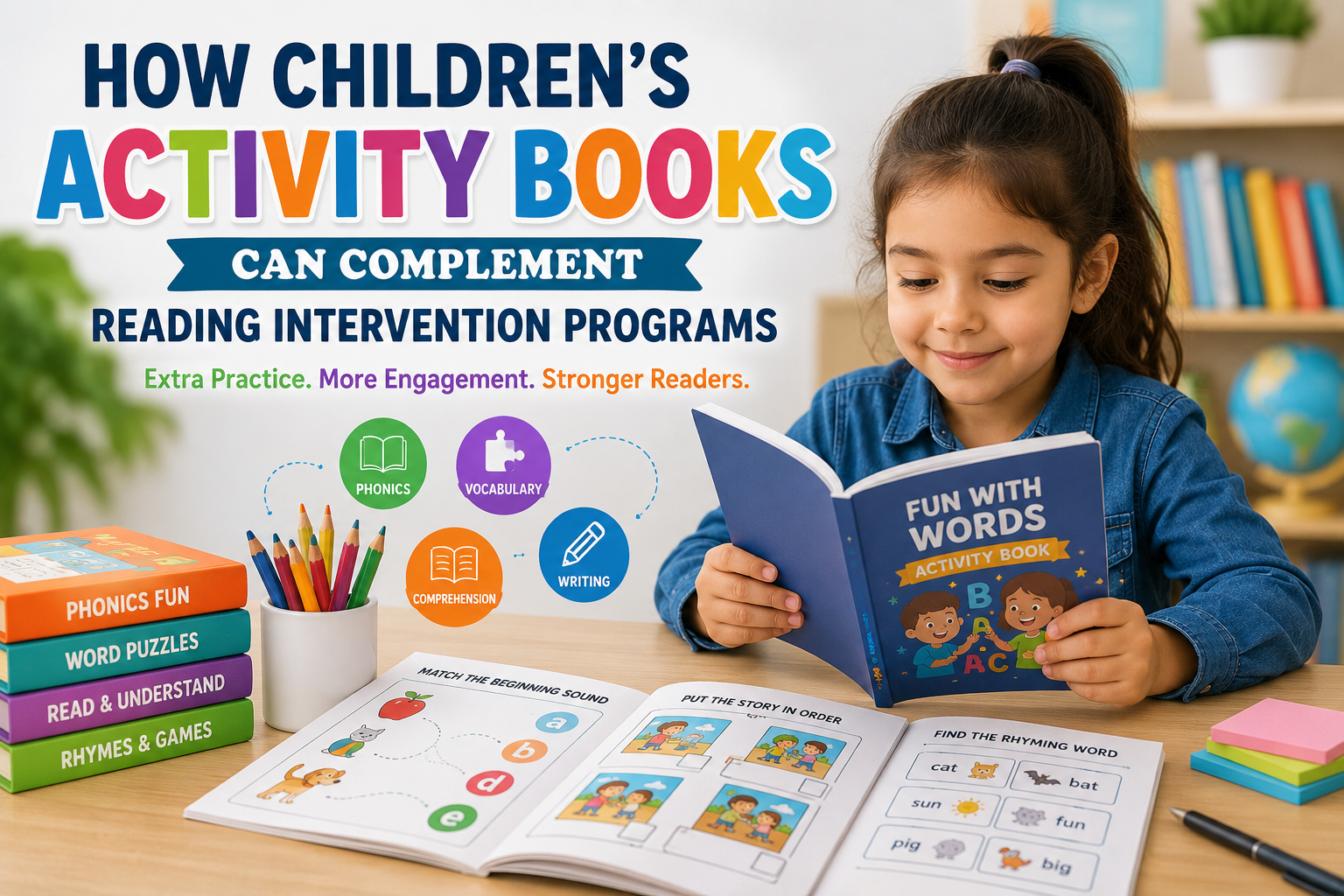
Helping a child become a stronger reader often takes more than one type of learning experience. Some children make steady progress through everyday classroom instruction, while others need extra support with phonics, fluency, vocabulary, comprehension or confidence. That is where reading intervention programs can make a meaningful difference.
However, structured intervention does not need to stand alone.
Children’s activity books can complement targeted reading support by giving young learners extra opportunities to practice important skills in a more interactive and enjoyable way. Matching games, word puzzles, rhyming activities, letter exercises, sequencing tasks and simple writing prompts can reinforce concepts children are already learning through intervention.
The key is to use activity books as a support tool rather than a replacement for direct instruction.
Educators and literacy-focused creators such as Cherry Carl have long demonstrated the value of combining reading practice with songs, rhymes, word play and hands-on activities. This type of approach shows how a children’s books author can help turn literacy practice into something children actively participate in.
So, how can parents and teachers use activity books alongside reading intervention in a productive way? Let’s explore the connection.
What Are Reading Intervention Programs?
Reading intervention programs are structured forms of instruction designed to provide extra help to children who are struggling with specific areas of reading.
These programs may focus on skills such as:
Phonemic awareness
Phonics
Letter-sound relationships
Decoding
Word recognition
Vocabulary
Fluency
Reading comprehension
Spelling
Writing
An effective intervention program usually begins by identifying a child’s specific needs.
For example, one child may understand stories well when someone reads aloud but struggle to decode unfamiliar words. Another child may read accurately but very slowly. A third child may read fluently yet have difficulty explaining the meaning of a passage.
Because these challenges are different, the support should also be different.
That is why targeted practice matters.
Where Children’s Activity Books Fit In
Children’s activity books can reinforce the same skills a child practices during reading intervention.
For example, if a child is learning beginning sounds, an activity book might include a page where the child matches pictures to their starting letters.
If the child is practicing word families, the book may include rhyming exercises.
If comprehension is the focus, the activity might ask the child to place story events in the correct order.
In this way, activity books provide another path to the same learning goal.
The child is not necessarily learning a completely new concept. Instead, they are practicing a familiar concept in a different format.
That repetition can be valuable.
Activity Books Make Repetition More Engaging
Children often need to practice a skill many times before it becomes automatic.
However, repeating the same type of lesson can become boring.
Activity books introduce variety.
For example, a child practicing the short “a” sound might first read a list of words in an intervention session.
Later, a children’s activity book could ask the child to:
Circle pictures with the short “a” sound.
Match rhyming words.
Complete missing letters.
Solve a simple word puzzle.
Color words that belong to the same word family.
The underlying skill stays the same, but the format changes.
As a result, practice can feel fresher.
This variety can help children stay engaged while still reinforcing important literacy patterns.
Phonics Practice Becomes More Hands-On
Phonics is a major focus in many reading intervention programs.
Children need to understand how letters and sounds work together before they can decode words efficiently.
Activity books can make phonics practice more interactive.
For example, children might:
Match letters with pictures
Fill in missing sounds
Sort words by beginning sound
Identify long and short vowels
Build simple words
Match rhyming pairs
Complete word families
These tasks require children to do something with the information.
That active participation can make learning easier to remember.
Instead of only hearing a phonics rule, children apply it.
Activity Books Can Strengthen Word Recognition
Beginning readers often need repeated exposure to common words and spelling patterns.
At first, they may sound out each word slowly.
Over time, familiar words become easier to recognize.
Children’s activity books can support this process through repetition.
A word may appear in a matching exercise, a puzzle, a short sentence and a coloring activity.
Each encounter gives the child another chance to recognize it.
Eventually, that word may become more automatic.
This matters because automatic word recognition supports fluency.
When children spend less effort decoding every word, they can focus more attention on understanding what they read.
Vocabulary Practice Can Feel More Meaningful
Reading intervention is not only about sounding out words.
Children also need to understand what those words mean.
Activity books can reinforce vocabulary through pictures, matching exercises, categories, short definitions and simple writing prompts.
For example, a child learning words related to weather might match:
rain
cloud
storm
wind
sun
with corresponding pictures.
Then, the child may use one or two of those words in sentences.
This moves the activity beyond memorization.
The child begins using new vocabulary in context.
That supports comprehension as well.
Comprehension Can Become More Interactive
Some children read words accurately but struggle to understand the text.
In these cases, reading intervention programs may focus more heavily on comprehension.
Children’s activity books can reinforce this skill through exercises such as:
Sequencing story events
Matching characters with actions
Identifying the main idea
Answering simple questions
Predicting what happens next
Comparing two characters
Drawing a favorite scene
These activities encourage children to think about meaning.
For example, asking a child to place story events in order requires more than remembering words.
The child must understand what happened first, next and last.
That kind of thinking strengthens comprehension.
Activity Books Can Support Writing Skills Too
Reading and writing develop together.
Children learn about spelling, sentence structure, vocabulary and storytelling through reading.
At the same time, writing can strengthen reading skills.
Many children’s activity books include simple writing prompts.
A child might complete a sentence such as:
“My favorite animal is ______.”
Or write a few words about a picture.
Older children may write a short ending to a story.
These exercises help children use the language they encounter in reading.
In addition, writing words reinforces spelling patterns and sound-letter connections.
Therefore, activity books can support several literacy skills at once.
Playful Learning Can Reduce Frustration
Children who participate in reading intervention may already feel frustrated by reading.
If every practice session feels difficult, they may become reluctant to participate.
That is why play matters.
Games, puzzles, coloring, word searches and matching activities can reduce some of the pressure.
The learning goal remains important, but the experience feels less formal.
For example, a child who hesitates to read a word list may eagerly complete a word maze containing the same words.
That does not mean every activity should become entertainment.
However, adding playful elements can improve motivation.
Educators such as Cherry Carl have used songs, rhymes, poems and interactive language activities to make literacy practice more inviting.
That approach highlights an important idea: effective learning can still feel enjoyable.
A Children’s Books Author Can Make Literacy More Accessible
A thoughtful children’s books author understands that children need more than information.
They need engagement.
That may involve using rhyme, humor, repetition, illustrations, predictable patterns or interactive tasks.
When a children’s books author also has experience in education, the material can connect more directly with learning goals.
Cherry Carl, for example, is associated with literacy-focused resources that combine phonics, word families, songs, poetry and activities.
This kind of content can complement intervention because it gives children additional ways to practice language.
A child who does not respond strongly to one method may connect with another.
For example, one child may remember a sound through a song.
Another may learn through a puzzle.
A third may understand it after seeing the pattern in a story.
Variety creates more opportunities for success.
Activity Books Can Encourage Independent Practice
As children become more confident, some activity books can support independent learning.
A child may complete a matching exercise or word puzzle without direct adult help.
This builds more than literacy.
It also develops confidence and responsibility.
However, adults should still check in.
Parents and teachers can review completed pages and talk about difficult items.
They might ask:
“Which part was easiest?”
“Which word was difficult?”
“How did you figure that out?”
These conversations help children reflect on their learning.
Choose Activity Books That Match the Intervention Goal
Not every activity book will be useful for every child.
The best choice depends on the specific skill being targeted.
If a child is working on phonics, choose activities that reinforce letter-sound relationships.
If the child is focusing on fluency, use short repeated passages.
If comprehension is the goal, look for sequencing and story questions.
If vocabulary needs improvement, choose activities with word meaning and context.
This alignment matters.
Otherwise, the activity book may become extra work without supporting the actual learning need.
In other words, more practice is only useful when it is the right practice.
Avoid Overloading the Child
Parents often want to help as much as possible.
However, too much additional work can create burnout.
Children who already receive reading intervention at school may not benefit from another hour of worksheets at home.
Short, focused sessions usually work better.
For example, a parent might spend 10 to 15 minutes on a literacy activity.
Then, they could read a story together for enjoyment.
This keeps the balance between practice and pleasure.
Children need both.
Combine Activity Books With Real Books
Activity books are helpful, but children also need to read actual stories, poems and informational texts.
A worksheet can teach a word pattern.
A story shows how that pattern appears in real language.
For example, a child might practice the “-ake” word family in an activity book:
bake
cake
lake
make
take
Then, the child can read a short story containing those words.
This connection helps children understand why phonics practice matters.
They are not learning word patterns simply to finish an exercise.
They are learning them so they can read more successfully.
Parents Can Extend Activities Beyond the Page
One of the best ways to use children’s activity books is to extend the lesson into everyday life.
If the activity focuses on beginning sounds, look for household objects that start with the same sound.
If the page teaches rhymes, make up silly rhymes together.
If the lesson focuses on vocabulary, use the new words in conversation.
If the activity includes a story sequence, ask the child to retell the events aloud.
These simple extensions strengthen learning.
They also show children that literacy exists beyond worksheets and books.
Language is everywhere.
Teachers Can Use Activity Books for Extra Practice
Teachers can also use activity books strategically.
For example, they might use certain pages for:
Small-group instruction.
Independent practice.
Learning centers.
Homework.
Review.
Early-finisher activities.
The key is to match the activity with the skill being taught.
A random puzzle may keep a child busy, but a targeted activity can reinforce learning.
That difference matters.
Monitor Progress Over Time
Reading growth usually happens gradually.
Parents and teachers should look for small signs of improvement.
For example:
Does the child recognize more words automatically?
Are they reading more smoothly?
Do they need less help with familiar sound patterns?
Can they explain stories more clearly?
Are they more willing to read?
These changes may be more meaningful than simply counting completed pages.
Reading intervention programs should ultimately help children become more capable readers.
Activity books can support that goal, but progress matters more than volume.
Keep Confidence at the Center
Children learn better when they believe improvement is possible.
A struggling reader may already feel discouraged.
Therefore, adults should focus on effort and growth.
Instead of saying:
“You got that wrong again.”
Try:
“Let’s look at the first sound and try it together.”
Instead of praising only perfect performance, notice improvement.
“You remembered that pattern from yesterday.”
“You read that sentence more smoothly.”
“You solved that word without help.”
These specific comments help children recognize progress.
Confidence encourages persistence.
And persistence supports learning.
Final Thoughts
Reading intervention programs provide structured, targeted support for children who need extra help with reading.
However, intervention becomes even more effective when children have opportunities to practice those skills in different ways.
That is where children’s activity books can help.
They can reinforce phonics, vocabulary, fluency, comprehension, spelling, writing and word recognition through hands-on activities.
They can also make repetition feel more engaging.
Most importantly, they can give children another way to experience success.
Literacy-focused educators such as Cherry Carl demonstrate how songs, rhymes, word play, poems and interactive resources can support reading development. A thoughtful children’s books author can create materials that do more than entertain. They can encourage children to listen, think, write, solve, predict and participate.
Still, activity books work best when adults use them purposefully.
Choose activities that match the child’s current learning goal. Keep practice short and manageable. Connect activities with real reading. Encourage progress. And make room for fun.
Ultimately, children do not need endless worksheets.
They need meaningful practice.
When reading intervention programs and children’s activity books work together, they can create a balanced learning experience that combines structure, repetition, creativity and confidence.
That combination can help young readers strengthen the skills they need while also developing a more positive relationship with reading.
Comments
Log in or sign up to join the conversation.