
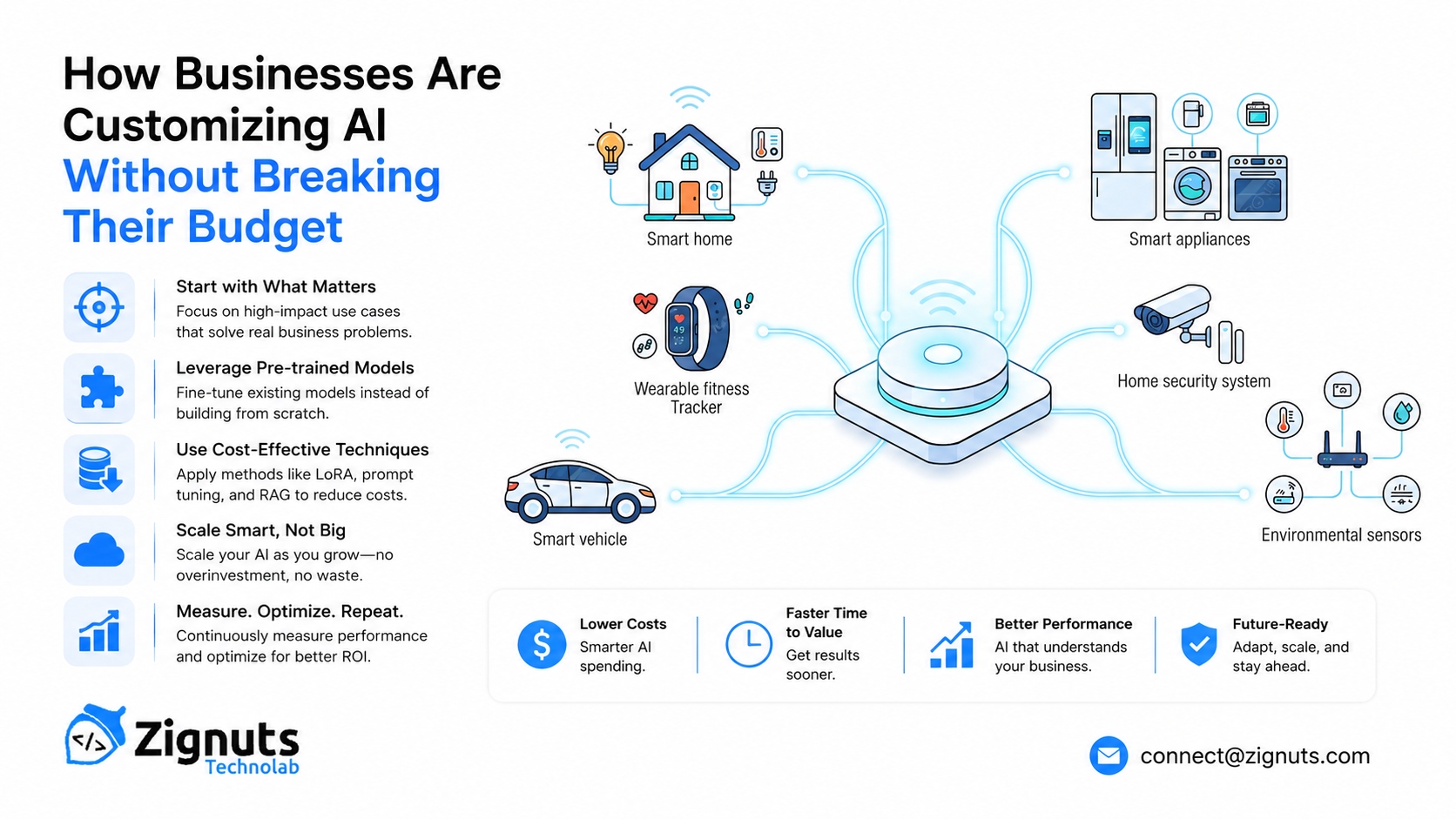
AI customization once appeared to be a privilege reserved for companies with massive datasets, expensive infrastructure, and specialized research teams. That assumption is changing. Businesses now have more efficient ways to adapt existing foundation models for specific tasks, industries, and workflows. LoRA Training Solutions are helping organizations explore specialized AI capabilities without automatically committing to the cost and complexity of retraining an entire model.
2027 Insight | Business Impact | What Leaders Should Do |
|---|---|---|
Efficient AI customization will become a mainstream enterprise strategy | More businesses can develop specialized AI capabilities | Prioritize targeted use cases with measurable value |
Parameter-efficient methods will reduce experimentation barriers | Faster testing and iteration | Build smaller pilots before major investments |
Modular AI architectures will become more common | Greater flexibility across departments | Create reusable evaluation and governance processes |
AI budgets will focus more on total business value | Better investment discipline | Measure operational outcomes, not only infrastructure costs |
The financial challenge of AI is becoming more complex. Accessing a powerful model is easier than ever, but making that model genuinely useful inside a business can still require significant investment. Organizations must consider data preparation, engineering resources, evaluation, integration, monitoring, and employee adoption. The smartest AI strategy is therefore not simply finding the cheapest model or spending the most on customization. It is identifying where targeted adaptation creates enough business value to justify the investment.
Why AI Customization Has Traditionally Been Expensive
Customizing an AI model historically meant significant technical effort.
Organizations often had to consider:
Large training datasets
High-performance computing infrastructure
Machine learning expertise
Long experimentation cycles
Complex model deployment
Ongoing maintenance
For large organizations with highly specialized requirements, these investments could be justified.
However, many businesses do not need to build a completely new AI model. They need an existing model to perform better within a specific environment.
That distinction changes the economics.
Instead of asking how to create a new intelligence system, businesses can focus on adapting existing capabilities.
The Shift Toward Efficient AI Customization
Foundation models already possess broad capabilities.
They can understand language, generate content, identify patterns, and assist with a wide range of tasks.
The challenge is specialization.
A business may need an AI system to consistently understand internal terminology, produce structured outputs, follow specific communication patterns, or support a recurring workflow.
Efficient customization approaches make it possible to focus training resources on these targeted requirements.
LoRA, or Low-Rank Adaptation, is one example of a parameter-efficient approach. Instead of broadly updating an entire model, smaller adaptation components can be trained for specific behaviors.
From a business perspective, the benefit is not simply technical efficiency.
It is strategic flexibility.
Why Budget Discipline Matters in AI
AI spending can quickly become difficult to control.
An organization may begin with a small pilot and gradually add:
Additional APIs
Cloud resources
New data pipelines
Specialized tools
Engineering teams
Monitoring platforms
Multiple model versions
Without a clear business framework, AI experimentation can become an expanding technology expense.
Leaders should therefore evaluate AI investments based on the total cost of ownership.
This includes more than infrastructure.
Consider:
Employee time
Data preparation
Integration work
Security reviews
Maintenance
Model monitoring
User training
A lower-cost training method is valuable only if it contributes to a sustainable operational model.
Customization Does Not Mean Changing Everything
One of the biggest misconceptions about AI customization is that improving performance requires modifying the entire model.
Often, businesses only need to improve a narrow capability.
For example, a company may want an AI system to:
Classify documents consistently
Generate industry-specific content
Follow structured output formats
Understand technical terminology
Support repetitive internal workflows
Produce standardized responses
These requirements are specific.
They do not necessarily require rebuilding every capability of a foundation model.
This is where targeted adaptation becomes attractive.
The objective is to customize what matters while preserving the useful capabilities that already exist.
A Practical Framework for Cost-Effective AI Customization
Businesses should avoid selecting a customization technique before understanding the actual problem.
A practical approach is:
Business Problem → Identify Performance Gap → Select the Simplest Effective Method → Test Results → Measure ROI → Scale Carefully
This framework helps organizations avoid unnecessary investment.
For example, not every AI limitation requires fine-tuning.
Missing Information
If a model lacks access to current documents or company knowledge, retrieval systems may be more appropriate.
Poor Instructions
If users receive inconsistent results because prompts are unclear, prompt engineering may solve the issue.
Strict Business Rules
If a workflow requires predictable decisions, traditional automation may be more reliable.
Specialized Repeated Behavior
If a model consistently struggles with a specific task despite having appropriate context, targeted fine-tuning may be worth evaluating.
The best budget strategy is often choosing the least complex solution that solves the business problem.
Where Cost-Effective AI Customization Creates Value
Customer Support
Businesses can explore customization for recurring support interactions where consistent language, formatting, and product context are important.
The potential value comes from reducing repetitive work and improving response consistency.
Document Processing
Organizations handling large volumes of structured documents can use specialized AI for classification, extraction, and summarization.
The business objective should be reducing manual effort while maintaining appropriate review processes.
Marketing Operations
AI can support content transformation and structured content workflows.
Customization may help where organizations require consistent formats, terminology, and messaging patterns.
Technical and Engineering Teams
Technology companies often work with specialized documentation and internal terminology.
Targeted model adaptation can potentially improve assistance for recurring technical workflows.
Comparing AI Customization Options
Business Need | Possible Approach | Primary Consideration |
|---|---|---|
Access to changing information | Retrieval systems | Information freshness |
Better instruction following | Prompt optimization | Workflow simplicity |
Specialized repeated behavior | Efficient fine-tuning | Training data quality |
Strict predictable decisions | Traditional automation | Reliability and control |
The purpose of this comparison is not to identify one universal solution.
Strong AI strategies often combine several approaches.
A company may use retrieval for internal knowledge, prompts for flexible interactions, automation for rule-based processes, and fine-tuning for specialized recurring tasks.
The architecture should follow the business requirement.
The Value of Smaller AI Experiments
Budget-conscious AI adoption does not mean avoiding experimentation.
It means reducing the cost of learning.
Large AI projects can fail because businesses commit significant resources before understanding whether users actually need the solution.
Smaller experiments provide a better path.
A business can:
Select one workflow.
Establish a performance baseline.
Test a targeted AI approach.
Evaluate results with users.
Measure operational impact.
Expand successful implementations.
This process reduces financial risk.
It also gives leadership teams better information before making larger investments.
What Executives Should Evaluate Before Spending
Is the Use Case Valuable Enough?
Not every process deserves AI customization.
Prioritize workflows with meaningful business impact.
Can Success Be Measured?
Define expected outcomes before implementation.
Possible measures include:
Reduced processing time
Improved output consistency
Lower review effort
Faster response cycles
Reduced operational errors
Increased employee productivity
What Data Is Available?
AI customization depends on relevant examples.
Poor-quality data can increase costs without producing useful improvements.
What Is the Total Cost?
Look beyond training infrastructure.
Include integration, maintenance, monitoring, security, and employee adoption.
Can the Solution Scale?
A successful pilot may create demand across multiple departments.
Plan for governance before widespread deployment.
A Step-by-Step Implementation Strategy
Step 1: Identify an Expensive Business Problem
Start with a process that consumes meaningful employee time or creates repeated operational friction.
Step 2: Understand Why the Existing AI Falls Short
Determine whether the issue involves knowledge, instructions, workflow design, or model behavior.
Step 3: Evaluate Alternatives
Compare retrieval, prompt engineering, automation, and fine-tuning.
Do not assume customization is always necessary.
Step 4: Build a Focused Pilot
Limit the scope.
A small experiment can provide valuable evidence at a lower cost.
Step 5: Measure Real Business Outcomes
Evaluate whether the system improves the workflow rather than simply demonstrating technical capability.
Step 6: Add Governance
Define ownership, evaluation standards, monitoring processes, and version control.
Step 7: Scale Strategically
Expand only after the organization understands the cost, benefits, and operational requirements.
The Risks of Optimizing Only for Low Cost
Reducing AI spending should not become the only objective.
The cheapest implementation may create higher costs later.
Businesses should avoid:
Poor Quality Training Data
Low-quality examples can produce unreliable behavior and additional correction work.
Inadequate Evaluation
A low-cost experiment without proper testing may create operational risk.
Weak Security Controls
Cost savings should not come at the expense of data protection.
Excessive Vendor Dependency
Businesses should understand the long-term implications of depending heavily on a single technology provider.
Ignoring Employee Adoption
An efficient AI system has limited value if employees do not trust or use it.
Cost efficiency should support business value, not replace it.
What AI Customization May Look Like by 2027
By 2027, AI customization may become less associated with massive research projects and more connected to everyday business operations.
Organizations may manage multiple specialized AI capabilities across departments.
Instead of one model performing every task, businesses could use combinations of:
General foundation models
Domain-specific adaptations
Retrieval systems
Workflow automation
Human review processes
This modular approach can give organizations more control over where they invest resources.
The key competitive advantage may not be access to the most expensive AI infrastructure.
It may be the ability to identify exactly where customization creates measurable value.
Conclusion
Businesses do not need unlimited budgets to explore AI customization.
The most effective strategy is not to train everything, automate everything, or deploy the largest available model.
It is to focus on the business problem.
Efficient customization methods are making specialized AI more accessible, but technology alone does not guarantee value. Organizations still need quality data, clear objectives, disciplined evaluation, and realistic expectations.
For executives and founders, the opportunity is to rethink AI investment.
Instead of asking, "How much will it cost to build a custom AI model?" ask, "What is the smallest and most effective change that can improve this business workflow?"
That shift in thinking can lead to smarter experimentation, better budget control, and more sustainable AI adoption.
FAQs
What are LoRA Training Solutions?
LoRA Training Solutions use parameter-efficient techniques to adapt AI models for specialized tasks without requiring broad retraining of the entire model.
Is AI fine-tuning expensive?
Costs vary based on the model, dataset, infrastructure, and implementation requirements. Parameter-efficient approaches can reduce resource requirements for targeted customization.
Can small businesses customize AI models?
Yes. Smaller businesses can begin with focused use cases and controlled experiments rather than attempting large-scale AI training projects.
When should a business fine-tune an AI model?
Fine-tuning may be appropriate when a model needs to consistently perform specialized tasks that cannot be adequately addressed through prompts, retrieval, or workflow changes.
Is fine-tuning better than retrieval?
Neither approach is universally better. Retrieval helps provide relevant information, while fine-tuning can adapt model behavior for specific tasks.
How should businesses control AI implementation costs?
Businesses should begin with high-value use cases, test smaller pilots, measure operational outcomes, and evaluate total costs beyond infrastructure spending.
Comments
Log in or sign up to join the conversation.