

Children are naturally curious about the world around them, and the night sky often sparks some of their biggest questions. Why do stars shine? How do planets move? What lies beyond our solar system? Astronomy turns these questions into exciting learning opportunities that help children develop essential scientific abilities from an early age.
For parents, educators, and businesses in the education sector, investing in astronomy-based learning is more than encouraging a hobby. It is a practical way to nurture problem-solving, observation, and analytical thinking. These experiences play a significant role in developing science skills for kids that support academic success and future careers.
Why Astronomy Is an Excellent Learning Tool
Astronomy combines multiple STEM disciplines, including physics, mathematics, engineering, and technology. Instead of learning concepts in isolation, children see how these subjects work together to explain real-world phenomena.
Whether observing the moon through a telescope or identifying constellations, children actively engage in scientific discovery. This hands-on approach keeps them motivated while making complex concepts easier to understand.
How Astronomy Strengthens Scientific Thinking
Encourages Observation Skills
Science begins with careful observation. Astronomy teaches children to notice patterns in the sky, track changes in celestial objects, and record their findings over time.
These activities improve attention to detail, which forms the foundation of strong science skills for kids.
Builds Critical Thinking
Astronomy encourages children to ask questions and search for logical explanations. Instead of memorizing facts, they learn to form hypotheses, compare evidence, and draw conclusions based on observations.
This inquiry-based learning helps develop independent thinkers who enjoy solving problems.
Introduces Data Collection
Children often record moon phases, star positions, or planetary movements during astronomy activities. Organizing and interpreting this information teaches valuable data analysis skills used across scientific fields.
These experiences also strengthen mathematical reasoning and analytical abilities.
Inspiring Curiosity Through Hands-On Learning
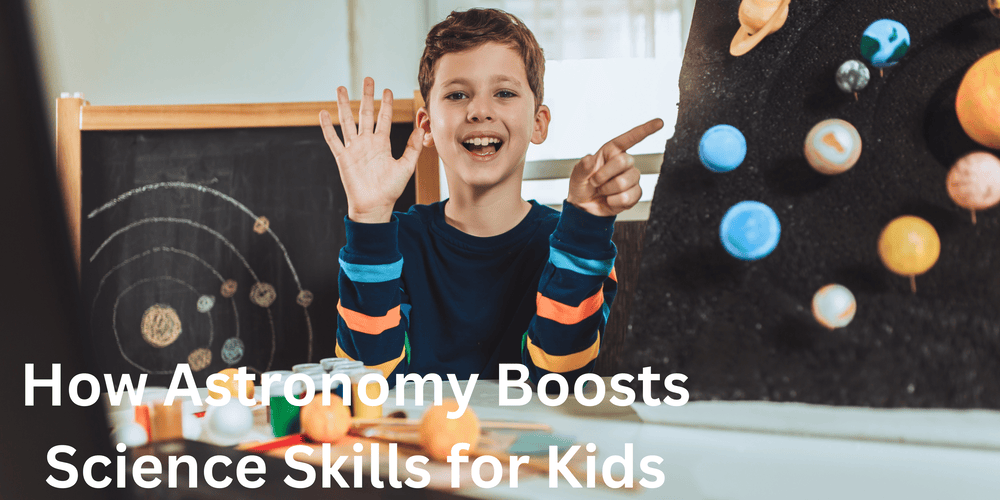
One of astronomy's greatest strengths is its ability to make science exciting. Activities like building simple solar system models, using star charts, or participating in Astronomy 101 workshops encourage children to explore scientific concepts through experience rather than passive learning.
Interactive learning keeps children engaged and increases knowledge retention. It also builds confidence as they successfully complete observations and experiments.
Supporting Future STEM Success
Today's employers increasingly value individuals with strong analytical and problem-solving abilities. Developing science skills for kids at an early age prepares them for future studies in science, engineering, technology, healthcare, and many other industries.
For educational organizations and businesses, astronomy programs also offer opportunities to create engaging STEM experiences that differentiate their learning offerings and encourage long-term student participation.
Conclusion
Astronomy is far more than learning about stars and planets. It develops observation, critical thinking, data analysis, and curiosity. Skills that benefit children throughout their education and beyond. By introducing astronomy into learning programs, parents, educators, and organizations can help young learners build strong science skills for kids while inspiring a lifelong passion for discovery.
As the demand for STEM talent continues to grow, astronomy provides an engaging and practical pathway for helping children become confident, curious, and scientifically minded learners.
Comments
Log in or sign up to join the conversation.