

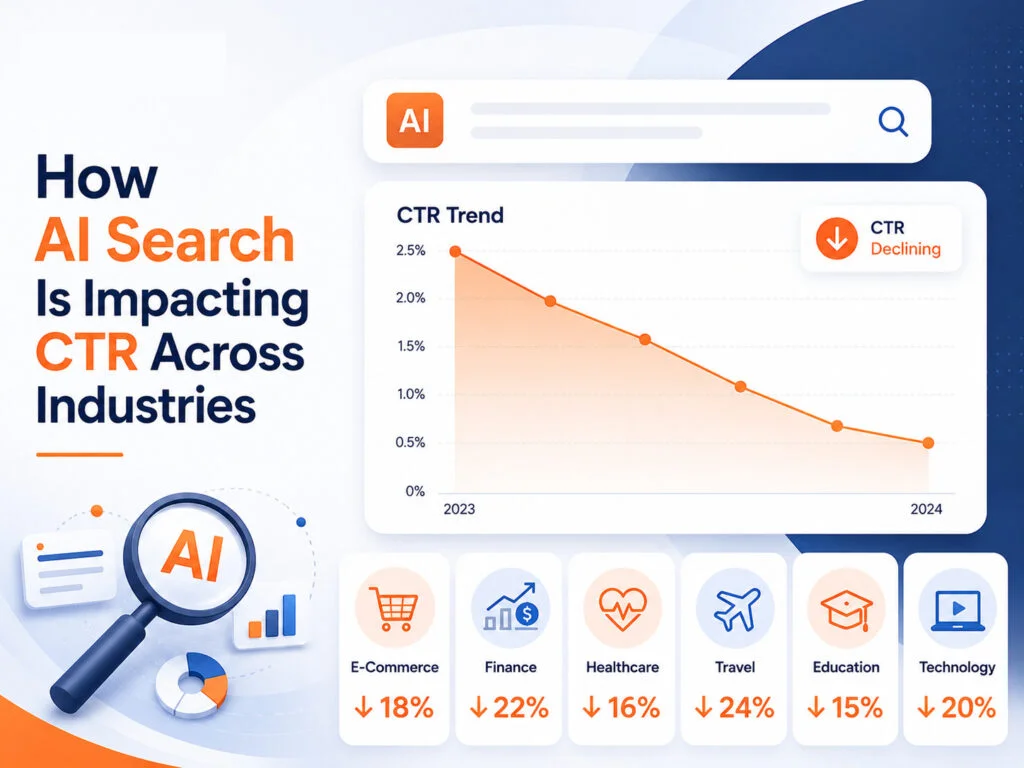
Search behavior is changing rapidly as AI-powered search experiences become a larger part of how people discover and evaluate information. Instead of visiting multiple websites to find answers, users can now receive summarized information, recommendations, comparisons, and explanations directly within search experiences. This shift is changing how businesses understand click-through rate (CTR) and organic search performance.
For years, businesses focused heavily on rankings because higher positions generally resulted in more impressions and clicks. AI search is changing that relationship. When users receive enough information directly from an AI-generated answer, they may not need to visit several websites. As a result, some informational searches may generate fewer clicks even when a business remains visible.
AI Search Is Impacting CTR Across Industries because the way users interact with search results is changing across e-commerce, healthcare, travel, finance, B2B, and professional services. The effect is not limited to fewer clicks. It is also changing the importance of visibility, search intent, qualified traffic, and the reasons users choose to visit a website.
This does not mean website traffic is becoming irrelevant. Instead, businesses need to understand which searches generate valuable clicks and how AI search visibility can influence users before they visit a website.
How AI Search Is Changing CTR
Traditional search requires users to review results, choose a page, and visit the website for more information. AI search can shorten this journey by understanding the query and presenting a direct response.
This is particularly important for informational searches involving definitions, explanations, comparisons, and general questions. If the AI-generated response satisfies the user's immediate need, the user may not click through to another website.
However, users still visit websites when they need detailed information, original research, expert guidance, products, services, pricing, or information that cannot be fully covered in a short answer. This creates an important shift in SEO. Businesses should not focus only on generating more clicks. They should focus on earning meaningful clicks from users with stronger intent.
AI Search Impact Across Industries
The effect of AI search varies from one industry to another. E-commerce businesses, for example, may see changes in how customers research products. Users can receive information about product features, comparisons, and buying considerations before visiting an online store.
This means generic product information may have less ability to generate clicks. E-commerce websites can create stronger opportunities by offering detailed product information, buying guidance, practical use cases, comparisons, and useful resources that encourage users to continue their research on the website.
Travel and hospitality businesses face a similar change. Users can obtain destination information, travel recommendations, activities, and planning suggestions without opening several websites. Businesses can respond by creating detailed destination guides, unique local information, planning resources, and useful service information that provides value beyond a basic AI-generated answer.
Why AI Search Visibility Matters
A website does not necessarily need to receive an immediate click to benefit from AI search visibility. When a business is referenced or represented within an AI-assisted search experience, users may become familiar with its name or expertise even if they do not visit immediately.
That visibility can influence future searches, branded queries, direct visits, and eventual conversions. Businesses therefore need to think beyond traditional rankings and CTR. To optimize for ai search visibility, businesses should create clear, authoritative, well-structured content that directly answers real user questions. Content should demonstrate expertise rather than simply repeat generic information.
Search Intent Is More Important Than Ever
AI search makes search intent increasingly important. Not every query has the same potential to generate a website visit.
A basic informational search may be satisfied directly within an AI response. A commercial search, however, can require users to compare services, evaluate providers, understand pricing, or investigate a specific solution before making a decision.
Businesses should therefore create content for different stages of the customer journey. Informational content can establish expertise and visibility, while commercial and service-focused pages can provide users with a clear reason to visit and take action.
For example, someone searching for general information about technical SEO may be satisfied with an AI-generated explanation. A person actively searching for technical seo services has stronger commercial intent and is more likely to research a provider.
Technical SEO Still Matters
AI search does not eliminate the importance of technical SEO. Websites still need to be accessible, crawlable, indexable, fast, mobile-friendly, and logically structured. Technical problems such as broken internal links, poor website architecture, indexing issues, duplicate content, slow loading times, and mobile usability problems can limit organic visibility.
A strong technical foundation also improves the experience after a user clicks. Businesses can use technical SEO services to identify technical barriers and improve the website structure that supports search visibility.
Building Authority Instead of Chasing Keywords
AI search is also encouraging businesses to move beyond a narrow keyword-focused approach. Ranking for individual keywords is useful, but sustainable visibility requires broader topical authority.
Businesses should build connected content around important subjects within their industry. Relevant internal links can connect informational resources with service pages, helping users and search systems understand the relationship between different topics.
Digital OmniTech recommends treating AI search as part of the broader search ecosystem. Content quality, technical SEO, search intent, internal linking, and website authority all contribute to long-term visibility.
Measuring SEO Performance in the AI Era
CTR remains an important metric, but it should not be measured alone. Businesses should also evaluate organic impressions, rankings, conversions, qualified leads, engagement, branded searches, and landing-page performance.
A decline in clicks does not automatically indicate that SEO performance is worsening. If fewer visits are producing more qualified leads or conversions, the overall quality of traffic may actually be improving.
This makes it important to evaluate the complete customer journey instead of judging SEO solely by traffic volume.
The Future of CTR Across Industries
AI search is not simply removing clicks. It is changing which clicks businesses need to earn. Informational searches may increasingly be answered directly, while users with stronger commercial, transactional, or research intent may continue visiting websites for deeper information.
Businesses that combine useful content, technical optimization, clear website structure, topical authority, and strong search intent alignment will be better positioned for this change.
Digital OmniTech focuses on adapting search strategies to changing user behavior while maintaining strong SEO fundamentals. The objective is not simply to achieve visibility, but to build enough relevance and trust that users have a reason to continue from search to website.
Ultimately, AI search is making search visibility more complex, but it is also making valuable website visits more meaningful. Businesses that provide genuine expertise, useful information, and strong user experiences can continue earning visibility and qualified traffic as search evolves.
Frequently Asked Questions
1. How does AI search affect CTR?
AI search can reduce clicks for some informational queries because users may receive direct answers without visiting multiple websites. The impact depends on search intent and industry.
2. Which industries are most affected by AI search?
Industries with research-heavy searches, including e-commerce, travel, healthcare, finance, and professional services, can experience significant changes in search behavior and CTR.
3. Is CTR still important for SEO?
Yes. CTR remains valuable, but it should be evaluated alongside impressions, rankings, conversions, engagement, and lead quality.
4. How can businesses improve AI search visibility?
Businesses should publish authoritative, well-structured content that directly answers user questions while maintaining strong technical SEO and internal linking.
5. Will AI search replace traditional SEO?
No. Traditional SEO remains essential. Technical accessibility, content quality, website structure, relevance, and authority continue to support search visibility.
Digital OmniTech helps businesses adapt to evolving search behavior through content, technical optimization, and search-focused strategies.
Comments
Log in or sign up to join the conversation.