

Key Benchmarks Performance
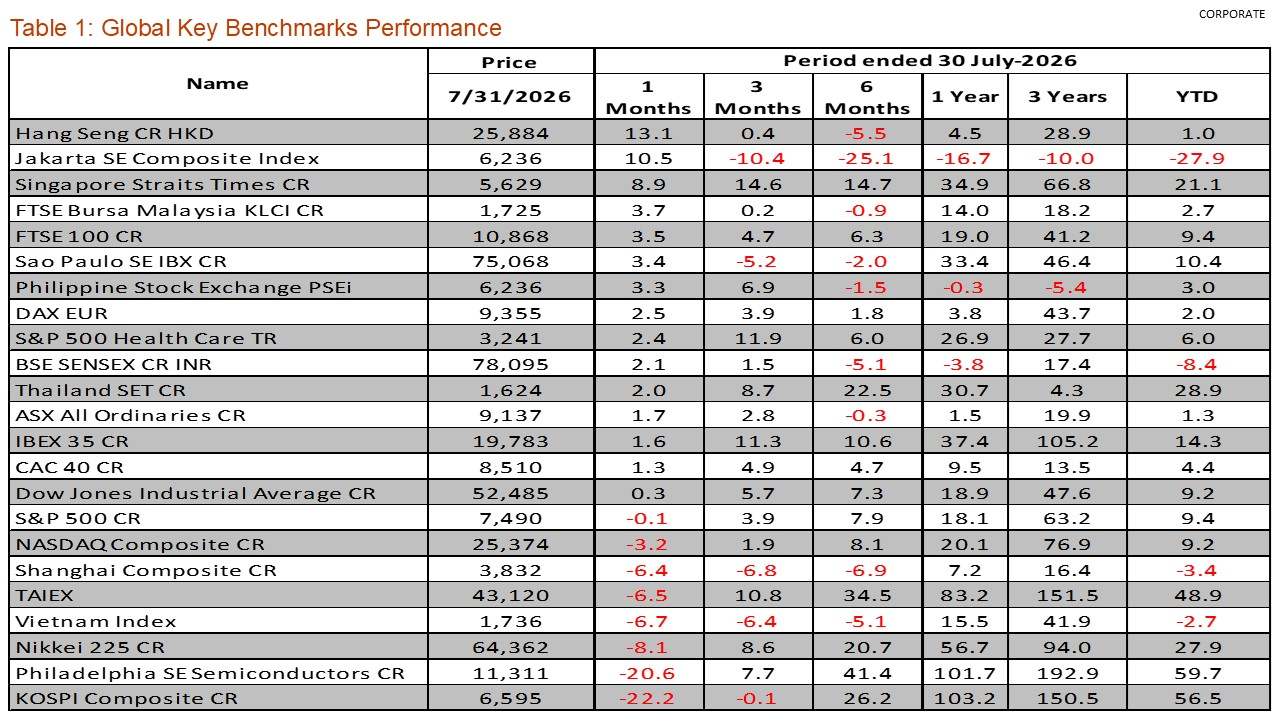
Global equity market performance was highly dispersed in July, highlighting a clear divergence between markets benefiting from domestic macro tailwinds and those exposed to stretched technology and semiconductor valuations.
Hong Kong led major markets, with the Hang Seng Index advancing 13.1%, driven by renewed investor interest in Chinese and Hong Kong-listed technology companies and expectations of continued policy support measures. The strong monthly gain helped offset weaker medium-term performance, although the market’s year-to-date advance remained relatively modest at 1.0%.
Within ASEAN, Indonesia market rallied 10.5% and outperformed in the region. Singapore’s Straits Times Index (+8.9%) continued its impressive momentum, supported by resilient banking earnings, attractive dividend yields, and defensive characteristics amid global market volatility. The Philippines (+3.3%), Malaysia (+3.7%), and Thailand (+2.0%) also delivered positive returns, reflecting stronger regional investor sentiment.
European markets generally maintained an upward trajectory. The FTSE 100 (+3.5%), DAX (+2.5%), CAC 40 (+1.3%), and IBEX 35 (+1.6%) posted solid gains as investors continued to rotate into cyclical sectors and companies benefiting from improving economic conditions and easing inflation concerns.
The US market delivered mixed results. While the Dow Jones Industrial Average rose 0.3% and the S&P 500 was broadly flat (-0.1%), the NASDAQ Composite declined 3.2%, reflecting profit-taking in technology stocks following a prolonged period of strong outperformance. The correction was notably sharper within the semiconductor space, with the Philadelphia Semiconductor Index plunging 20.6%, making it the weakest-performing index during the month. Despite the pullback, semiconductor stocks remained among the strongest performers over longer time horizons.
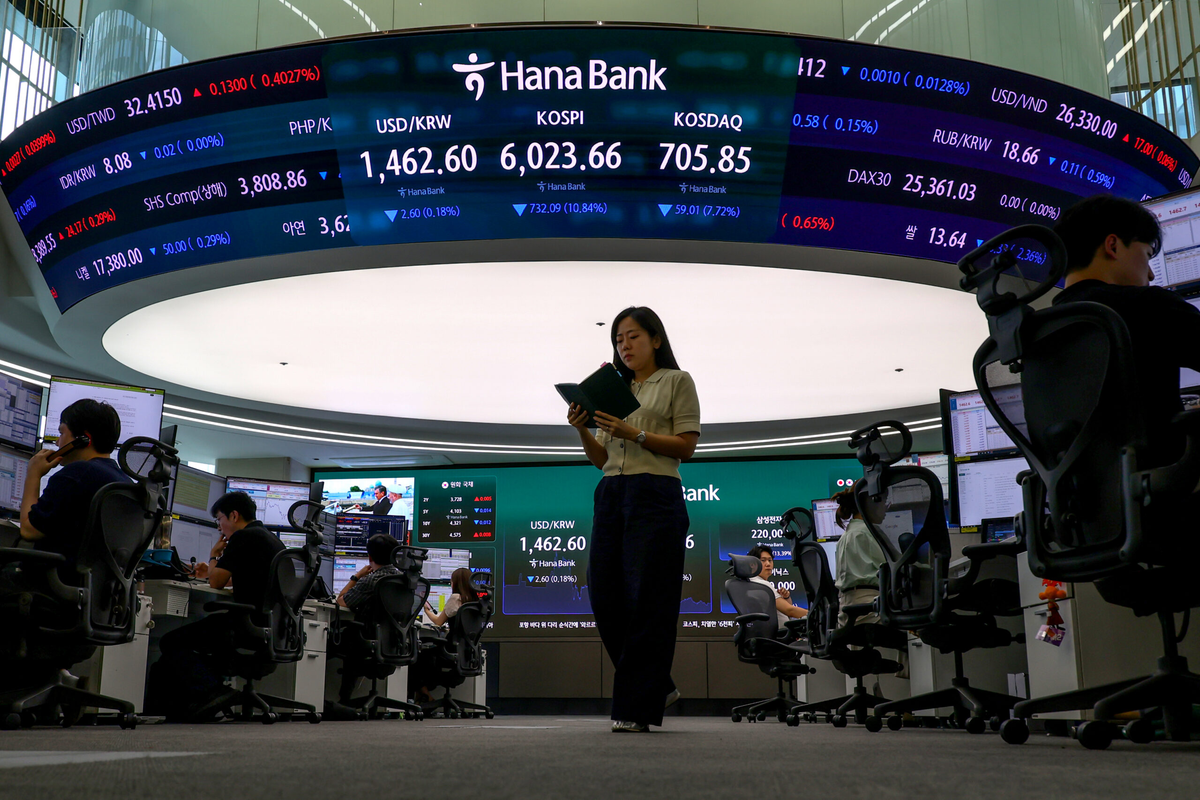
In Asia, several of the strongest-performing markets year-to-date experienced notable profit-taking during July. Taiwan’s TAIEX (-6.5%), Korea’s KOSPI (-22.2%), and Japan’s Nikkei 225 (-8.1%) all recorded significant declines after exceptionally strong gains earlier in the year. The sharp correction in Korea was particularly striking given its substantial 56.5% year-to-date gain, suggesting that investors were locking in profits and deleveraging following an extended rally driven by technology and AI-related sectors.
Year-to-date performance continues to reflect a market environment dominated by technology, artificial intelligence themes, and export-oriented Asian markets.Taiwan remains one of the strongest-performing equity markets globally, with the TAIEX gaining 48.9% YTD, underpinned by robust semiconductor demand, AI-related capital expenditure trends, and continued strength among leading technology exporters. Despite the July correction, Taiwan’s structural positioning within the global AI supply chain continues to support long-term investor interest.
Technology-driven performance is also evident in the Philadelphia Semiconductor Index (+59.7%) and Korean KOSPI (+56.5%), both benefiting from the recovery in memory chips, semiconductor equipment demand, and broader AI infrastructure investment. The magnitude of these gains illustrates how semiconductor-related sectors have remained key drivers of global equity returns throughout 2026.
Among developed Asian markets, Japan’s Nikkei 225 delivered a strong 27.9% YTD gain, supported by corporate governance reforms, earnings growth, and sustained foreign investor inflows. Similarly, Thailand recorded a robust 28.9% advance, making it one of Southeast Asia’s best-performing markets.
Within ASEAN, Singapore continued to stand out, with the Straits Times Index rising 21.1% YTD, significantly outperforming most regional peers. Singapore’s combination of strong financial sector performance, stable economic fundamentals, and defensive dividend characteristics has attracted international investors seeking both growth and income.
European equities have also generated respectable returns. Spain’s IBEX 35 (+14.3%) emerged as the strongest performer within Europe, followed by the FTSE 100 (+9.4%), while both the DAX (+2.0%) and CAC 40 (+4.4%) posted more modest gains. European performance has generally been supported by lower interest-rate expectations and improving economic activity, although gains have lagged those seen in technology-heavy Asian markets.
The US market continued to deliver solid returns, with the S&P 500 (+9.4%), Dow Jones Industrial Average (+9.2%), and NASDAQ Composite (+9.2%) posting relatively similar YTD gains. Notably, US market performance has become broader compared to previous years, with sectors such as healthcare and industrials increasingly contributing to returns. The S&P 500 Health Care Index gained 6.0% YTD, reflecting investor demand for defensive growth opportunities.
At the opposite end of the spectrum, several emerging markets continued to face significant challenges. Indonesia was the weakest performer globally, declining 27.9% YTD, reflecting persistent foreign capital outflows and macroeconomic headwinds. India’s Sensex fell 8.4%, while China Shanghai Composite (-3.4%) and Vietnam (-2.7%) also remained in negative territory.
Hong Kong MPF Performance by LGC Analysis
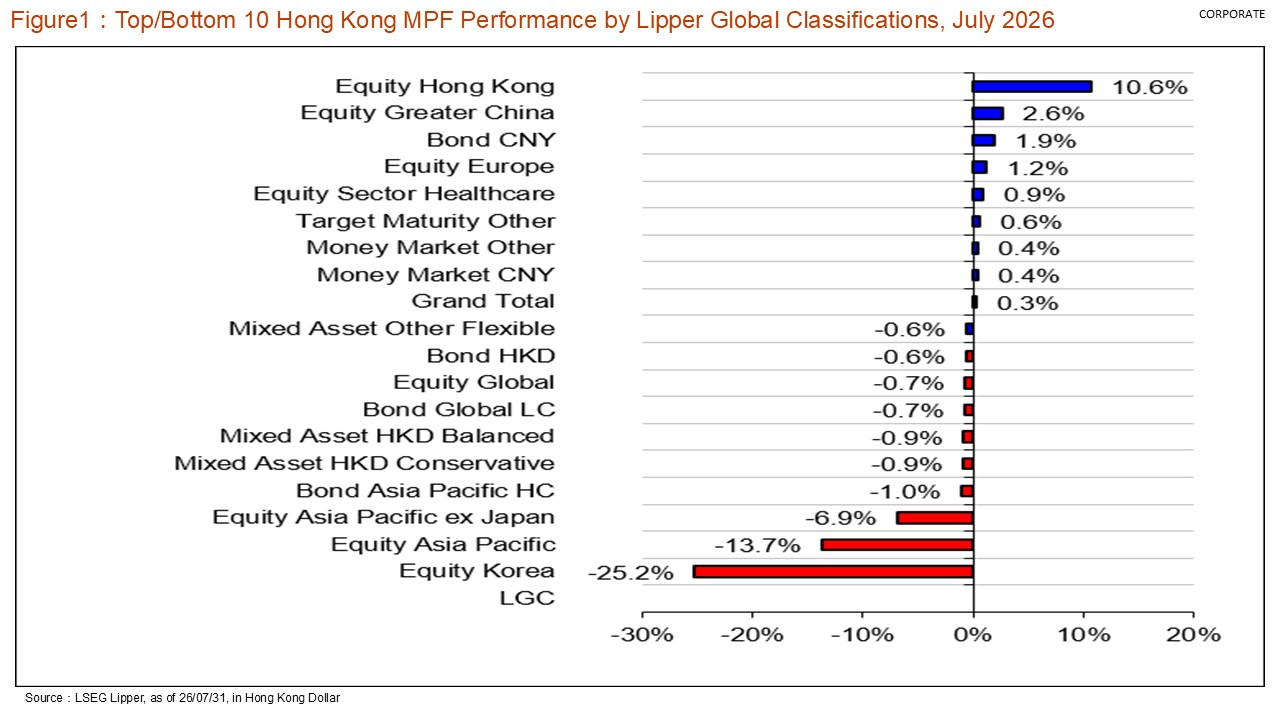
July marked a significant rotation in global fund performance, with Greater China-oriented classifications emerging as the strongest performers, while previously high-flying North Asian technology markets experienced substantial profit-taking. Equity Hong Kong led all classifications of Hong Kong MPFs with a gain of 10.6%, supported by improving sentiment toward Chinese technology stocks, policy support expectations, and attractive valuations. Equity Greater China (+2.6%) also delivered positive returns, reflecting renewed investor interest in the region.
In contrast, technology-heavy Asian markets underwent a sharp correction, with Equity Korea falling 25.2%, followed by Equity Asia Pacific (-13.7%) and Equity Asia Pacific ex Japan (-6.9%). The decline was largely driven by profit-taking in semiconductor and AI-related sectors after exceptionally strong gains earlier in the year. The sharp performance reversal highlights increasing investor sensitivity to elevated valuations within growth-oriented technology segments.
Defensive asset classes provided relative stability amid heightened market volatility. Bond CNY (+1.9%), Equity Europe (+1.2%), and Equity Sector Healthcare (+0.9%) generated positive returns, benefiting from their defensive characteristics and lower exposure to technology-sector weakness. Most mixed-asset and global equity classifications recorded modest declines as losses in North Asian equities outweighed gains elsewhere.
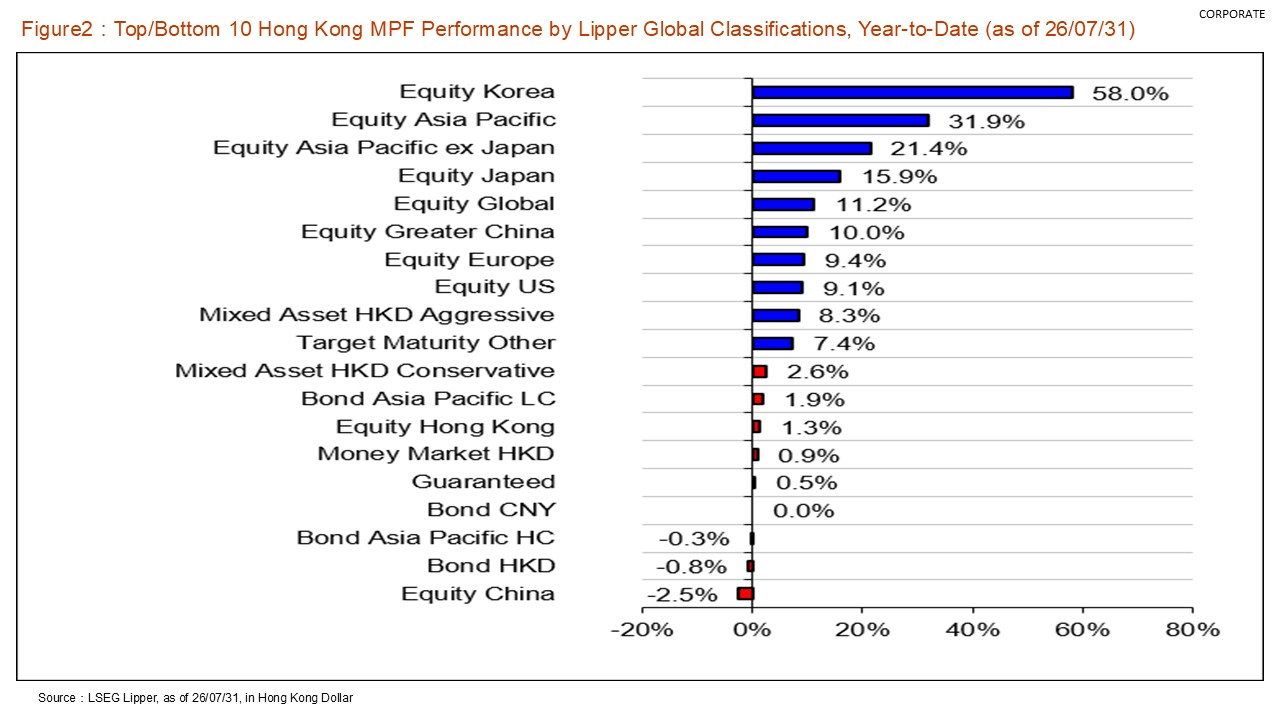
Year-to-date returns continue to reflect the dominance of AI, semiconductor, and technology investment themes, with Equity Korea (+58.0%) emerging as the best-performing Lipper classification globally. Strong demand for advanced semiconductors, memory chips, and AI infrastructure has fueled substantial gains across North Asian markets, lifting Equity Asia Pacific (+31.9%), Equity Asia Pacific ex Japan (+21.4%), and Equity Japan (+15.9%).
Global equity markets have also delivered healthy returns, with Equity Global (+11.2%), Equity Greater China (+10.0%), Equity Europe (+9.4%), and Equity US (+9.1%) all registering solid gains. Performance has broadened beyond a narrow group of technology leaders, supported by resilient corporate earnings and improving macroeconomic conditions across major developed markets.
Greater China’s recovery remains uneven. While the broader Equity Greater China classification has generated double-digit gains, Equity China (-2.5%) and Equity Hong Kong (+1.3%) continue to lag, reflecting persistent concerns surrounding China’s domestic growth outlook and consumer demand.
By contrast, fixed income and capital-preservation strategies have materially underperformed equities. Most bond classifications produced low single-digit returns or modest losses, while money market and guaranteed funds generated limited gains. The performance gap between growth-oriented equity sectors and defensive assets underscores the strongly risk-on nature of global markets during the first seven months of 2026.
Outlook
The outlook for Hong Kong equities in the second half of 2026 is increasingly constructive following a strong rebound in July. Improving sentiment toward Chinese assets, supportive policy measures, attractive valuations, and renewed capital inflows are creating a more favorable environment for the market after several years of relative underperformance.
Hong Kong’s investment case is primarily supported by its compelling valuations, which remain significantly below those of major developed markets despite recent gains. This valuation discount provides room for further upside should corporate earnings continue to stabilize and investor confidence improve. In particular, Hong Kong-listed Chinese technology and internet companies remain well positioned to benefit from both earnings recovery and potential valuation re-rating.
The market is also expected to benefit from ongoing policy support from Beijing, including measures aimed at supporting economic growth, encouraging consumption, and improving financial market sentiment. As the primary offshore listing venue for many Chinese companies, Hong Kong stands to be a key beneficiary of any further improvement in mainland economic conditions.
Another supportive factor is the growing importance of mainland Chinese capital flows, which have become a structural source of demand through the Southbound Stock Connect program. Continued domestic investor participation could help strengthen market liquidity and reduce reliance on foreign investor flows.
Nevertheless, risks remain. The pace of China’s economic recovery, unresolved property-sector challenges, and geopolitical tensions could continue to weigh on sentiment. In addition, Hong Kong’s significant exposure to technology stocks leaves the market vulnerable to further volatility should global technology valuations come under pressure.
Overall, the balance of risks and opportunities has improved meaningfully for Hong Kong equities. While short-term volatility is likely to persist, the combination of attractive valuations, improving policy support, recovering earnings expectations, and strengthening capital flows suggests the market is positioned for further gains in the second half of 2026, with upside potential exceeding that of many other developed markets.


Comments
Log in or sign up to join the conversation.