

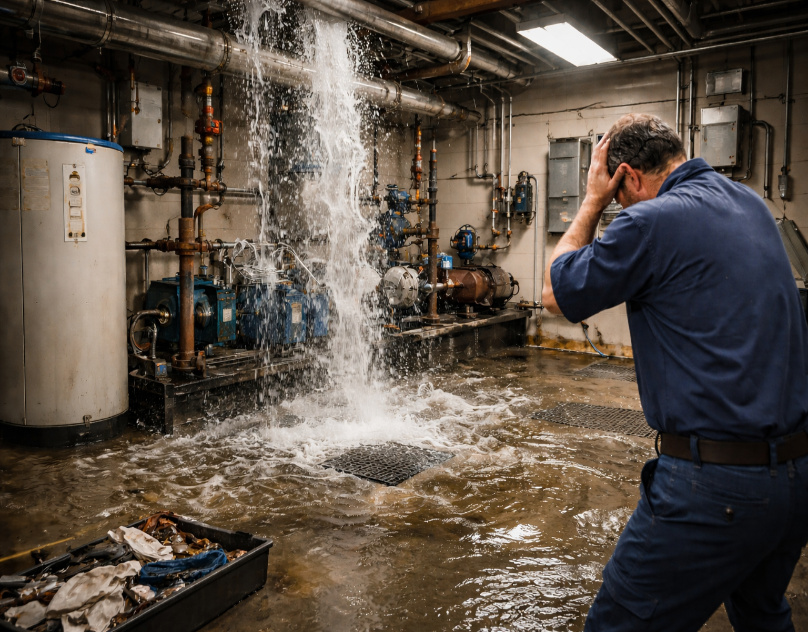
Virginia business owners who skip routine plumbing maintenance rarely see the cost coming until it arrives as a burst pipe at 2 a.m., a flooded server room, or a health department closure notice. The true cost of deferred commercial plumbing maintenance extends far beyond the repair bill itself.
Key Takeaways
Emergency plumbing repairs in Virginia commercial buildings average three to nine times the cost of the same issue caught during scheduled maintenance
Water damage from plumbing failures is among the top five causes of commercial property insurance claims in Virginia
Business interruption losses from a single major plumbing event can exceed the cost of five years of preventive maintenance
Deferred maintenance compounds over time and accelerates deterioration of connected systems beyond the plumbing itself
Insurance carriers increasingly scrutinize maintenance records before approving water damage claims in Virginia
Virginia businesses that track plumbing maintenance costs discover preventive service pays for itself within the first incident avoided
What Is the True Cost of Skipping Commercial Plumbing Maintenance?
The conventional way Virginia business owners calculate plumbing costs is straightforward: add up what was spent on service calls last year and compare it to a maintenance plan quote. This calculation misses the majority of actual costs because it only counts the invoice, not the downstream consequences. Commercial plumbers who work with Virginia businesses on maintenance programs consistently see this gap between perceived and actual plumbing costs.
Business interruption is the most significant cost that the invoice calculation ignores. A restaurant that cannot serve customers during a lunch rush because the main drain backed up loses revenue that no insurance policy replaces without significant documentation and delay. An office building with a burst pipe that forces employees home loses productive hours that are never recovered.
According to the International Facility Management Association's Operations and Maintenance Benchmark Report, reactive maintenance consistently runs three to nine times more expensive per issue than the same problem caught during a scheduled inspection. The difference compounds for Virginia businesses in older buildings where multiple systems are simultaneously approaching failure thresholds. Fast action matters. Slow leaks destroy more.
"Virginia business owners almost always underestimate what a single plumbing failure actually costs them when you add it all up. The emergency call-out rate, the water damage remediation, the business interruption, the increased insurance premium the following year, the structural repairs behind the walls. We've seen a failed water heater connection cost a business more in total than two years of scheduled maintenance would have." , Kevin Jenkins, Owner, K. Jenkins Plumbing
How Water Damage Multiplies the Cost of Plumbing Neglect
Water damage from plumbing failures does not stay contained to the plumbing system. A slow leak inside a wall soaks insulation, framing, and drywall for months before visible damage appears. By the time it is discovered, the remediation scope has expanded to include mold testing, structural drying, and replacement of building materials that would have cost nothing if the leak had been caught during a routine inspection.
Virginia commercial properties with multiple tenants face liability exposure beyond their own remediation costs. When a leak originates in one tenant's space and damages another's inventory, equipment, or operations, the property owner faces claims from multiple directions simultaneously. Documented plumbing maintenance is the primary evidence used to defend against negligence claims in these scenarios.
Insurance carriers in Virginia's commercial property market have tightened coverage terms and increasingly require maintenance documentation before approving water damage claims. Properties with no service records face coverage disputes that delay claims for months and sometimes result in partial or full denial. The cost of a denied water damage claim routinely exceeds the cost of years of preventive maintenance.
"Commercial property insurance adjusters are trained to look for maintenance documentation as the first filter in a water damage claim. A property with regular plumbing service records gets a very different claims experience than one with no history of maintenance. The latter often triggers a coverage investigation that delays payment and sometimes results in significant exclusions." , American Property Casualty Insurance Association, Commercial Claims Best Practices Guide, 2024
How Deferred Maintenance Cascades Across Connected Systems
Plumbing failures rarely remain isolated to a single system. A water heater that exceeds its service life and fails catastrophically releases dozens of gallons of water that saturates the mechanical room, damages adjacent electrical systems, and wicks into structural elements. The electrical damage and structural remediation costs can double or triple the baseline water heater replacement cost alone.
Slow drain lines that go uncleaned eventually back up into floor drains and under-sink areas of commercial kitchens and restrooms. The backup damages flooring, attracts pests, and creates health code violations simultaneously. Resolving a backup emergency always costs more than the hydro jetting service that would have prevented it, and the associated violations and pest remediation add costs that compound the plumbing expense significantly.
Commercial plumbers conducting routine inspections catch these cascade risks before they activate. A water heater with visible corrosion on the tank base signals an imminent failure. A drain camera inspection that reveals partial blockage allows clearing before a backup occurs. Catching these conditions during a scheduled visit converts a potential cascade into a line item on a maintenance invoice.
What Virginia Business Owners Underestimate About Component Lifespans
Most Virginia business owners do not know the expected service life of their commercial plumbing components, which means they have no framework for anticipating replacement needs. Commercial copper supply lines typically last 50-70 years but fail faster in buildings with highly corrosive water chemistry. Commercial water heaters last eight to twelve years depending on usage intensity and maintenance history.
Cast-iron drain lines in older Virginia commercial buildings are often at or past end of life. These pipes corrode internally and develop hairline cracks that allow root intrusion and sewage seepage that contaminates soil before surfacing as a major emergency. A camera inspection of main drain lines identifies the condition of these systems without excavation, allowing planned replacement before emergency failure occurs.
Pressure-reducing valves and backflow preventers have service lives of five to ten years under normal operating conditions. When these devices fail, the consequences extend to every downstream fixture. A failed pressure-reducing valve can expose all fixtures in a building to unrestricted city main pressure, causing simultaneous failures across multiple locations at once.
Building the Business Case for Preventive Commercial Plumbing in Virginia
Virginia business owners who track plumbing costs with enough detail to separate emergency calls from scheduled maintenance consistently find that their emergency costs alone would have funded a full preventive maintenance program with money remaining. The data makes the business case clear once it is collected and categorized.
The shift from reactive to preventive commercial plumbing maintenance does not require a large upfront investment. A phased approach starting with the highest-risk systems , water heaters past eight years of age, drain lines without recent cleaning, and unverified backflow preventers , captures most of the risk reduction benefit while spreading costs over time. Our commercial plumbing services help Virginia businesses build a maintenance approach that systematically eliminates these hidden costs.
Conclusion
The hidden costs of skipping commercial plumbing maintenance in Virginia are real, documented, and consistently larger than business owners expect until they experience them. Emergency repair premiums, water damage remediation, business interruption losses, insurance complications, and cascading system failures all add up to a total that dwarfs what preventive maintenance would have cost. K. Jenkins Plumbing helps Virginia businesses build maintenance programs that eliminate these costs before they occur. Contact us to schedule a plumbing assessment and see the true cost picture for your Virginia building.
FAQ
How much more does emergency commercial plumbing repair cost compared to preventive maintenance?
According to the International Facility Management Association, reactive plumbing repairs cost three to nine times more per issue than the same problem caught and corrected during scheduled maintenance. For Virginia commercial buildings, this multiplier is highest for water heater failures, sewer backup events, and supply line breaks, where the cost of water damage remediation and business interruption significantly exceeds the repair invoice itself. Businesses that track actual total costs of plumbing events consistently find that a single emergency pays for years of preventive maintenance.
Can skipping plumbing maintenance void commercial property insurance in Virginia?
While skipping plumbing maintenance rarely voids a policy outright, Virginia commercial property insurers increasingly use maintenance documentation as a primary factor in claims investigations for water damage events. Properties with no service records face coverage disputes, delayed claim payments, and in some cases partial or full denial for losses that could have been prevented with documented maintenance. Insurance adjusters treat the absence of maintenance records as evidence of negligence, which affects both current claims and future premium calculations.
What plumbing systems in Virginia commercial buildings fail most often from deferred maintenance?
Commercial water heaters past their service life are the most common deferred maintenance failure in Virginia commercial buildings, followed by clogged drain lines that back up into occupied spaces, corroded supply line fittings in pre-1980 buildings, and failed backflow prevention devices with expired test certificates. Each of these failures is predictable and preventable with regular inspection from licensed commercial plumbers who track component age and condition across a service history.
How long do commercial plumbing systems last in Virginia buildings?
Commercial copper supply lines typically last 50-70 years in Virginia buildings with normal water chemistry, but corrode faster in areas with high mineral or chlorine content. Commercial water heaters have an eight-to-twelve-year service life under normal commercial use. Cast-iron drain lines in pre-1980 Virginia buildings are often at or near end of life and should be camera-inspected before failure. Pressure-reducing valves and backflow preventers last five to ten years before requiring replacement or rebuilding.
How do I calculate the true cost of skipping plumbing maintenance for my Virginia business?
Start by identifying all plumbing-related expenses from the past three years, including emergency call-outs, water damage remediation, business interruption, increased insurance premiums, and any structural repairs caused by plumbing failures. Compare this total to what a maintenance contract would have cost over the same period. Virginia businesses that complete this analysis almost universally find that their emergency costs alone would have funded a preventive maintenance program with budget remaining, often by a factor of three or more.
#CommercialPlumbing #PlumbingRepairCosts #WaterDamagePrevention #BusinessMaintenanceTips #FacilityManagement
Comments
Log in or sign up to join the conversation.