

Despite the Drop, the Risk Factors That Drive the Gold Price Higher Remain
Despite an ever-more-confusing international situation, the gold price has failed to benefit from the mounting tensions.
Even the analysts and brokers have been ignoring gold. Gold experts, who not even eight months ago expected gold to post the highest gains of the past five years, are baffled. (Source: “Gold seen at highest annual price for five years in 2018: GFMS,” Reuters, May 8, 2018).
The gold price appeared to be heading back toward $1,400 per ounce. It was more than reasonable to expect a boost to $1,500 per ounce before the end of 2018, yet the chart has been disappointing. Far from higher, the gold price is at its lowest:
(Click on image to enlarge)
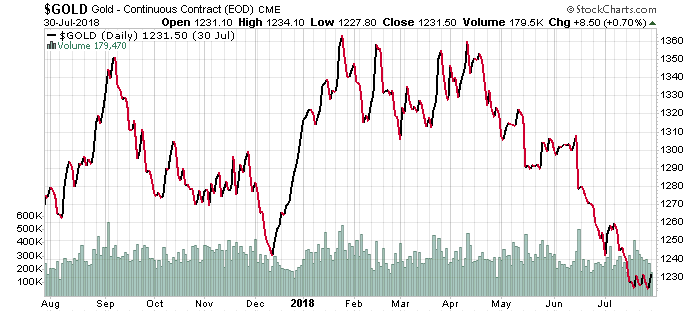
Chart courtesy of StockCharts.com
Gold prices are the “victim” of a tug-of-war between what appears to be a stronger economy and higher U.S. dollar on one side and the off-and-on threat of a major international war on the other.
When the gold price was trending higher for a while, supporting bullish expectations, it was due to specific events. Or rather, it was due to specific threats.
Don’t Treat Gold Like a Day Investor Would, Go for the Long Haul
Between April and May, President Donald Trump put the world on high alert with actions and words that undermined relations with Russia, Syria, North Korea, and Iran. The tensions remain, but meetings with Kim Jong-un and Vladimir Putin have softened them (or so the media has interpreted it). Yet it’s only a matter of time before they resume.
Trump is preparing for the November midterm elections. He’s making sure he does everything he promised in order to get the Republicans re-elected.
One of those promises was, in fact, to “talk to Putin”. And he can check that off his list. Yet nothing has really changed.
Even when it comes to Russia, despite rumors of another summit in the works in 2019, there are forgotten issues that could flare up the White House–Kremlin dialogue to an argument.
One of those is the investigation into Malaysian Airlines Flight MH17. That was the airliner that crashed in eastern Ukraine in July 2014, for which an international investigation blames (even if admitting an accident) a Russian military unit. Some say Putin himself was aware.
And that’s just a single incident. There are pending issues, from Syria to Iran, that remains as volatile as ever.
In gold price terms, this means that patience is the path to a reward. Precious metals and resources are not for day traders.
There Is a Silver Lining: The Long-Term Trend Is Bullish
However bearish the gold price expectations might be, 2018 has shown that medium- and short-term predictions miss the mark.
Gold may be trending toward $1,200 per ounce in August, yet even at that level, it would still be $100.00 higher than it was in January 2017.
Indeed, even for the less patient investors, the gold price could yet produce some pleasant surprises, such as $1,400 or higher before 2019. Just don’t expect miracles–not yet, anyway.
The Dollar Factor
The gold price is due for a rebound. One of the reasons is that you can blame its recent drop to one specific factor. If you guessed the higher U.S. dollar, you’re right.
Higher interest rates–or better yet, the expectation of higher interest rates–has been driving the dollar. This reduces gold’s appeal as a haven.
But the perceived strength of the dollar is relative. As high as the dollar is moving, mostly on fumes, U.S. debt (already at some-$21.0 trillion) is climbing.
In other words, the perceived strength of the U.S. economy is just that, a perception, given the government is borrowing at its highest in a decade. (Source: “US government borrowing soars to highest level since recession, despite strong economy,” South China Morning Post, July 31, 2018.)
Considering that Treasury yields are rising, the longer-term situation would appear to favor havens and lower risk-investments rather than equities.
In other words, even without the “benefit” of international tensions, the gold price momentum is due to swing on the bullish side.
The End of QE Is a Risk Factor
And while the higher interest rates should contribute to strengthening the dollar, the Fed has already made the announcement. Therefore, the market has already absorbed whatever premium to the dollar on the news.
Moreover, the dollar’s rise won’t look as impressive once the Euro will also start climbing as quantitative easing (QE) ends in the eurozone as well.
And the end of QE in the eurozone could prove rather premature triggering a financial crisis, not unlike the one in the U.S.
The end of QE on both sides of the Atlantic will raise stock and economic volatility. That’s when gold will return to fashion.
Therefore, consider 2018 a time for potential gold accumulation ahead of a sharp rise in the gold price in 2019 as many economic risk factors will come to a boil.

Comments
Log in or sign up to join the conversation.