
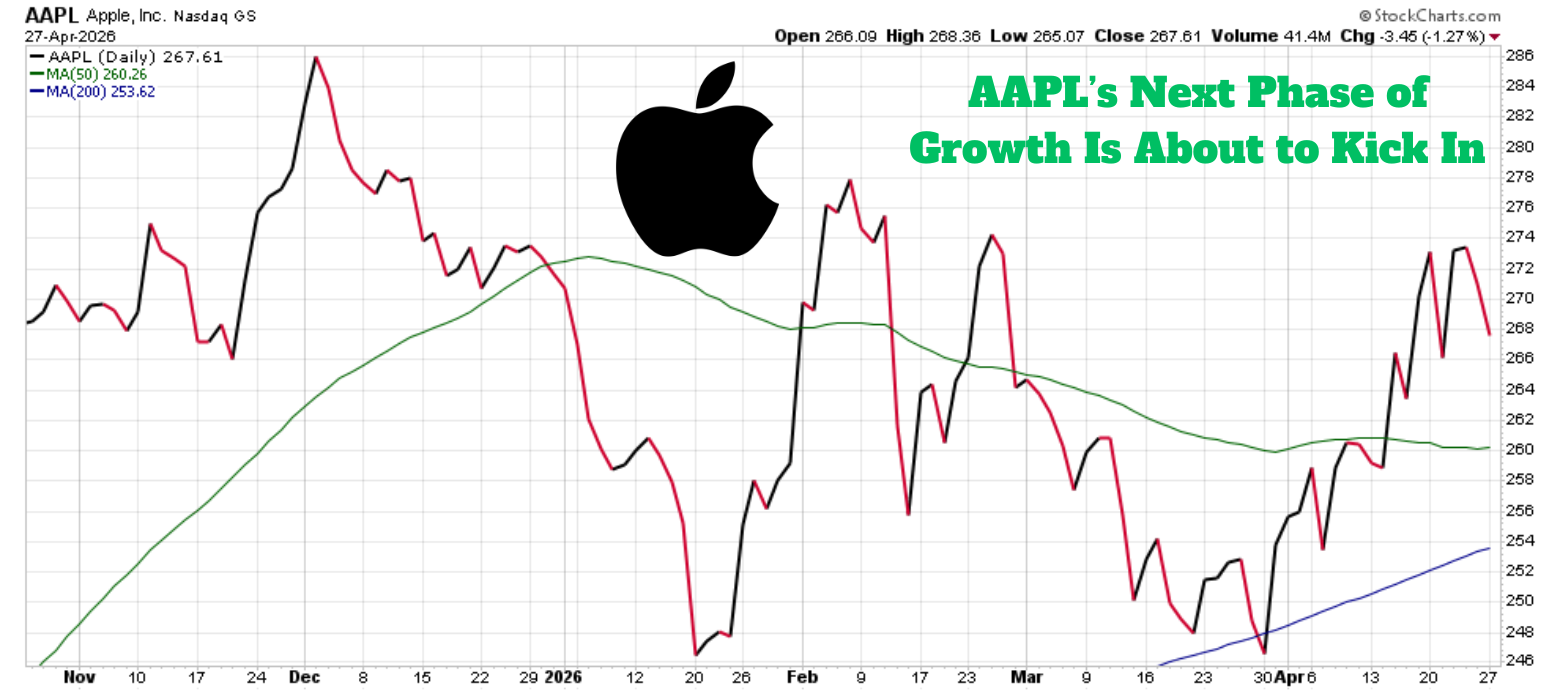
With Apple (AAPL) stock hovering near all-time highs and Wall Street still debating how long the AI-driven tech rally can last, investors are circling one familiar question: where does the next leg of earnings growth actually come from?
Leadership at Apple is already signaling the answer.
Incoming CEO John Ternus — who officially takes over from Tim Cook on Sept. 1 — recently addressed employees at a town hall. The tone wasn''t about radical reinvention. It was about doubling down on what''s already working: Apple''s fast-expanding services engine.
And for investors, that matters more than it might sound.
The Quiet Shift That''s Driving Apple''s Next Phase
Ternus reportedly praised Apple''s services division as something that has gone from "nearly nothing" a decade ago to a core profit driver today. More importantly, he emphasized expanding integration between hardware, software, and services — tightening Apple''s ecosystem rather than chasing new product categories.
That ecosystem is already enormous. With roughly 2.5 billion active devices worldwide, Apple is no longer just selling iPhones — it''s monetizing a closed loop of recurring digital behavior.
Services like Apple Pay, Apple Music, Apple TV+, and Podcasts sit on top of that installed base. The result is a high-margin subscription layer that keeps users paying long after the initial hardware purchase.
And switching costs are real. Leaving an iPhone means abandoning payments, media libraries, and device syncing that reinforce loyalty daily.
The Numbers Behind the Services Machine
Apple''s services segment continues to quietly outperform expectations.
Services revenue hit roughly $30 billion in the most recent quarter, up double digits year over year
Full-year fiscal 2025 services revenue reached about $109 billion, or roughly a quarter of total company sales
Gross margins in services run around 75%+, far above hardware margins, which sit closer to 35%–40%
That margin gap is the real story. Even when hardware drives headline revenue — especially iPhone cycles — services does the heavy lifting for profits.
Compare the trajectories: hardware is cyclical and upgrade-dependent, while services compounds steadily on top of the installed base.
Why Services Is Becoming Apple''s Stability Engine
Apple''s services growth has consistently outpaced total company growth in recent years, expanding at roughly double-digit rates even as hardware fluctuates.
In practical terms, that means:
More predictable cash flows
Higher-quality earnings mix
Stronger funding capacity for buybacks and dividends
Reduced reliance on iPhone upgrade cycles
Apple has generated well over $120 billion in trailing free cash flow, and services contributes a disproportionate share of profitability despite being a smaller slice of revenue.
Even Apple Pay alone processes massive transaction volumes globally while reducing fraud across the ecosystem.
What It Means for AAPL Investors
Apple trades at a premium multiple — roughly low-30s forward earnings — but that reflects the durability of its recurring revenue base.
The dividend yield remains modest at under 1%, but with a payout ratio below 20%, Apple retains flexibility for increases and buybacks.
The key risk is unchanged: hardware still dominates revenue, and challenges remain in China, global smartphone saturation, and AI competition.
But services provides a buffer when hardware slows — and a compounding engine when it doesn''t.
Bottom Line
Ternus'' comments reinforce a trend already in motion: Apple is steadily shifting from a hardware-led company to an ecosystem monetization machine.
For investors, the takeaway is simple. Apple''s growth story is no longer just about the next iPhone cycle — it''s about how deeply it can monetize the billions of devices already in users'' hands.
And as that ecosystem expands its grip, Apple''s earnings engine stays firmly intact.

Comments
Log in or sign up to join the conversation.