

Modern warehouses are expected to store more inventory, handle materials faster, and use available space more efficiently. As businesses expand their product ranges and distribution activities, conventional floor storage can quickly become inefficient. This is where Heavy Duty Racks become an important part of warehouse infrastructure.
A properly designed Heavy Duty Racking System does more than provide space for goods. It supports inventory organization, improves accessibility, makes better use of vertical warehouse space, and helps businesses create a more structured material-handling environment.
From manufacturing facilities and logistics centers to wholesale warehouses and industrial storage areas, heavy-duty racking can be configured according to different load types, pallet dimensions, warehouse layouts, and operational requirements.
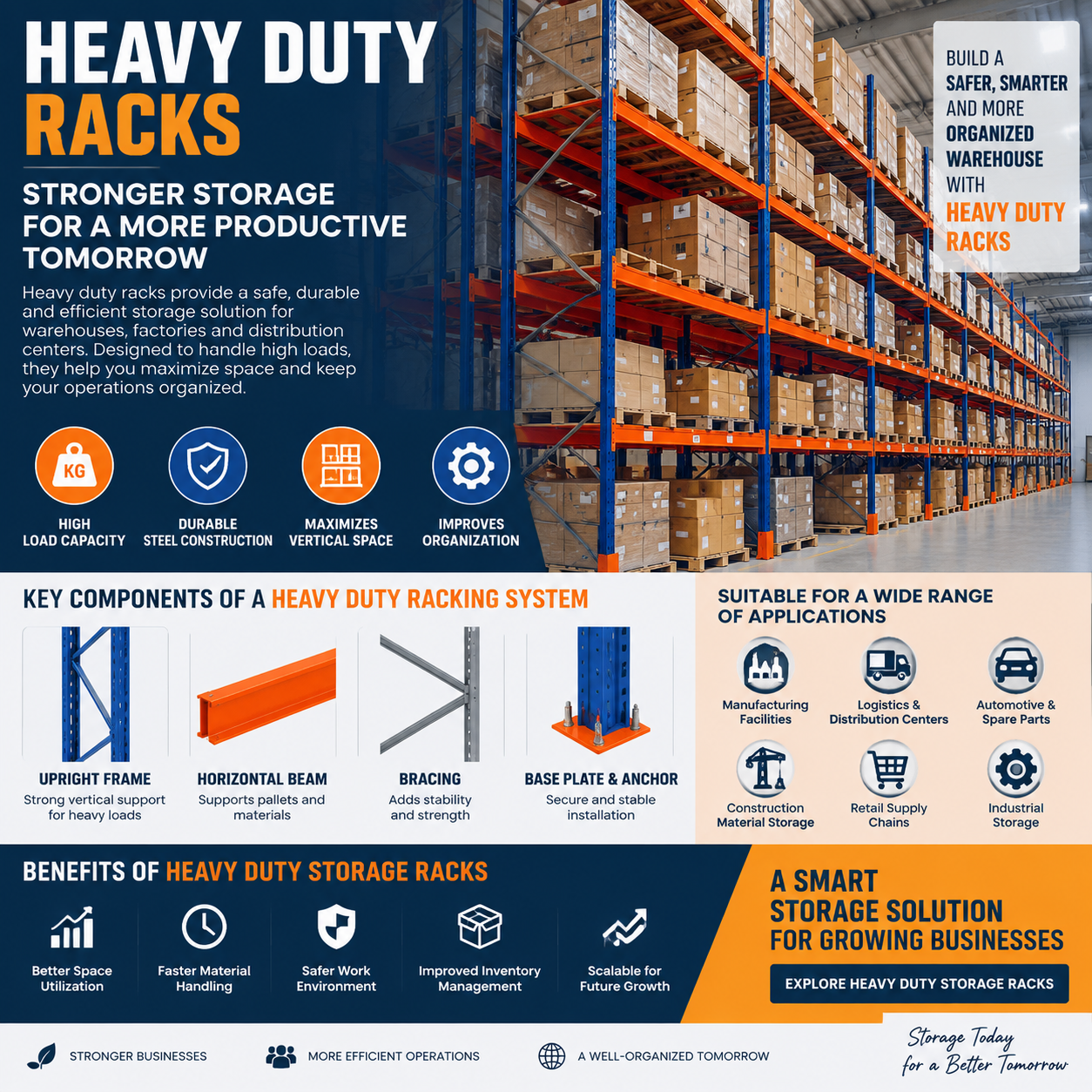
The Changing Role of Warehouse Storage
Traditional storage methods often rely on open floor areas where products are stacked according to available space. While this approach may work for small operations, it creates challenges as inventory volumes increase.
Growing businesses usually face problems such as:
Limited storage capacity
Difficulty locating materials
Increased handling time
Poor warehouse space utilization
Higher risk of product damage
Inefficient movement of goods
Modern companies are moving toward organized storage infrastructure using advanced Heavy Duty Racking System solutions that support better control over inventory and warehouse operations.
Heavy Duty Racks as an Industrial Investment
Many businesses consider storage equipment as an expense, but professionally designed racking systems should be viewed as a long-term operational investment.
A properly planned rack installation can help companies:
Increase storage density
Reduce unnecessary warehouse expansion
Improve inventory visibility
Create safer working conditions
Support faster material movement
Prepare for future business growth
For industries dealing with large quantities of products, raw materials, or finished goods, investing in reliable Heavy Duty Storage Racks can significantly improve daily operations.
Supporting Modern Supply Chain Requirements
Supply chains today require speed, accuracy, and flexibility. Warehouses are expected to receive, store, and dispatch products with minimum delays.
Industrial Storage Racks help businesses create structured storage zones where materials can be arranged according to product category, movement frequency, or operational priority.
For example:
Fast-moving products can be positioned in easily accessible areas.
Long-term inventory can be stored in higher rack levels.
Production materials can be arranged near manufacturing zones.
Dispatch inventory can be organized close to loading areas.
This structured approach supports smoother warehouse workflows.
Different Applications of Heavy Duty Steel Racks
The use of Heavy Duty Steel Racks has expanded across various industries because businesses require stronger, safer, and more organized storage solutions. Unlike standard shelving systems, heavy-duty racks are designed to handle higher loads, withstand demanding industrial environments, and provide efficient storage for different types of materials.
From manufacturing plants and warehouses to logistics hubs and retail distribution networks, these systems help companies improve inventory organization, maximize available space, and create smoother material-handling operations.
Manufacturing Facilities
Manufacturing plants often deal with large quantities of raw materials, production components, tools, and finished goods that require proper organization.
Heavy Duty Steel Racks help factories create dedicated storage areas for different materials, reducing clutter around production lines and improving workflow efficiency.
Commonly stored items include:
Steel coils and metal components
Machine parts
Production materials
Spare parts
Finished products ready for shipment
By keeping materials properly arranged, manufacturers can reduce searching time, improve inventory control, and maintain a safer working environment.
Logistics and Distribution Centers
Logistics companies and distribution centers handle thousands of products that move continuously through receiving, storage, and dispatch operations.
Heavy Duty Warehouse Racks provide an organized structure where goods can be stored systematically according to product category, delivery schedule, or movement frequency.
Benefits for logistics operations include:
Faster loading and unloading processes
Better inventory visibility
Improved warehouse traffic flow
Efficient use of vertical storage space
Easier product identification
For high-volume warehouses, properly designed Warehouse Racking Systems are essential for maintaining fast and reliable supply chain operations.
Automotive and Spare Parts Industries
The automotive industry requires highly organized storage because spare parts come in many shapes, sizes, and weights.
Components such as engines, mechanical parts, electrical items, accessories, and replacement parts need storage systems that provide easy access while protecting products from damage.
Heavy Duty Storage Racks system help automotive warehouses:
Separate parts according to categories
Improve picking accuracy
Reduce handling time
Maintain better stock management
Support large inventories
This makes heavy-duty racking an important solution for automotive manufacturers, workshops, and spare-parts distributors.
Construction Material Storage
Construction companies and suppliers often handle heavy materials that require strong and durable storage structures.
Products such as steel sections, pipes, hardware items, tools, and building components need storage solutions capable of supporting significant weight.
Heavy Duty Industrial Racks provide the strength required for storing these materials while maintaining organized warehouse operations.
Proper storage helps:
Prevent material damage
Improve workplace safety
Reduce handling difficulties
Make materials easier to locate
Optimize warehouse capacity
For industries dealing with bulk materials, selecting the correct Heavy Duty Racking System is critical for safe and efficient storage.
Retail Supply Chains
Modern retail businesses depend on efficient warehouse operations to manage large quantities of products before distribution to stores or customers.
Retail distribution centers use Heavy Duty Pallet Racks and industrial shelving systems to organize inventory such as:
Consumer goods
Electronics
Household products
Packaged items
Seasonal inventory
A well-planned storage system allows retailers to maintain accurate stock levels, improve order fulfillment speed, and handle increasing product demand.
Heavy Duty Pallet Racks for High-Volume Storage
For businesses handling palletized goods, Heavy Duty Pallet Racks provide an effective method of organizing inventory vertically.
Instead of spreading pallets across warehouse floors, pallet racks allow multiple storage levels while maintaining accessibility for forklifts.
When designing pallet storage systems, companies should evaluate:
Pallet dimensions
Product weight
Storage height
Forklift operations
Warehouse layout
Safety requirements
The correct configuration helps achieve a balance between storage capacity and operational convenience.
How Warehouse Racking Systems Improve Efficiency
Efficiency in warehouses depends on more than having enough storage space. The arrangement of that space determines how quickly materials can be located, moved, and processed.
Modern Warehouse Racking Systems contribute to efficiency by:
Reducing Search Time
Clearly defined rack locations make inventory easier to identify.
Improving Workflow
Organized storage areas reduce unnecessary movement of workers and equipment.
Supporting Inventory Management
Rack labeling and location systems can improve stock tracking procedures.
Creating Safer Work Areas
Properly arranged storage reduces clutter and improves movement pathways.
Selecting the Right Heavy Duty Racking Solutions
Every warehouse has different operational requirements. The ideal storage system depends on several technical factors.
Before selecting a rack solution, businesses should evaluate:
Storage Load Requirements
The weight of stored materials determines the required rack strength and configuration.
Available Space
Warehouse dimensions, ceiling height, and column locations affect rack planning.
Material Handling Equipment
Forklifts, pallet trucks, and other equipment influence aisle width and rack positioning.
Product Characteristics
Product size, shape, and movement frequency determine the most suitable storage arrangement.
Companies looking for reliable Heavy Duty Storage Racks should focus on solutions designed according to their actual operational needs.
Industrial Racking Systems and Future Expansion
Business growth often creates new storage challenges. A warehouse that meets today’s requirements may become insufficient as inventory increases.
A scalable Industrial Racking System allows companies to consider future expansion through additional rack bays, modified layouts, or increased storage levels where suitable.
Planning for future requirements helps businesses avoid frequent redesigns and unnecessary investment.
Maintenance: Protecting Your Storage Investment
Heavy-duty storage structures are designed for long service life, but regular care is essential.
Warehouse teams should monitor:
Rack frame condition
Beam alignment
Safety accessories
Floor anchoring
Signs of impact damage
Load compliance
Regular inspection helps maintain safe operations and protects the company's storage investment.
The Future of Industrial Storage
As industries become more organized and technology-driven, warehouse storage will continue evolving.
Businesses are increasingly focusing on:
Higher storage density
Better inventory visibility
Faster material handling
Safer warehouse environments
Flexible storage systems
Modern Heavy Duty Industrial Racks are becoming an essential part of this transformation by supporting efficient and scalable warehouse operations.
Conclusion
Storage capacity directly affects how efficiently a business operates. Companies that invest in professionally planned Heavy Duty Racks can create better-organized facilities, improve material flow, and prepare for future growth.
For organizations planning to improve their storage infrastructure, selecting the right Heavy Duty Racking Solutions can be a valuable step toward long-term operational improvement.
From manufacturing plants to logistics centers, the right combination of Heavy Duty Warehouse Racks, pallet storage solutions, and industrial shelving systems can transform available warehouse space into a productive business asset.
#HeavyDutyRacks #HeavyDutyStorageRacks #HeavyDutyRackingSystem #IndustrialStorageSolutions #HeavyDutyWarehouseRacks #HeavyDutySteelRacks
Comments
Log in or sign up to join the conversation.