

Efficient storage is one of the most important elements of a well-managed warehouse, industrial facility, distribution center, or commercial storage area. When goods, equipment, raw materials, and finished products are stored without a proper system, businesses can face wasted floor space, difficult inventory handling, and inefficient daily operations.
This is where Heavy Duty Racks provide practical value. Designed for organized storage of different materials, these rack systems help facilities use available space more effectively while supporting better material handling and inventory control.
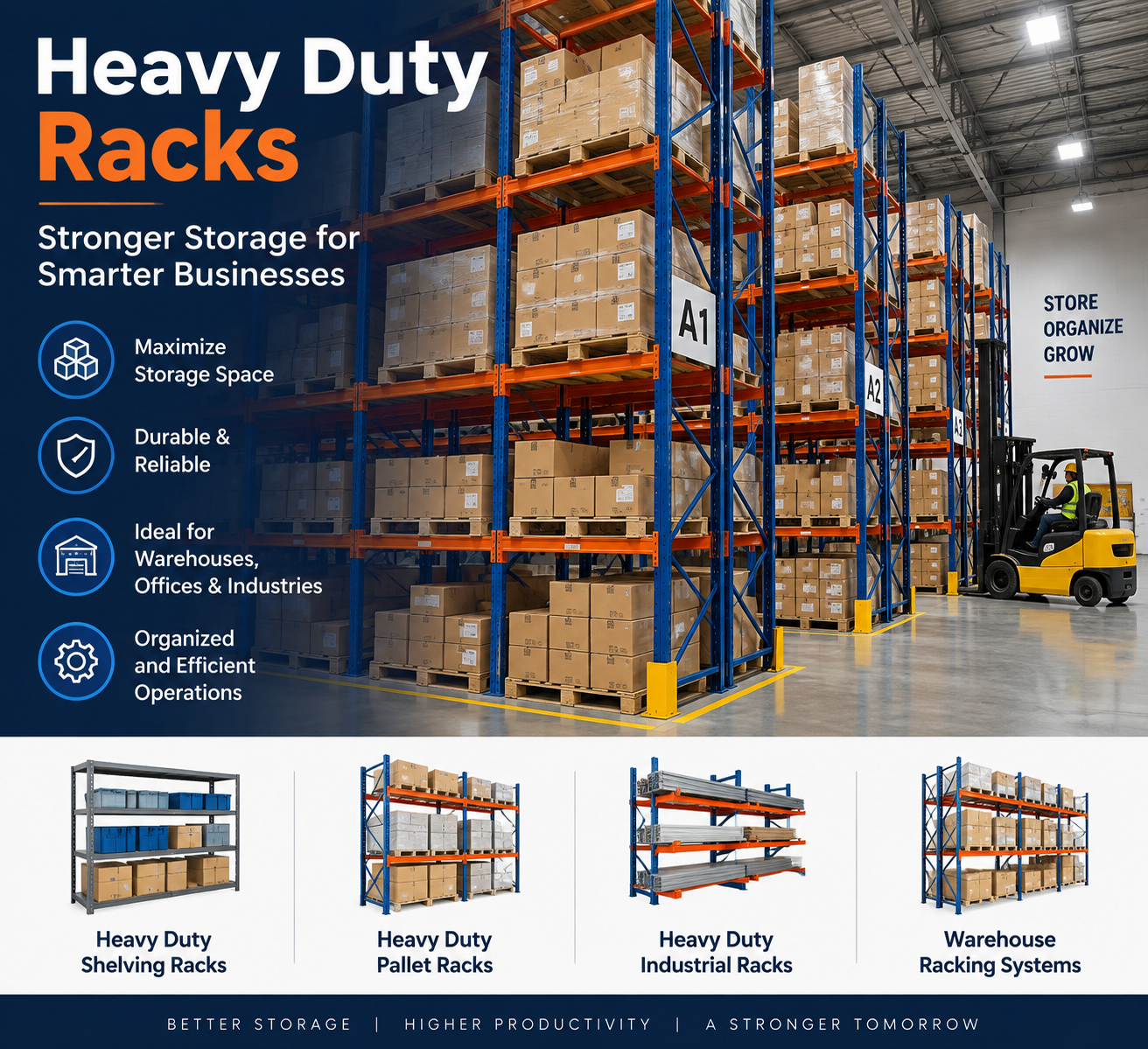
From Heavy Duty Storage Racks and pallet-based systems to industrial shelving and warehouse racking, businesses can select configurations according to their products, available space, and operational requirements.
Why Heavy Duty Racks Are Important for Modern Warehouses
Industrial and commercial facilities often need to store materials with different sizes, weights, and handling requirements. Keeping these goods directly on the floor can quickly reduce usable warehouse space and make stock difficult to organize.
Heavy Duty Warehouse Racks help overcome this challenge by utilizing vertical storage space. Instead of expanding the warehouse footprint, businesses can organize goods across multiple rack levels.
A properly planned racking layout can support:
Better use of warehouse height
Clearer product organization
Improved inventory accessibility
More efficient material movement
Better separation of different stock categories
Reduced congestion in storage areas
More organized picking and replenishment activities
For facilities handling larger or heavier goods, Heavy Duty Industrial Racks are particularly useful because they can be configured according to the required storage arrangement.
Heavy Duty Shelving for Organized Material Storage
Not every warehouse stores products on pallets. Many facilities also handle cartons, spare parts, tools, packaged goods, components, and manually handled materials.
In these situations, Heavy Duty Shelving Racks can provide an organized multi-level storage arrangement that keeps products accessible while maximizing available space.
Heavy-duty shelving is commonly suitable for:
Spare parts storage
Maintenance materials
Industrial components
Boxes and cartons
Workshop supplies
Commercial inventory
Manufacturing materials
General warehouse stock
By dividing inventory into organized sections, shelving systems can make identification and retrieval much easier.
Heavy Duty Pallet Racks for Palletized Goods
Warehouses handling palletized materials generally require a system that supports forklift loading and unloading.
Heavy Duty Pallet Racks are commonly used for this purpose. They allow pallets to be stored vertically across multiple levels while maintaining defined storage locations.
Depending on warehouse operations, different Pallet Racking Systems may be selected based on:
Pallet dimensions
Load requirements
Forklift type
Warehouse height
Required aisle width
Stock rotation method
Number of pallets
Product accessibility requirements
A well-planned pallet rack layout can significantly improve the organization of high-volume storage operations.
Heavy Duty Rack Systems and Space Optimization
Warehouse space represents a major operational asset. When storage areas are poorly organized, valuable floor space may remain underutilized.
Heavy Duty Rack Systems provide a structured approach to vertical storage. Rack heights, shelf levels, bay widths, aisle arrangements, and loading zones can be planned according to the available building dimensions.
Effective space utilization can help businesses delay unnecessary warehouse expansion while improving existing storage capacity.
For example, materials that previously occupied several floor locations may be arranged vertically using Heavy Duty Storage Shelves or pallet racks.
Industrial Storage Racks for Different Business Applications
Industrial Storage Racks are designed to help businesses organize, store, and manage different types of materials efficiently. They are not only used in large warehouses but also in manufacturing plants, workshops, distribution centers, commercial storage areas, and logistics facilities.
Different industries have different storage requirements. Some businesses need to store heavy raw materials, while others need organized shelving for spare parts, finished products, tools, or inventory. Industrial rack systems can be customized according to the product type, load capacity, available space, and handling method.
Manufacturing Facilities
In manufacturing industries, storage organization plays an important role in maintaining smooth production operations.
Industrial Storage Racks help manufacturers store:
Raw materials such as steel, components, and packaging materials
Machine parts and production accessories
Work-in-progress materials
Finished products before shipment
Tools and maintenance equipment
Distribution Centers
Distribution centers handle large volumes of products that need to be received, stored, picked, packed, and dispatched efficiently.
Warehouse Storage Racks allow distribution facilities to organize products according to:
Product categories
Stock quantity
Order frequency
Dispatch schedules
Storage requirements
Workshops
Workshops often require organized storage for tools, spare parts, consumables, and maintenance materials.
Without proper storage, small components and tools can become difficult to locate, affecting productivity.
Heavy Duty Shelving Racks provide an effective solution for workshops by creating dedicated storage spaces for:
Mechanical parts
Electrical components
Hand tools
Equipment accessories
Repair materials
Consumable items
Commercial Storage Areas
Retail businesses, suppliers, and commercial facilities often need storage solutions for bulk inventory, cartons, products, and equipment.
Heavy Duty Commercial Racks provide strong and organized storage options for businesses that handle regular stock movement.
Applications include:
Retail back stores
Wholesale storage areas
Office storage rooms
Product warehouses
Equipment storage facilities
Logistics Facilities
Logistics operations depend on efficient storage and movement of goods. A poorly organized storage system can slow down receiving, picking, and dispatch activities.
Warehouse Storage Racks support logistics facilities by creating structured storage zones for incoming and outgoing materials.
They help improve:
Inventory visibility
Loading and unloading operations
Product tracking
Space utilization
Material flow management
Choosing the Right Industrial Racking System
Selecting the correct Industrial Racking System is an important decision for any warehouse, manufacturing facility, or storage area. A suitable rack design should not only support the weight of stored materials but also improve space utilization, accessibility, and daily operational efficiency.
Before installing a racking system, businesses should carefully evaluate their storage requirements, product characteristics, available space, and material handling methods.
Load Capacity
The first and most important factor when selecting a rack system is load capacity.
Every rack component, including shelves, beams, frames, and pallet levels, must be designed to safely support the expected weight of stored materials.
For example:
Light cartons may require standard shelving systems.
Heavy machinery parts or industrial materials may require Heavy Duty Storage Racks.
Palletized goods may require reinforced Heavy Duty Pallet Racks designed for forklift operations.
Product Dimensions
The size and shape of stored products directly influence the rack configuration.
Businesses should consider:
Product height
Product width
Product depth
Packaging type
Individual item size
Storage quantity
For example, long materials such as pipes, steel sections, or timber may require specialized storage solutions, while cartons and smaller components may be better suited for shelving systems.
Available Warehouse Height
Warehouse height is an important factor because vertical space can significantly increase storage capacity.
Instead of using only floor space, businesses can install multi-level Warehouse Racking Systems to store products vertically.
Effective use of warehouse height helps:
Increase storage volume
Reduce floor space requirements
Improve warehouse organization
Support future inventory growth
Handling Equipment
The type of equipment used for loading and unloading materials affects rack design and warehouse layout.
Common handling methods include:
Forklifts
Reach trucks
Pallet jacks
Manual handling
For forklift-operated warehouses, rack spacing and aisle width must allow safe movement and easy access to stored pallets.
A properly planned layout helps reduce handling difficulties and improves workplace safety.
Inventory Movement
The speed at which products move through the warehouse should influence rack selection.
Fast-moving products require quick and easy access because they are frequently picked, replaced, or dispatched.
Examples:
Daily-use products
Frequently ordered items
Production materials
These items may require easily accessible rack locations.
Slow-moving or reserve stock can be stored in higher or less accessible areas to maximize available space.
Future Storage Requirements
Businesses often experience changes in inventory levels, product ranges, and operational needs. Therefore, selecting a flexible racking solution is important.
A scalable Heavy Duty Rack System allows businesses to:
Add additional rack sections
Modify shelf levels
Increase storage capacity
Adjust layouts according to changing requirements
Warehouse Racking Systems and Operational Efficiency
The purpose of Warehouse Racking Systems is not simply to store more products. A good rack layout should also support the movement of people, equipment, and inventory.
Poorly positioned racks can create narrow aisles, difficult forklift movements, or unnecessary travel distances.
For this reason, warehouse planning should consider both storage density and accessibility.
Businesses evaluating storage racks for warehouses and offices can benefit from reviewing different racking configurations before selecting a system suitable for their available space and operational requirements.
Key Benefits of Heavy Duty Storage Racks – Explanation
Heavy Duty Storage Racks are more than just storage structures; they are an important part of efficient warehouse and industrial operations. A properly designed racking system helps businesses organize materials, improve workflow, maximize available space, and create a safer working environment.
Whether used in warehouses, manufacturing facilities, workshops, or commercial storage areas, heavy-duty rack systems provide several operational advantages.
Improved Space Utilization
One of the biggest advantages of Heavy Duty Storage Racks is the ability to maximize available storage space.
Traditional floor storage uses only the available ground area, which can quickly become limited as inventory increases. Heavy-duty racks allow businesses to utilize vertical warehouse height by storing products on multiple levels.
Benefits include:
Increased storage capacity within the same warehouse area
Better use of unused vertical space
Reduced requirement for warehouse expansion
More organized placement of materials
For example, Heavy Duty Pallet Racks allow multiple pallets to be stored vertically, helping warehouses handle larger inventory volumes efficiently.
Better Inventory Organization
A well-planned racking system creates dedicated storage locations for different products, materials, or inventory categories.
Instead of placing items randomly on the warehouse floor, businesses can assign specific rack positions for each product type.
This improves:
Product identification
Stock counting accuracy
Picking efficiency
Inventory tracking
Material accessibility
With organized Warehouse Storage Racks, employees can quickly locate required materials, reducing time spent searching for products.
Easier Material Handling
Efficient material movement is essential for warehouse productivity. Poorly arranged storage areas can create unnecessary movement, delays, and handling difficulties.
Properly designed Industrial Racking Systems create clear pathways and organized storage zones, making it easier for workers and equipment to move safely.
Advantages include:
Reduced travel distance for workers
Faster loading and unloading operations
Improved forklift movement
Smoother picking and dispatch processes
A good rack layout supports better workflow from receiving materials to final shipment.
Flexible Storage Configuration
Different businesses store different types of products, which means storage solutions must be adaptable.
Heavy Duty Rack Systems can often be configured according to:
Product size
Material weight
Storage quantity
Warehouse dimensions
Handling requirements
Rack levels, shelf heights, and layouts can be adjusted to accommodate changing storage needs.
For example:
Shelving racks can support small components and cartons.
Pallet racks can store bulk palletized materials.
Industrial racks can support heavier equipment and materials.
Cleaner Warehouse Layout
An organized warehouse is safer and more efficient.
Using properly installed Heavy Duty Industrial Racks helps create clearly defined storage areas and maintains open working aisles.
A cleaner warehouse layout provides:
Better workplace safety
Reduced risk of blocked pathways
Easier warehouse navigation
Improved overall appearance
Better compliance with operational requirements
Support for Business Growth
As businesses grow, inventory requirements usually increase. A properly planned storage system helps companies manage growth without immediately investing in additional warehouse space.
A scalable Warehouse Racking System allows businesses to:
Increase storage capacity
Add additional rack sections
Adjust storage layouts
Handle increased inventory volumes
Planning a Heavy Duty Racking Layout
Before installing Heavy Duty Racks, the warehouse should be evaluated carefully.
A practical planning process may include:
Measuring the available floor area and clear height.
Identifying the type and quantity of products.
Determining individual load requirements.
Reviewing pallet and carton dimensions.
Identifying forklift and handling equipment.
Defining required aisle widths.
Planning receiving and dispatch zones.
Considering future inventory growth.
Selecting suitable rack configurations.
Maintaining clear access routes throughout the facility.
This approach helps ensure that the rack system supports both storage requirements and daily warehouse operations.
Conclusion
Heavy Duty Racks are a fundamental part of efficient industrial and warehouse storage. Whether a facility requires Heavy Duty Shelving Racks, Heavy Duty Pallet Racks, Heavy Duty Industrial Racks, or complete Warehouse Racking Systems, the correct solution should be selected according to product type, load requirements, available space, and material-handling operations.
A properly designed storage system can transform an unorganized warehouse into a structured and efficient facility. By using vertical space, maintaining defined inventory locations, and selecting suitable Industrial Racking Systems, businesses can improve storage capacity while supporting smoother daily operations.
#HeavyDutyRacks #HeavyDutyStorageRacks #HeavyDutyIndustrialRacks #HeavyDutyWarehouseRacks #HeavyDutyPalletRacks #HeavyDutyRackSystems
Comments
Log in or sign up to join the conversation.