

When looking for winning stocks over the long term, there are a few important factors that can make a huge difference in returns. Companies with solid profitability, abundant potential for growth, and high-quality management teams tend to deliver superior returns for shareholders. From this perspective, HealthEquity (HQY) looks like an interesting candidate to consider.
An Attractive Business Model
The U.S. healthcare system is too expensive and inefficient - this is a widely acknowledged fact. Healthcare demand is set to explode higher due to an aging population and technological innovation in the space, and companies that can deliver better healthcare solutions will generate massive rewards for investors.
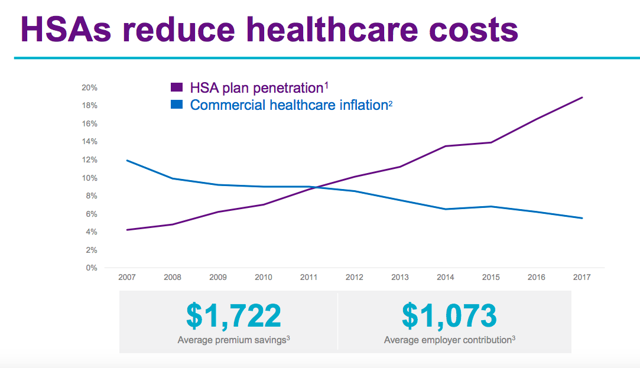
HealthEquity is a top player in health savings accounts. These accounts replace traditional health insurance with high-deductible health plans. Due to the high deductibles, the premiums are materially lower, and employers often share some of the savings with employees. High deductibles also make consumers more discerning, which has major advantages in terms of efficiency and cost reductions overall.
Health savings accounts also offer massive tax benefits. Contributions are tax-deductible, investments in the account get compounded on a tax-deferred basis, and withdrawals are tax-except as long as the money is used for qualified healthcare expenses. Reducing healthcare costs is a crucial consideration, and health savings accounts offer many advantages in that area.
Source: HealthEquity
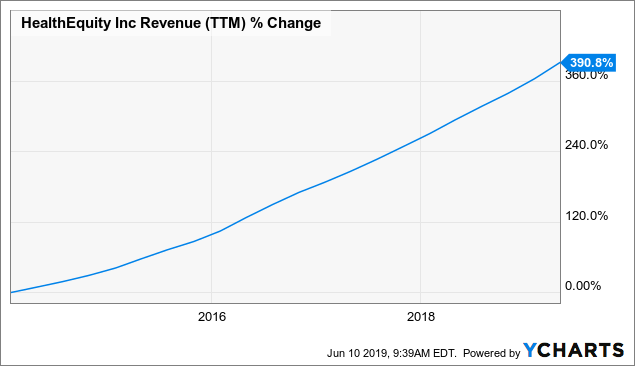
HealthEquity has done a solid job in terms of capitalizing on its growth opportunities over the long term, and revenue growth has been nothing short of impressive over the past several years.
Data by YCharts
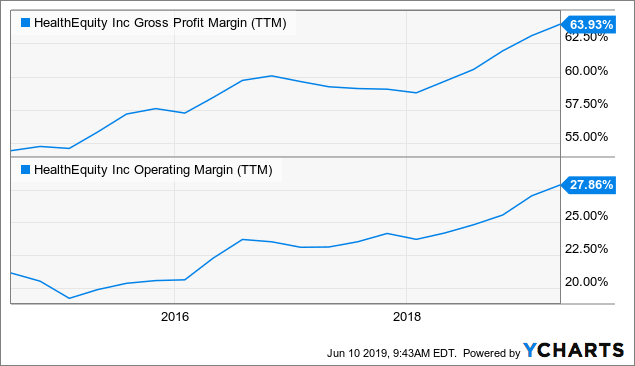
Many high-growth companies tend to have demanding reinvestment needs, which means that profit margins are generally low and unstable. But HealthEquity is well beyond the inflection point in terms of profitability, with both gross profit margin and operating profit margin significantly expanding over the past several years.
Data by YCharts
This combination of rapid revenue growth and expanding profitability is providing a double boost to profits, as the company is making increasing revenue and retaining a larger share of such a revenue as earnings.
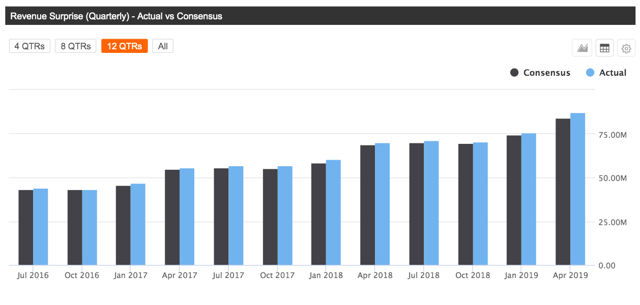
HealthEquity delivered both sales and earnings above expectations last quarter. In a sign of confidence, management also raised earnings guidance for the rest of the year.
Some key data points from the report:
- Revenue reached $87.1 during the quarter, an increase of 25% versus the same quarter last year.
- Adjusted EBITDA came in at $38.9 million, growing by 31%.
- HSA Members of 4.1 million, an increase of 17%.
- Total Custodial Assets of $8.3 billion, an increase of 21%.
Summing up, HealthEquity is a market leader in an industry with abundant potential for growth over the years ahead, the company has effectively capitalized on its opportunities for growth over the years, and the business keeps firing on all cylinders as of the most recent earnings report.
The Numbers
Shares of HealthEquity do not come for a cheap price, but valuation is not necessarily excessive either when considering the company's performance and long-term potential for growth. The forward price-to-earnings ratio is quite elevated at around 50. However, the company is growing at full speed, and this needs to be considered when looking at the valuation numbers.
Looking at current earnings does not really tell the whole story when those earnings are growing rapidly. The Price-to-Earnings Growth (PEG) ratio, which takes the P/E ratio divided by earnings growth expectations, can be a more relevant metric in these cases.
In that regard, HealthEquity is trading at a PEG ratio of 0.73 versus an industry average of 0.81. Simply put, HealthEquity looks expensive based on current earnings numbers, but the valuation is far more attractive when considering the company's potential for growth.
Importantly, valuation is always changing based on earnings expectations, and fundamental momentum can be a powerful fuel for stocks. Current prices are incorporating a particular set of expectations about the future. If the company can outperform those expectations and generate rising expectations about future earnings, this means the stock is actually more undervalued than what the numbers are currently reflecting.
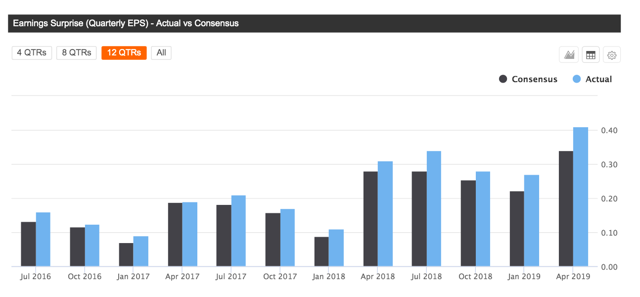
HealthEquity has an outstanding track record of consistency in terms of delivering both sales and earnings numbers above Wall Street expectations quarter after quarter. This speaks well about management and its ability to underpromise and overdeliver.
Source: Seeking Alpha Essential
Source: Seeking Alpha Essential
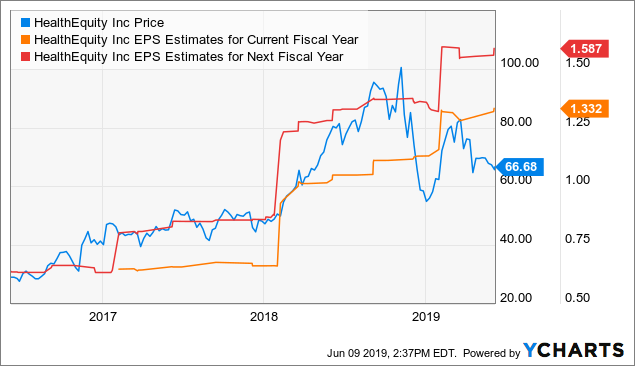
The chart shows how earnings expectations for HealthEquity in both the current year and the next fiscal year have significantly increased over time. Stock prices and earnings estimates tend to move in the same direction over time, and it's interesting to note that the stock price has lagged earnings so far in 2019.
Data by YCharts
It's not easy to keep beating expectations over the long term, but fundamental momentum is a pervasive force, meaning companies that generally deliver above expectations tend to continue doing so more often than not.
Valuation needs to be analyzed in its due context. A company with strong financial performance and accelerating momentum obviously deserves a higher valuation than a business producing mediocre financial performance and languishing momentum.
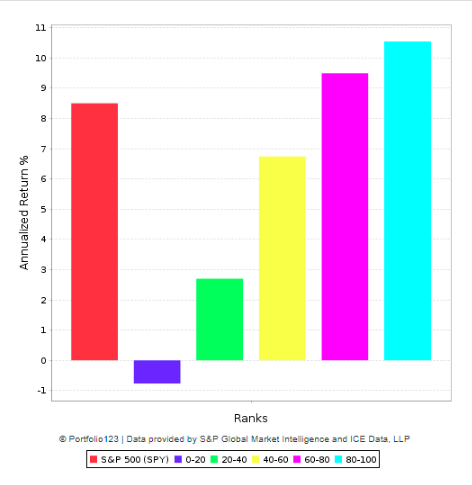
This is beyond discussion, but sometimes it can be challenging to incorporate the multiple factors into the analysis in order to see the complete picture from a quantitative perspective. The PowerFactors system is a quantitative investing system available to members in "The Data Driven Investor." This system basically ranks companies in a particular universe according to a combination of factors, such as financial quality, valuation, fundamental momentum and relative strength.
In simple terms, the PowerFactors system is looking to buy good businesses (quality) for a reasonable price (valuation) when the company is doing well (fundamental momentum) and the stock is outperforming (relative strength).
Data from S&P Global via Portfolio123
The backtested performance numbers show that companies with high PowerFactors rankings tend to deliver superior returns over the long term, and this bodes well for investors in HealthEquity going forward.
The company has a PowerFactors ranking of 99.6 as of the time of this writing, meaning that HealthEquity is in the top 10% of companies in the US stock market based on financial quality, valuation, fundamental momentum and relative strength combined.
Moving Forward
The healthcare industry is exposed to significant regulatory risk, and this is generating concerns among investors in the sector. This uncertainty will probably remain in place over the coming months, but it will also be a source of opportunity for long-term investors in the best stocks in the sector.
Another important risk factor to watch is that HealthEquity made a bid to purchase WageWorks (WAGE) for $2 billion in cash. WageWorks is still reviewing the deal, and there is no official decision as of the time of this writing. Since scale is a key source of strength in the industry, growing through acquisitions can make a lot of sense. Nevertheless, big acquisitions always carry implementation risks, and it's hard to tell if the purchase price is justified or not.
Those risks being acknowledged, HealthEquity is delivering rock-solid financial performance, and the company has a lot of room for growth in the years ahead. The stock is no bargain, but it's not overvalued at all considering the company's quality and growth prospects. As long as management keeps leading the company in the right direction, chances are that HealthEquity stock will deliver attractive returns for investors going forward.
Statistical research has proven that stocks and ETFs showing certain quantitative attributes tend to outperform the market over the long term. A subscription to The Data Driven Investor provides you access to profitable screeners and live portfolios based on these effective and time-proven return drivers. Forget about opinions and speculation, investing decisions based on cold hard quantitative data can provide you superior returns with lower risk. Click here to get your free trial now.



Comments
Log in or sign up to join the conversation.