
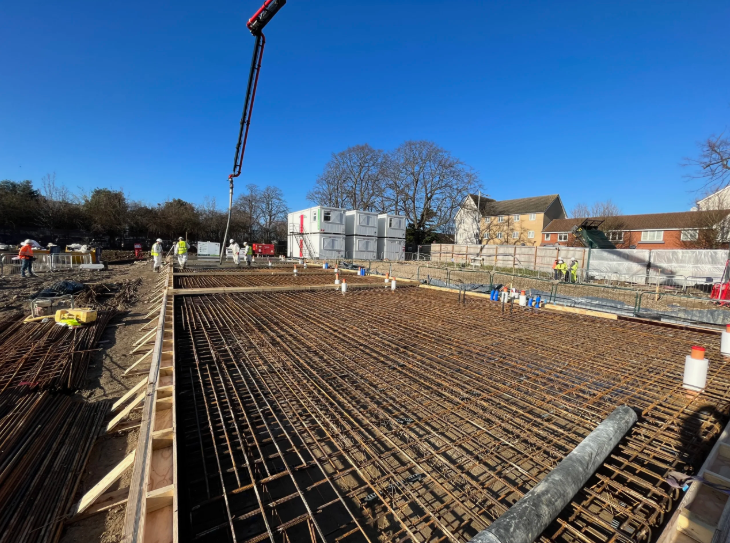
I stood in a muddy excavation in North London two winters ago, staring at a freshly exposed raft slab that was already showing hairline cracks. The project wasn’t ours originally. A homeowner had used a general builder who’d poured a thick reinforced raft on soft clay, convinced that “more concrete” would compensate for no piles. Six months later, the extension was pulling away from the main house, doors wouldn’t close, and the floor felt bouncy. When we took over, the ground investigation – which should have been done first – revealed a buried pocket of compressible alluvium right beneath one corner. That one missing step cost the client an extra £28,000 in remedial underpinning and nearly four months of lost time. It’s a story I share not to frighten anyone, but to make a point: a foundation isn’t a blunt instrument. It’s a calibrated load-transfer system. And when ground conditions get tricky, the most elegant, cost-effective solution you’ve probably never heard of is the piled raft foundation.
Why Most People Get Foundation Design Wrong
I’ve been around piling rigs and raft shutters for over 15 years, and I still meet architects, surveyors, and even structural engineers who treat pile and raft design as an either/or decision. Either you dig shallow trenches and pour strip footings, or you go full deep piling with a suspended slab. That binary thinking leaves huge value on the table. In reality, the ground beneath a building isn’t a uniform block of “good” or “bad” soil. It’s a layered, unpredictable composite. You’ll have stiff clay overlying loose sand, or a thin crust of weathered chalk above voids. Treating it like a uniform medium almost guarantees over-design in some areas and under-design in others.
We regularly see designs where every column gets its own heavily reinforced pile cap, and the slab just floats as a non-structural cover. That approach ignores the ability of a well-detailed raft to distribute loads across multiple piles, smoothing out localised soft spots. The unnecessary steel and concrete in those designs routinely add 20 to 30 percent to the foundation budget, and they don’t necessarily improve performance. What you need is a system that acknowledges the ground’s complexity and makes the soil, piles, and raft work together. That’s exactly what a piled raft foundation does.
So, What Actually Is a Piled Raft Foundation?
Forget textbook definitions. On site, a piled raft foundation means you’re placing a structurally reinforced concrete slab directly on the ground, with piles strategically located beneath it – not necessarily under every load-bearing point, but where they’re needed to control settlement and bridge weak zones. The raft isn’t a passive mat; it’s part of the load-sharing mechanism. The piles don’t take the entire building weight; the soil directly under the raft still carries a proportion, typically 20 to 40 percent. The magic lies in the interaction. The piles reduce overall settlement and, crucially, differential settlement, which is what really damages buildings. The raft stiffens the system and distributes uneven loads from walls, columns, and ring beams. Used properly, a piled raft foundation often uses 30 to 50 percent fewer piles than a conventional pile-and-cap solution, while achieving tighter settlement tolerances.
This isn’t new – it’s been used on high-rise towers for decades, where the concrete raft is metres thick. But in domestic and light commercial work, many contractors still shy away because it demands more geotechnical rigour upfront. And that’s where the real skill sits.
The Problem-Solution Pivot: What Happens When You Ignore Soil-Structure Interaction
I remember a project in Surrey that still makes me wince. A developer had obtained planning for four townhouses on a sloping site with London Clay overlying the Lambeth Group – notoriously variable, with sand lenses and water-bearing layers. The original foundation scheme specified 73 CFA piles, each topped with a heavily reinforced square pile cap, all linked by ground beams. The client came to us because the piling contractor’s quote had blown the budget. We reviewed the site investigation data, did a quick settlement analysis using a simplified raft interaction model, and realised that by turning the ground beams into a fully integral stiffened raft – a ring beam and raft slab working together – we could reduce the pile count to 41. We kept piles under the heaviest party wall loads and at areas where the boreholes showed a drop in undrained shear strength, but allowed the raft to span across intermediate zones.
The result: pile installation time dropped by nine working days. Concrete volume for pile caps reduced by 62 percent. The overall foundation cost came down 27 percent. Even more importantly, predicted maximum differential settlement after 30 years fell from 12mm to 6mm, which is well within normal cosmetic crack limits. That project wasn’t a success because we were cleverer than the previous engineer; it was a success because we didn’t treat the ground as a passive lump. We designed a pile raft system that respected what the ground was actually telling us.
Ring Beams Are the Unsung Heroes
When you’re working with a piled raft foundation, peripheral ring beams aren’t optional extras – they’re essential structural elements. A properly dimensioned ring beam does three things simultaneously: it stiffens the edge of the raft against differential rotation, it provides a robust bearing surface for masonry or timber frame walls, and it acts as a torsion-resisting element if the raft tries to cantilever over a marginal soil zone. On a recent job in a heavily treed area of Kent, we used a 600mm deep by 400mm wide reinforced ring beam integrated with the raft edge to bridge surface desiccation cracks in the clay that extended nearly 1.5 metres deep. The piles were taken down to 8 metres, beyond the influence of tree roots, but the ring beam allowed us to keep the raft thickness at a sensible 225mm over most of its area, instead of having to thicken the whole slab. That detail alone saved about 11 cubic metres of concrete – not huge in isolation, but on a project with tight margins, every cubic metre counts.
The interaction between ring beam reinforcement and the raft’s top and bottom mats needs careful detailing. Poor lapping or a weak construction joint at the beam-slab interface can introduce a crack plane exactly where you don’t want it. I’ve seen the aftermath: water tracking through a cold joint into a finished living space because the contractor poured the ring beam one day and the slab the next without proper shear connectors. We now specify continuity bars bent into both elements and insist on a single pour wherever possible, even if it means a longer day for the concrete gang. The extra coordination is trivial compared to the cost of breaking out and re-waterproofing a floor.
Ground Investigation Isn’t a Tick-Box Exercise – It’s the Whole Strategy
The biggest single source of piled raft foundation problems I encounter isn’t poor concrete or faulty piling – it’s inadequate ground investigation. You can’t design a piled raft foundation without knowing the vertical stiffness profile of the soil to at least the pile toe depth. A couple of trial pits and a dynamic probe test won’t cut it. You need at least two properly logged boreholes with SPT N-values or CPT data, combined with laboratory classification and undrained triaxial tests on cohesive samples. On a site in Buckinghamshire last year, a desk study said “Head deposits over chalk.” Three boreholes later, we found a buried soft clay channel that pinched out halfway across the footprint. Without that data, a uniform raft would have tilted, and a pure piled solution would have been overkill for two-thirds of the area. We placed four extra CFA piles in the soft zone, densified the raft reinforcement locally, and saved the client from what could easily have become a £15,000 insurance claim five years down the line.
When we present our designs, we always show the settlement contour plots generated from a simple Winkler spring model or a more advanced finite element analysis if the job justifies it. Clients may not understand the engineering, but they absolutely understand a colour map showing their extension dropping 3mm while the neighbour’s wall stays put. It builds trust and gives them a quantified reason to invest in the right investigation. For a typical residential piled raft project, expect to spend £1,200 to £2,500 on ground investigation. That’s money you’ll recover many times over in foundation optimisation.
Quantifiable Benefits You Can Take to the Bank
Over the years, we’ve tracked the numbers. Here’s what a well-designed piled raft foundation typically delivers compared to a conventional pile-and-cap arrangement on a similar soil profile:
Pile count reduction: 30 to 50 percent. On a recent 180m² extension, we used 11 piles instead of 22. At £350 per linear metre of pile, that’s an immediate saving of nearly £9,000.
Concrete volume savings: Eliminating discrete pile caps and rationalising the slab thickness typically cuts total concrete by 15 to 25 percent. For the same extension, we poured 34m³ instead of the originally estimated 43m³.
Reinforcement optimisation: Though raft steel can be slightly higher due to continuous top and bottom mats, you remove the heavy cage congestion in pile caps. On balance, steel weight often stays roughly the same or reduces by about 10 percent because you’re not over-reinforcing isolated caps.
Programme compression: Driving or boring fewer piles and skipping individual cap excavations often saves 5 to 10 working days on a residential project. Time is money, especially when you’re paying for temporary accommodation.
Settlement control: A properly calibrated piled raft foundation consistently limits differential settlement to under 10mm, often under 5mm. That means no expensive call-backs for sticking doors, cracked tiles, or failed drainage falls.
Lower ground risk: Because the raft engages the soil surface, you have a built-in “early warning” system. If the soil is marginally weaker than assumed, the raft picks up a bit more load and the piles a bit less, rather than a pure pile system where overloaded piles can punch into a weak layer without any load redistribution.
When the Ground Bites Back: Real-World Complications
It’s not all smooth concrete. I’ve seen a piled raft foundation go wrong when a contractor decided the pile cut-off levels didn’t need to be precise. In a hybrid system, if a pile head sits 30mm too low, the void beneath the raft can prevent proper load transfer until the raft deflects enough to close the gap. That initial movement can cause early-age cracking before the building even goes up. We now specify a strict tolerance of +10mm / -5mm on pile head levels and require a compressible void former beneath the raft if we suspect heave from clay or variable cut-off compliance.
Another pitfall is waterproofing continuity. A piled raft foundation often doubles as the ground floor slab, meaning any penetrations for services, pile heads, or ring beam kickers create potential water entry points. We’ve switched to specifying type B integrated waterproof concrete with hydrophilic strip systems around pile perimeters as standard on sites with even moderate groundwater risk. It adds about £18 per square metre but eliminates the long-term liability of tanking failures in habitable rooms below ground.
Heave is a third headache. If you’re piling through shrinkable clay and the raft sits near the surface, seasonal moisture changes can exert uplift on the raft edge. On one project in Cambridge, we introduced a compressible clayboard layer under the raft perimeter linked to the ring beam, allowing the clay to swell without heaving the structure. The cost was modest – roughly £800 for the material – but it prevented a potential cracking issue that could have persisted for decades.
My First Piled Raft Failure (And What It Taught Me)
Early in my career, I designed a piled raft for a lightweight steel-framed garden room over soft silt. The model looked perfect: 4 piles, a 150mm raft, predicted settlement of 4mm. Six weeks after pouring, one corner had dropped 14mm. I’d made a classic mistake: I used average shear strength values from a single borehole and missed that the silt had a very high void ratio, leading to consolidation settlement under the sustained dead load of the slab itself, even before the building load was applied. The piles were fine, but the soil under the raft crept. We had to jack the corner, underpin with two additional piles, and cast a new thickened raft section. The lesson burned itself into my memory: always check the long-term consolidation settlement of the raft bearing stratum separately from the pile settlement. They are additive. If the raft’s self-weight settlement alone exceeds a few millimetres, you need a stiffer raft, more piles, or a different design approach. That mistake cost me £4,200 out of my own pocket at the time – a very effective teacher.
Integrating Ring Beams, Rafts, and Piles into One Seamless Detail
I want to share a detail that’s saved more projects than I can count. When you have a ring beam cast monolithically with the raft edge, and bored piles projecting into the beam soffit, use a double-reinforcement cage in the ring beam zone. The outer cage handles the perimeter bending and torsion from eccentric wall loads; the inner cage provides continuity with the raft’s top mat and confinement around the pile head. We also leave a 100mm deep recess in the top of the pile to receive the ring beam’s bottom reinforcement, and we wet-bond the pile head with a bonding agent before pouring the beam. This creates a full moment connection between pile and beam, allowing the raft to mobilise the pile’s lateral capacity. It’s a small practice that isn’t in every textbook, but it transforms the robustness of the whole system, particularly on sloping sites where horizontal earth pressures push against the ring beam.
Cost Benchmarks and Real Numbers
Let me give you some honest figures based on our work across London and the Home Counties in 2024-2025:
Small residential extension (30–50m²): A piled raft foundation with 4–6 CFA piles, integrated ring beam, and 200mm raft typically costs between £12,000 and £18,000 including ground investigation, design, and all concrete works. A conventional mass-fill pad and strip solution in good ground might be £6,000–£9,000, but the piled raft is for poor ground where that cheaper option simply won’t work.
New detached house (150–200m²): Expect £22,000–£35,000 for a full piled raft with 12–20 piles, depending on access, depth to bearing stratum, and reinforcement ratios. That might sound substantial, but the equivalent traditional piling and ground beam system often reaches £30,000–£50,000 when you factor in pile caps and the suspended floor deck.
Light industrial unit (500m²): A piled raft can come in at £80,000–£110,000 versus £130,000+ for a pure pile and cap arrangement. The savings really scale with floor area.
These numbers include temporary works, spoil removal, concrete pump, and reinforcement. They don’t include the cost of empty rooms and lost rent if you get it wrong – that’s the unplanned downtime I always warn clients about. Foundation rectification after handover rarely costs less than £20,000 and always destroys trust.
How to Know if a Piled Raft Foundation Suits Your Site
I’m often asked, “Can I just use a piled raft on any site?” The short answer is no. There are clear indicators where it works best:
Variable ground: When boreholes show different strata across the footprint, a piled raft bridges the inconsistencies.
Moderate loading: Detached houses, low-rise apartment blocks, and single-storey commercial units are ideal. High-rise buildings use them too, but that’s a different scale of engineering.
Sensitive neighbours: If you need to minimise vibration and settlement next to a fragile structure, a piled raft with smaller-diameter bored piles (rather than driven piles) reduces risk.
Time-sensitive projects: The reduced pile count and simpler sequencing can shave crucial weeks off a programme.
Sites where a piled raft foundation often doesn’t make sense include very high loads concentrated on small areas (e.g., a 10-storey tower on a tiny footprint – you might still use a piled raft but with very thick rafts, blurring the line), or sites with collapsing soils or deep, uncontrolled fill where the raft can’t reliably bear on the surface. Also, if the client insists on a full basement with tanking, the interaction becomes more complex and a traditional base slab with piles might be simpler.
My Personal Take on the Industry’s Future
I’ve watched foundation design edge toward more collaborative, data-driven approaches, and that fills me with optimism. We now routinely share 3D ground models with geotechnical engineers before finalising reinforcement schedules. Laser scanning of excavations gives us actual cut-off levels to the millimetre. We load-test selected piles to verify skin friction rather than relying solely on empirical correlations. On one recent project, static load testing confirmed a 15 percent higher shaft resistance than the borehole logs suggested, allowing us to reduce pile lengths by 1.2 metres across 17 piles – a saving of over £2,700. This kind of adaptive design isn’t yet standard, but it should be. When you treat the ground investigation as a living document rather than a one-off report, you unlock efficiencies that benefit everyone.
The popularity of piled raft foundations is rising, not because they’re trendy but because they force engineers to actually engage with the ground. And that engagement – measuring, testing, modelling, verifying – is what prevents those heartbreaking phone calls from homeowners whose dream extension has started to tear itself apart. If I could leave every self-builder and small developer with one guiding thought, it would be this: invest in knowing your ground, then let a properly integrated raft and pile system do the heavy lifting. The numbers, and the peace of mind, will follow.
Frequently Asked Questions
What is the difference between a piled raft and a traditional pile-and-beam foundation?
A traditional pile-and-beam foundation uses piles connected by ground beams, with the floor slab usually suspended or non-structural. The soil under the floor isn’t intended to carry significant load. A piled raft foundation, by contrast, uses a structural raft slab that sits directly on the ground and shares the building load with the piles. This load-sharing typically reduces the number of piles needed and controls settlement more effectively.
How do I know if my site needs a piled raft foundation instead of just a raft or just piles?
If your ground investigation reveals soft, variable, or compressible soils where a plain raft would settle excessively or differentially, but the loads aren’t so concentrated that the raft can’t help, a piled raft becomes a strong option. Key triggers include desiccated clay near trees, pockets of infill, or adjacent buildings that can’t tolerate vibration from heavy piling.
Can a piled raft foundation be used for a single-storey extension?
Absolutely. We frequently design piled rafts for extensions on tight urban sites with poor ground. The system is scalable – you might only need 3 or 4 bored piles and a relatively thin reinforced raft. It often works out more cost-effective than a suspended concrete floor on piles, and you avoid step details at door thresholds.
Is a ring beam always necessary with a piled raft?
While not every piled raft requires a separate perimeter ring beam, in domestic-scale work we almost always incorporate one. The ring beam stiffens the slab edge, provides a clean bearing for walls, and helps resist differential rotation. In marginal ground it becomes essential to bridge desiccation cracks or protect against edge heave.
How deep do the piles need to go?
Pile depth depends entirely on where competent bearing strata or sufficient shaft friction can be mobilised. In London Clay, CFA piles for a residential piled raft commonly extend 6 to 12 metres. On chalk sites, they might go 3 to 5 metres into sound chalk. We determine the exact depth through borehole data and pile load testing.
What does a piled raft foundation cost compared to other foundation types?
For poor-ground sites where conventional trench fill or strip footings aren’t feasible, a piled raft often undercuts a full pile-and-suspended-slab solution by 20 to 35 percent. For a typical 150m² house, that can mean £22,000–£35,000 for a piled raft versus £30,000–£50,000 for traditional deep piling and ground beams. The exact figure varies with ground conditions and access.
How long does it take to install a piled raft foundation?
After enabling works, piling typically takes 2 to 4 days for a residential project. Preparing the raft formation, installing the reinforcement, and pouring the raft and ring beam usually takes another 5 to 7 working days. Compared with conventional piling and cap construction, you can often save a week or more.
Can trees and clay shrinkage damage a piled raft foundation?
Yes, but the design can mitigate this. By carrying piles below the zone of moisture fluctuation and using compressible void formers or deeper ring beams at the perimeter, we accommodate seasonal clay movement without translating it into building movement. This is far more controllable than with shallow strip foundations.
Do I still need a suspended floor if I use a piled raft?
No. The raft itself forms your ground-bearing floor slab. You pour the concrete to a finished level suitable to receive insulation, a damp-proof membrane, and your screed or floor finish. This eliminates the need for block-and-beam or precast planks, saving both cost and headroom.
What are the signs that a piled raft foundation isn’t performing correctly?
Watch for sticking doors or windows, diagonal cracks radiating from corners, gaps opening between the skirting board and floor, or cracking in the ring beam itself. Any of these could indicate excessive differential settlement. If you spot them, commission a level survey and a structural inspection promptly – early intervention is far cheaper than major underpinning later.
Comments
Log in or sign up to join the conversation.