

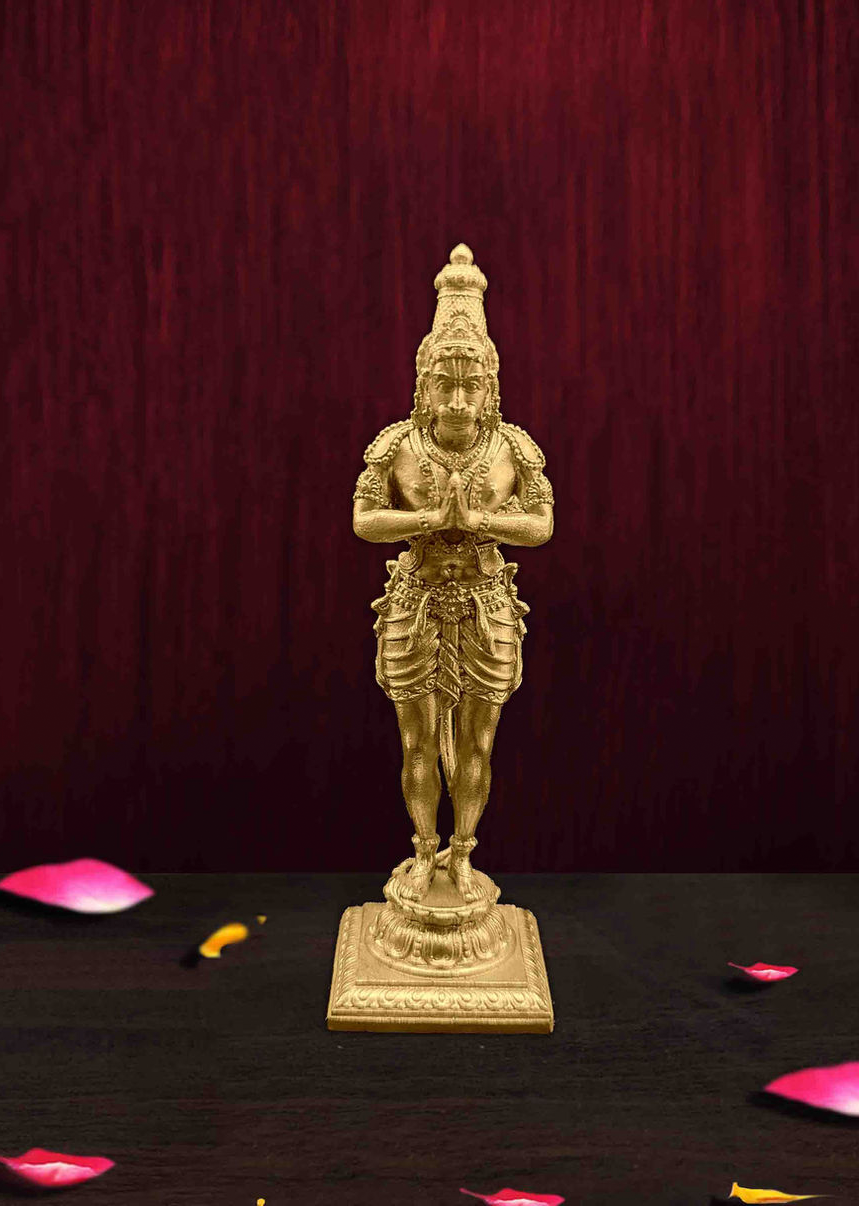
Lord Hanuman - One guardian, One unshakeable gaze, One promise that never breaks. That's the image Hanuman has carved into the hearts of devotees for centuries — mace raised, eyes fixed forward, radiating a strength that feels less like myth and more like memory. This handcrafted Brass Standing Hanuman Idol brings that very spirit home, embodying the loyalty, courage and selfless devotion that made Hanuman not just Lord Rama's greatest devotee, but a symbol worshipped across India — from humble wayside shrines to towering temple complexes — as proof that true power lies in service, not self.
Who Is Hanuman?
Hanuman is a vanara — a divine, monkey-like being — celebrated as the son of Anjana and Kesari, and is widely regarded as the spiritual son of Vayu, the wind god, who is said to have blessed him with immense strength, speed and the power of flight. This divine parentage is why Hanuman is also known as Pavana-putra, "Son of the Wind," a name that reflects both his physical power and his swift, unwavering nature.
Hanuman and Rama: The Devotee and the Divine
Unlike many deities who are worshipped alongside a consort, Hanuman is celebrated for his complete devotion to another — Lord Rama. Their bond is considered the ideal expression of Bhakti, or devotional surrender, in Hindu philosophy. Where deities like Shiva-Parvati or Vishnu-Lakshmi represent divine partnership, Hanuman and Rama represent something distinct: the perfect relationship between God and devotee, master and servant, friend and protector.
Hanuman Among the Vanaras
Within the vanara army of Kishkindha, figures like Sugriva and Angada held positions of kingship and leadership, yet it is Hanuman who is remembered above all others. While Sugriva ruled and Angada fought valiantly, Hanuman's distinction lay in the completeness of his surrender — his strength was never used for personal glory, but always in service of Rama's cause.
The Yogic and Philosophical Symbolism of Hanuman
Hanuman is often described as the perfect yogi, and his form carries deep philosophical meaning beyond the events of his story.
Symbol of Bhakti and Selfless Service
In the Bhakti tradition, Hanuman represents Seva — service without expectation of reward — and Bhakti, devotion so complete that the self dissolves into the will of the divine. He is frequently invoked as the ideal example of how devotion, not power alone, leads to spiritual liberation.
Strength Guided by Discipline
Hanuman is also revered as a Brahmachari, a celibate ascetic whose immense physical power is entirely disciplined and directed toward righteous purpose. This union of strength and self-restraint is central to his symbolism — he is never depicted as power without control, but as power in complete service of dharma.
The Legend of Hanuman: From Childhood to Lanka
A Childhood Marked by Divine Mistake
As a child, Hanuman is said to have mistaken the rising sun for a ripe fruit and leapt into the sky to seize it, prompting Indra to strike him down with his thunderbolt. Enraged, Vayu withdrew his breath from the world until the gods relented, blessing the young Hanuman with extraordinary boons — invulnerability, immense strength and the ability to change his size at will.
Forgotten Power and the Curse of Humility
Due to his mischievous nature as a child, sages are said to have cursed Hanuman to forget his own powers until reminded of them by another. This meant that for much of his early life, Hanuman remained unaware of the full extent of his own strength — a detail that adds poignancy to his later transformation.
Meeting Rama and the Turning Point
Hanuman's life found its true purpose when he encountered Rama and Lakshmana in the forests of Kishkindha, during Rama's search for the abducted Sita. It was in this meeting that Hanuman's dormant powers and unwavering loyalty began to fully awaken, setting in motion the events that would define his legend.
The Leap to Lanka and the Burning of the City
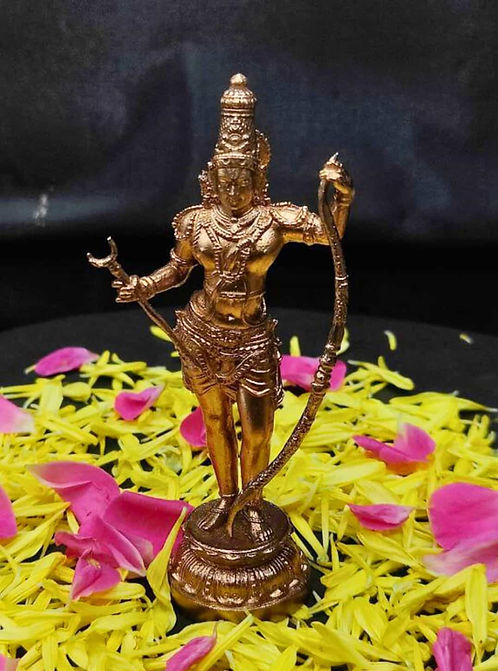
Tasked with finding Sita, Hanuman is remembered for his extraordinary leap across the ocean to Lanka, where he located her in the Ashoka Vatika and delivered Rama's message of hope. When captured and his tail set ablaze by Ravana's forces, Hanuman used the flames to set fire to the city of Lanka itself, before extinguishing his own tail and returning triumphant to Rama.
Bringing the Sanjeevani Mountain
Perhaps the most celebrated episode of all is Hanuman's flight to the Himalayas to retrieve the Sanjeevani herb to save the fallen Lakshmana. Unable to identify the exact herb, Hanuman is said to have lifted the entire mountain and carried it back to the battlefield — an act that has come to symbolize boundless devotion overriding any limitation.
Temples and Shrines Devoted to Hanuman
Hanuman worship is deeply woven into India's sacred geography. The Hanuman Garhi temple in Ayodhya stands as one of his most important shrines, closely tied to the Ramayana's central narrative, while the Sankat Mochan Temple in Varanasi is revered as a place where devotees seek relief from hardship and fear. In Hampi, the ruins of ancient Kishkindha and the hill traditionally identified as his birthplace draw pilgrims seeking a connection to Hanuman's earliest legend. Across these sites, Hanuman is worshipped not as a distant, unreachable god, but as a protector who remains close to ordinary devotees.
Spiritual Significance of Hanuman
Courage and Protection
Hanuman is invoked as a guardian against fear, negative energy and obstacles, and is often the first deity approached by those seeking protection in difficult times.
Devotion and Selfless Service
His life stands as the clearest example of Bhakti in Hindu tradition, teaching that true strength lies in service to a higher purpose rather than self-interest.
Strength and Humility
Despite his immense power, Hanuman remains a symbol of humility, reminding devotees that true might is measured by how it is used, not merely by its scale.
Remover of Obstacles and Fear
Many devotees recite the Hanuman Chalisa specifically for the removal of fear, illness and obstacles, reflecting his enduring role as a steadfast, accessible protector.
Why Is Hanuman Different from Other Forms of Divine Strength
While deities like Bhairava or Narasimha also embody fierce protective power, Hanuman's distinction lies in the gentleness beneath his strength. He is depicted as fierce in battle yet tender in devotion, powerful yet humble, a warrior yet a servant. Compared to the multi-headed Panchamukhi Hanuman form — worshipped primarily for warding off severe negative influences — the Standing Hanuman form is more approachable, representing everyday courage, steady vigilance and quiet devotion rather than esoteric or tantric power.
Conclusion
Hanuman's story is ultimately one of transformation — from a mischievous child unaware of his own power, to the most trusted devotee in Hindu tradition. His legend continues to inspire because it speaks to something universal: that true strength finds its highest purpose in devotion and service to others.
Comments
Log in or sign up to join the conversation.