

The Global Gypsum Board Market is expected to grow steadily to 2031, driven mainly by construction, urbanization, sustainability, and new product formats like pre‑decorated boards.
Market Overview
According to TechSci Research report, The Global Gypsum Board Market is projected to grow from USD 23.13 Billion in 2025 to USD 32.46 Billion by 2031, reflecting a CAGR of 5.81% over 2026–2031. Gypsum board, also known as drywall or plasterboard, is a noncombustible panel material with a gypsum core and typically paper surfacing, widely used for interior walls and ceilings in residential, commercial, and institutional buildings.
Demand is primarily driven by the expanding global construction sector, rapid urbanization, and large infrastructure programs that require fast, cost‑efficient interior finishing solutions. Sales of gypsum board products in the United States alone reached around 574 million square meters in the first quarter of 2025, underscoring the scale of usage in modern building projects.
Growing preference for fire‑resistant, moisture‑resistant, and energy‑efficient building materials, coupled with the adoption of advanced construction technologies and green building initiatives, further supports market expansion. At the same time, producers must navigate volatility in raw material and energy costs, as well as evolving environmental regulations related to gypsum mining and end‑of‑life disposal.
Report Description
Forecast Period: 2027–2031
Market Size (2025): USD 23.13 Billion
CAGR (2026–2031): 5.81%
Fastest Growing Segment: Pre‑decorated Boards
Largest Regional Market: Asia Pacific
Market Size (2031): USD 32.46 Billion
Key Market Drivers
Expanding global construction activity Population growth, urbanization, and rising incomes are supporting new residential, commercial, and industrial building projects, especially in emerging economies. This creates a sustained need for interior finishing materials such as gypsum board across new build, renovation, and remodeling work.
Renovation and remodeling demand In mature markets, a large share of demand comes from renovation and retrofit projects, where gypsum board is preferred for its ease of installation, versatility, and compatibility with modern interior design requirements.
Sustainable and green building practices Developers and building owners increasingly seek materials that contribute to green certifications and improved energy performance. Gypsum boards with recycled content and favorable thermal and indoor air quality characteristics fit well into these sustainability strategies.
Supportive industry context A growing number of projects are being delivered under updated green standards and ratings systems, while major construction materials companies report robust sales linked to strong building activity worldwide. This broader context reinforces gypsum board’s role as a standard interior solution.
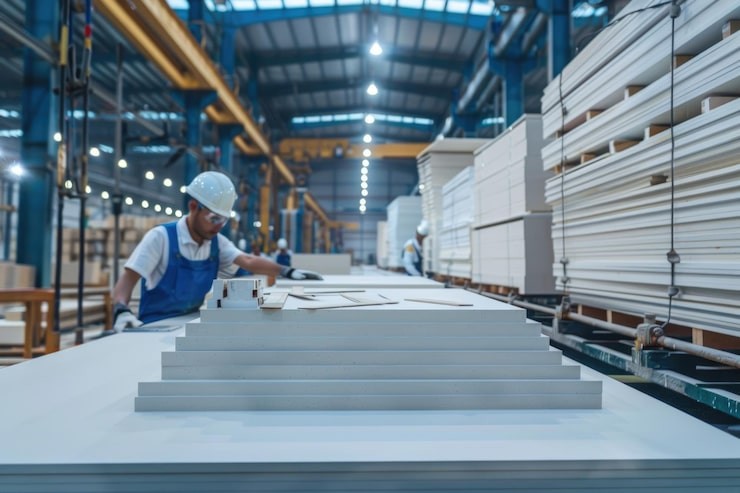
➝ 𝐆𝐘𝐏𝐒𝐔𝐌 𝐁𝐎𝐀𝐑𝐃 𝐌𝐀𝐑𝐊𝐄𝐓 𝐎𝐔𝐓𝐋𝐎𝐎𝐊 𝐓𝐎 𝟐𝟎𝟑𝟏F
Key Market Challenges
Volatility in raw material and energy costs Rising prices for gypsum, energy, and related inputs increase manufacturing costs, squeeze margins, and can lead to higher prices for finished boards. This is especially challenging for large projects with tight budgets, where cost efficiency is critical.
Constraints on raw gypsum supply Declines in calcined gypsum supply, influenced by energy costs, regulatory compliance, and mining conditions, can limit producers’ ability to expand output in line with construction demand. Lower availability makes capacity planning and investment decisions more complex.
Investment and technology adoption risks Unpredictable input costs discourage aggressive capital expenditure on new lines and advanced manufacturing technologies. This slows modernization and may limit the ability of some producers to keep pace with demand for high‑performance and more sustainable gypsum boards.
Key Market Trends
Circular economy and recycled content Manufacturers are increasingly integrating recycled gypsum and paper into production, developing boards that incorporate high proportions of end‑of‑life material. Products that contain 100% recycled gypsum from demolition waste demonstrate how closed‑loop systems can be implemented at scale.
Modular and prefabricated construction Growth in modular homes and prefabricated building components favors standardized, high‑quality gypsum boards that can be installed quickly in factory‑built units. Rising manufactured home shipments and modular projects drive demand for panels optimized for off‑site assembly.
Low‑carbon and high‑efficiency boards Producers are introducing lighter, higher‑performance boards that reduce embodied carbon, water use, and energy consumption during production, while improving jobsite productivity. New product families combine fire, mold, and moisture resistance with reduced environmental footprints.
Zero‑carbon and electrified plants Investments in electrified, renewable‑powered gypsum wallboard plants and low‑carbon board categories signal a shift toward decarbonization, supporting customers seeking lower‑carbon building materials for housing and commercial real estate.
Segmental Insights
Pre‑decorated Boards Pre‑decorated boards are the fastest‑growing product segment in the Global Gypsum Board Market. They offer factory‑applied finishes, colors, and textures that eliminate on‑site painting or wallpapering, cutting installation time and labor costs. These boards are particularly attractive for commercial interiors, hospitality, retail spaces, and high‑end residential projects where aesthetics, speed, and cost control are critical. Their standardized quality and ready‑to‑use surfaces align well with modular and prefabricated construction methods.
Regional Insights
Asia Pacific Asia Pacific is the leading regional market, driven by strong construction activity in China, India, and other fast‑growing economies. Rapid urbanization, population growth, and government‑led infrastructure and affordable housing programs all contribute to rising demand. National building codes and standards that emphasize fire safety, ease of installation, and performance support the use of gypsum board as a preferred interior material. The region’s focus on modern, high‑density housing and commercial development reinforces its dominant position in global gypsum board consumption.
Other RegionsNorth America: Significant renovation and remodeling demand, established gypsum board usage in residential and commercial segments, and growing interest in low‑carbon, high‑performance products.Europe: Steady demand from energy‑efficient retrofit projects and sustainable building initiatives, alongside tightening environmental regulations and increased focus on recycled content.Latin America and Middle East & Africa: Gradual expansion linked to urban growth, infrastructure investments, and modernization of building practices.
Recent Developments
Capacity expansion in gypsum board production New production lines and expanded facilities in key gypsum manufacturing complexes increase overall capacity to meet rising demand. Capacity additions from around 33 million to 58 million square meters per year in certain plants illustrate the scale of recent investments.
Zero‑carbon wallboard plants and low‑carbon product categories The opening of electrified, zero‑carbon gypsum wallboard plants powered by renewable electricity, and the launch of low‑embodied‑carbon wallboard ranges, show how producers are integrating decarbonization into core manufacturing operations.
Regional expansion initiatives Strategic investments in plasterboard plants across Peru, Chile, and Argentina aim to upgrade technology, improve efficiency, and increase supply to meet regional demand for gypsum‑based building materials.
Innovative product lines The introduction of new, lighter‑weight, performance‑enhanced gypsum board families targeting fire resistance, mold/moisture resistance, and sustainability, often using 100% recycled paper facings, demonstrates ongoing innovation in both technical and environmental performance.
Key Market Players
American Gypsum Company LLC | BGC Australia Pty Ltd | USG Corporation | Beijing New Building Material Public Limited Company | Chiyoda Ute Co. Ltd | Continental Building Products | Georgia‑Pacific LLC | Global Gypsum Board Co. LLC | Jason Plasterboard Jiaxing Co. Ltd | PABCO Building Products LLC
These companies supply a wide range of gypsum board products for residential, commercial, industrial, and modular construction, and many are actively investing in sustainable manufacturing, capacity expansion, and new product development.
𝟏𝟎 𝐁𝐞𝐧𝐞𝐟𝐢𝐭𝐬 𝐨𝐟 𝐭𝐡𝐞 𝐑𝐞𝐬𝐞𝐚𝐫𝐜𝐡 𝐑𝐞𝐩𝐨𝐫𝐭
Provides clear Global Gypsum Board Market size and CAGR forecasts to 2031 for planning and investment.
Highlights Pre‑decorated Boards as the fastest‑growing segment and explains why.
Explains demand drivers across residential, commercial, industrial, and renovation projects.
Details challenges from raw material volatility, energy costs, and regulatory constraints.
Tracks key trends in circular economy, recycled content, and low‑carbon board development.
Analyses the impact of modular and prefabricated construction on standardized board demand.
Shows why Asia Pacific is the leading region and how government programs support growth.
Summarizes major capacity expansions, zero‑carbon plants, and innovative product launches.
Provides practical examples that clarify where gypsum board delivers efficiency and aesthetic value.
Profiles leading market players and their strategic directions for competitive benchmarking.
FAQ
What is gypsum board used for? Gypsum board is used for interior walls and ceilings in residential, commercial, and institutional buildings, providing smooth surfaces, fire resistance, and acoustic performance.
Why are pre‑decorated boards growing so fast? They reduce on‑site finishing work, save time and labor, and offer factory‑applied designs and colors, making them ideal for fast‑track and design‑driven projects.
What is driving gypsum board demand globally? Construction growth, urbanization, renovation and remodeling, and the shift toward sustainable, energy‑efficient buildings are key demand drivers.
Which region leads the Global Gypsum Board Market? Asia Pacific leads due to rapid urbanization, large infrastructure and housing programs, and national building standards that favor gypsum board interiors.
Comments
Log in or sign up to join the conversation.