

Guruvayurappan Swamy is one of the most revered forms of Lord Krishna in Indian devotion, worshipped at the sacred Guruvayur Temple in Kerala — and today, that same devotion is carried into homes across the world through a handcrafted Idol Brass Guruvayurappan idol. Known as "Bhuloka Vaikuntham," or Vaikuntha on Earth, Guruvayur is one of the most significant Krishna shrines in South India, drawing millions of devotees each year.
Unlike the playful child-Krishna seen in many other temples, Guruvayurappan is worshipped in a majestic four-armed form, blending Krishna's intimacy with the cosmic grandeur of Lord Vishnu. This article traces his story, symbolism, and enduring spiritual significance.
Who Is Guruvayurappan?
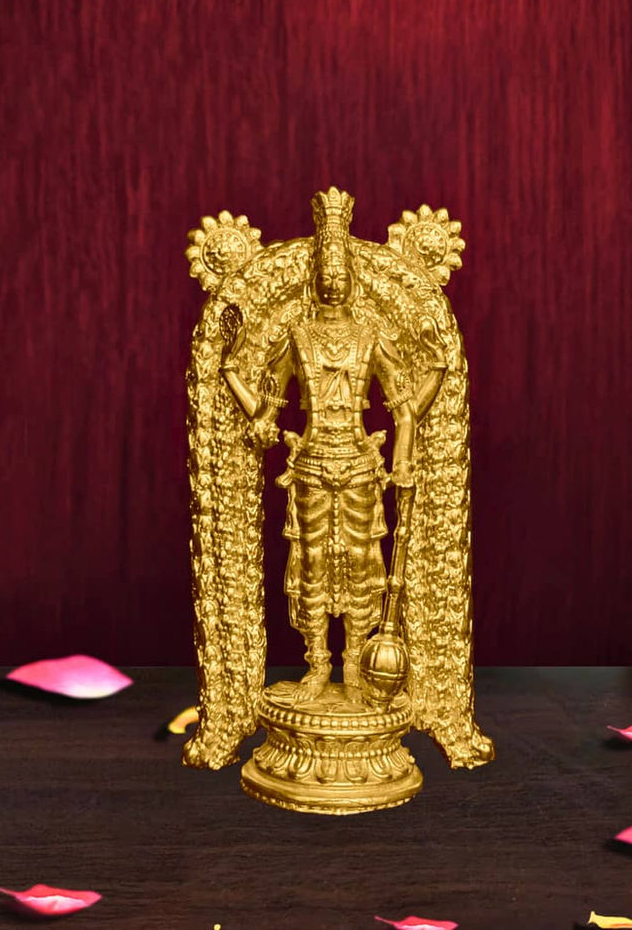
Guruvayurappan is understood as Krishna in his fullest divine aspect — the very form in which he is believed to have appeared before his parents, Vasudeva and Devaki, at the moment of his birth in Mathura. He is worshipped not as the mischievous cowherd of Vrindavan, but as the supreme, all-pervading reality that Krishna represents.
Guruvayurappan and His Divine Family
The deity is closely tied to the story of Vasudeva and Devaki, whose own worship of this very idol in their lifetime gives it a deeply personal and familial resonance for devotees, distinct from more mythologically distant forms of Vishnu.
Guruvayurappan Compared to Other Krishna Forms
While shrines like Udupi Krishna emphasize Krishna's childhood, and Parthasarathy temples honor him as Arjuna's charioteer, Guruvayur venerates him in his most complete, majestic form — approachable, yet infinite.
The Symbolism of Guruvayurappan's Four Arms
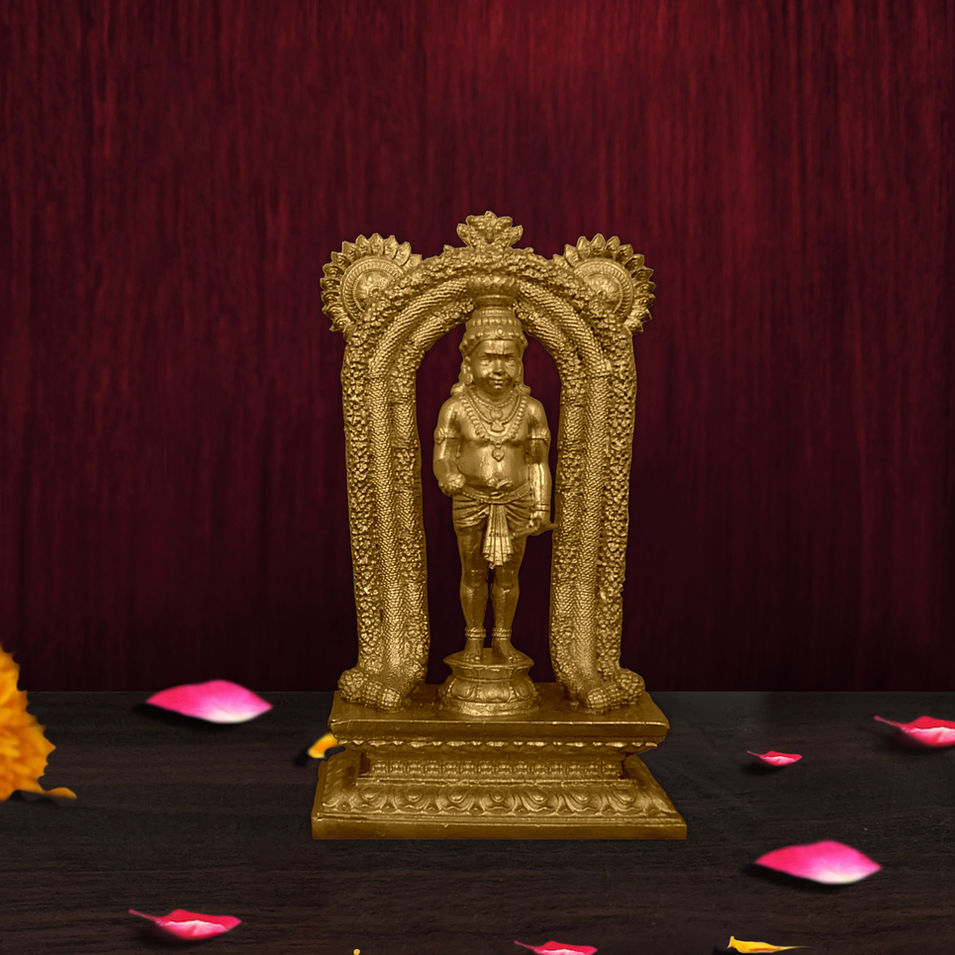
Guruvayurappan holds the conch (Panchajanya), the discus (Sudarshana Chakra), the mace (Kaumodaki), and a lotus, with a Tulasi garland at his chest. Each object reflects a facet of divine power: the conch as the sound of creation, the discus as the force that dispels ignorance, the mace as strength upholding dharma, and the lotus as purity and grace. Together, they present Krishna not merely as a beloved figure of devotion, but as the sustaining force of the universe itself.
The Legend of Guruvayurappan
The Idol's Life in Dwaraka
Tradition holds that this very idol was worshipped by Vasudeva and later by Krishna himself throughout his life in Dwaraka, making it, in devotees' eyes, the idol closest to Krishna's own presence on Earth.
Krishna's Final Instruction
As Krishna's earthly life drew to a close and Dwaraka was foreseen to be submerged by the sea, he instructed his devoted disciple Uddhava to entrust the idol to Brihaspati (Guru, preceptor of the gods) and Vayu, the wind god, asking them to find it a new, sanctified home.
The Search, Guided by Parasurama
Guided by the sage Parasurama, Guru and Vayu travelled across the land in search of a fitting site, eventually arriving at a serene lake in Kerala.
The Installation at the Hallowed Lake
At this lake, Lord Shiva and Goddess Parvati were residing in contemplation and graciously permitted the installation of the idol there, after which Shiva relocated to the nearby site now known as the Mammiyoor Temple, continuing to watch over the shrine. This joint act by Guru and Vayu is what gave the temple its name — Guruvayur.
The Guruvayur Temple: Home of Guruvayurappan
The temple's rituals begin each dawn with the Nirmalya Darshan, the first glimpse of the deity before any ceremonial bathing or decoration takes place — considered especially auspicious. The temple is also closely tied to the 16th-century scholar Melpathur Narayana Bhattathiri, who composed the devotional Sanskrit text Narayaneeyam here, condensing the Bhagavata Purana into a poetic offering to Guruvayurappan. Festivals such as Guruvayur Ekadasi, along with the temple's revered elephants, continue to draw devotees from across the country.
Spiritual Significance of Guruvayurappan
Divine Protection – Devotees turn to Guruvayurappan as a guardian presence, shielding them from hardship.
Compassion and Grace – His form embodies Krishna's gentleness toward every devotee who seeks him.
Devotion and Surrender (Bhakti) – Guruvayur is considered one of the great centers of Bhakti tradition, where surrender to the divine is central to worship.
Why Is Guruvayurappan Different from Other Krishna Forms?
Most Krishna shrines emphasize a single chapter of his life — his childhood, his role as charioteer, or his romance with Radha. Guruvayurappan instead represents Krishna's complete, eternal form, worshipped as Vishnu himself, making the deity here a bridge between Krishna's earthly life and his infinite divinity.
Conclusion
From his life in Dwaraka to his enduring presence in Kerala, Guruvayurappan Swamy embodies the union of Krishna's intimate grace and Vishnu's cosmic majesty. His story continues to inspire devotion, reflection, and surrender across generations.
Comments
Log in or sign up to join the conversation.