

Numbers:
Yield Curves:
Credit Curves:
Making Sense:
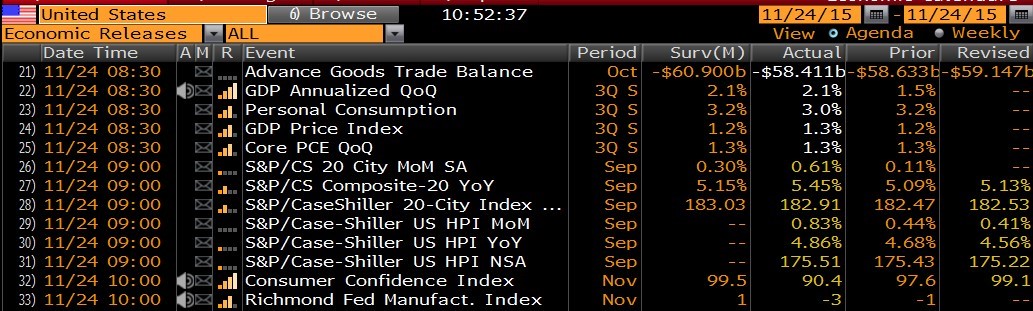
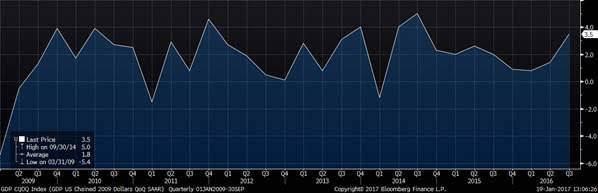
The second look at Q3 GDP is in and it appears that the U.S. economy grew at a faster pace than originally believed. According to GDP data, “2” is the magic number.
We got the (second) Look
The second look at Q3 U.S. GDP indicated that the U.S. economy grew at an annualized 2.1%, up from an initial read of 1.5%. The upward revisions was due to a stronger inventory build in September. However, what the September inventory build giveth, the September inventory build taketh away. Following the data, many economists revised their Q4 GDP forecasts lower on the belief that the stronger September inventory build probably pulled economic activity forward from the fourth quarter. Word on the Street following the data is that the consensus forecast for Q4 GDP could be revised lower to the 2.0%-2.1% area from the 2.3% to 2.4% area. This points to an annual U.S. GDP growth rate of 2.175%. The 2.0% economy appears entrenched.
Of concern is that inventory levels remain high, questioning the need for the September inventory build in the first place. Demand for goods has not been strong enough to significantly deplete inventory stockpiles. Some economists have opined this morning that inventory stockpiles are so high, growth could be shaved off of Q4 2015 and Q1 2016 GDP totals. We shall soon see Personal Consumption was revised lower to 3.0% from an initial read of 3.2%. Wages and salaries rose by $102.7 billion in the third quarter. This was a somewhat slower pace than the $109.4 billion increase in Q2. Other than inventories, nearly every other component of GDP was unchanged or revised lower.
This is the last look at GDP prior to the December FOMC meeting. There was nothing in the GDP data which should influence the Fed, one way or another. Tomorrow we get October PCE data. The Street consensus estimate for annual headline PCE calls for an inflation rate of 0.3%, up from
0.2%. The consensus estimate for Core PCE calls for an increase to 1.4% from 1.3%. An improvement (in Fed terms), but hardly Earth-shattering.
Gun-shy and Roses
Cheap credit might not have caused a bubble, at least not in the classic sense, but it appears to have caused an over-allocation of capital in the high yield energy sector. In fact, it has caused some investors to double-down on the sector. I opined that junk debt appeared way overdone in Q2 2014. This morning, an article in Bloomberg News states:
“After six years of easy-money central-bank policies kept over-leveraged companies afloat and left scant opportunities for traders who profit off the market’s scrap heaps, a rout in commodities prices in 2014 presented what had seemed like a perfect chance to buy again. Instead, those prices only declined further this year, causing the debt of everyone from oil drillers to coal miners to fall deeper into distress. As the losses intensified, gun-shy investors pulled back from almost anything that smacked of risk, spreading the losses to industries from retail to technology.”
The article quotes David Tawil, president of Maglan Capital who stated:
“It wasn’t just energy. It was anything with loads of leveraged debt on it."
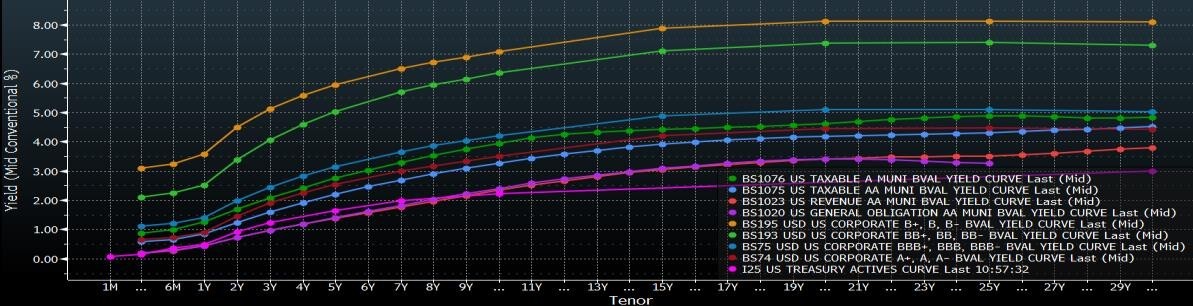
For that past two years, I have cautioned readers not to fall in love with leverage. Leverage can amplify returns when the speculation works out, but it can magnify losses when it doesn’t. Typically, tightening monetary policy is bad for leveraged strategies as leverage becomes more expensive. That the Fed is expected to raise rates moderately and very gradually might provide some solace to some leveraged speculators, but add to the equation corporate earnings results which should be far worse than originally anticipated and there could be less and less support for high yield debt valuations. This is especially true since the first attempt to buy the junk debt has not worked out as planned.
The official Bond Squad view is that junk debt defaults should pick up in the first quarter of 2016. We shall see which companies are survivors and which are not. Investors seeking exposure in the high yield space should do their credit homework and, in my opinion, seek companies with relatively low balance sheet leverage compared with their peers. Suitability is critical when considering high yield debt as receiving par at maturity is not a forgone conclusion.
Feliz Navidad
Speaking of high yield debt, Puerto Rico has been in the news (again). This time with a debt exchange deal. Apparently, Puerto Rico would like to exchange its outstanding debt. The so-called universal debt-exchange proposal would allow bondholders owning securities with various repayment priorities to swap their debt for a single new bond. Investors are awaiting the December 1st debt payment (mainly Government Development Bank and corporation debt) results. There are also legal questions regarding the universal debt exchange. The saga continues.
Mr. Roboto
The Wall Street Journal has published new installments of its “2050 Demographic Destiny” study. In the installment titled “End of Cheap Labor,” The Journal discusses the World’s rush to find replacements for cheap Chinese labor which is no longer available. The Journal quotes a corporate executive:
““Labor is getting more expensive and technology is getting cheaper,” says Andrew Lo, chief executive of Crystal Group, one of Levi’s major suppliers in China.”
Increased labor costs have forced businesses to seek alternatives to simply paying higher wages. The Journal also cautions that the rescinding of China’s one child policy might not help much with the supply of labor, even years down the road, stating:
“Last month, China announced it was abolishing its decades-old policy restricting most couples to one child. But that won’t likely put much of a dent in the country’s looming demographic problem because relatively few Chinese prefer to have more than one child, economists note—and it will be at least 16 years before any additional babies make it to the job market.”
The Journal touches on the topic of 3D printing, a hot topic around our offices:
“Some technologists even think that inventions such as 3-D printing—essentially printers that replicate solid objects like copiers reproduce printed pages—will have a big impact by 2050. In such a world, printers could spew out clothing, food, electronics and other goods ordered online from a nearly limitless selection, with far fewer workers involved in production.”
“In 2050, you could potentially have a 3-D printer at home that could produce all the fabrics you want,” said Roger Lee, the chief executive of Hong Kong’s TAL Group, which makes 1 of every 6 dress shirts sold in the U.S. for brands from Banana Republic to Brooks Brothers. “That would make us obsolete.”
It might not be cost-effective or time-efficient for every household to “print” its own goods, but it could lead to a rise of self-proprietor cottage businesses which can turn out desired goods, tailored for each customer, with small inventories of tailored goods. Such a world would probably be very competitive, thereby holding down inflation. The rise of large factories, sprawling warehouses and big-box retail outlets was all about cost efficiencies. In the future, smaller and nimble might prove more efficient in some industries.
It is my view that to think that a smaller labor force automatically means rising wage gains and inflation is myopic as it discounts labor alternatives from technology. Businesses will determine the right mix of labor and technology based on the cost of each.
In another installment, the Journal points out that even in low wage countries with expanding populations, factory-based manufacturing is not the clear path to success it once was. The study states:
“The U.S. and Europe—and East Asia more recently—first got rich because of their factories. Over time, as incomes rose and their economies became more sophisticated, they shifted into modern services like health care and finance.”
“But today, parts of South Asia, Africa and Latin America are failing to create thriving manufacturing sectors even though their wages remain low. Manufacturing employment and output are peaking and declining at vastly lower levels of income and development than they did in the West.”
“Economists’ worry is that the factory-led model of advancement—which, for more than a century, has offered the quickest route out of poverty—is simply no longer available to today’s poorest nations.”
Technology is changing how we live and how we earn a living. Predictions put forth by economists and business executives will probably not come true precisely as stated, but to think that the economy and the lifestyles of the people within will revert to some specific historic mean is, in my opinion, foolish. Thus, investors and investment professionals must be very vigilant.
Blue(er) Christmas
As I was going to press, The Conference Board released its November read of Consumer Confidence. The good news is that the October read was revised higher to 99.1 from a prior 97.6. The bad news is that the November read plunged to 90.4. This was the lowest print since the September 2014 print of 89.04. The share of Americans who see greater job availability in the next six months declined to the lowest level since March 2009, and more expect their incomes to decline. The report showed buying plans were resilient and suggested a good amount spending during the holiday season.
I have previously opined that the trend for Consumer Confidence might have peaked in January 2015 with a print of 103.80. With a Fed tightening on the horizon, job growth slowing and wage growth moderate, I pondered whether the January print of 103.80 was at or near the cyclical peak. This was followed by a general downward trend until two prints over 100 in August and September. Many economists and strategists believe that a topping out of Consumer confidence marks the peak of the economic cycle. However, they typically look for the peak to come with Consumer Confidence north of 110.
I was not so certain if Consumer Confidence could get that high, considering the damage done to consumer psyches and expectations following the financial crisis and during a sluggish recovery. It is too early to be absolutely certain, but it appears as though the economic cycle is in the late innings.
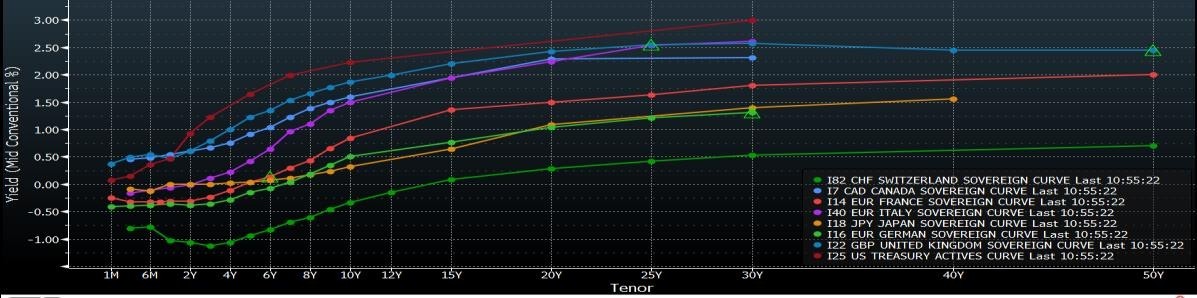
At the time of this writing, the benchmark UST 10-year note yield stood at 2.23%, down one basis point from yesterday’s close. The yield of the 30-year government bond was down one basis point as well to yield 2.99%. Ten-year mid swaps were priced at 2.11% and 30-year mid swaps were priced at 2.55%. Thus we have seen UST note/bond yields move toward swap spreads. This is much as I have anticipated, but contrary to much of the financial punditry. Also as I have expected, the UST yield curve continues to flatten. The yield curve, 2-years to 30-years, stands at 207 basis points. This is down from 220 basis points at the end of October.
That is all I have for today Please send in your votes for your most and least favorite Thanksgiving foods. We will not broadcast “Bond Squad After Hours” this week. Even bond guys need family time.
Also, those who would like to save money during the holiday season can renew/extend their Bond Squad subscriptions for $250 per year. This is a significant savings from the regular price of $299. Contact me directly for payment details.

Comments
Log in or sign up to join the conversation.