
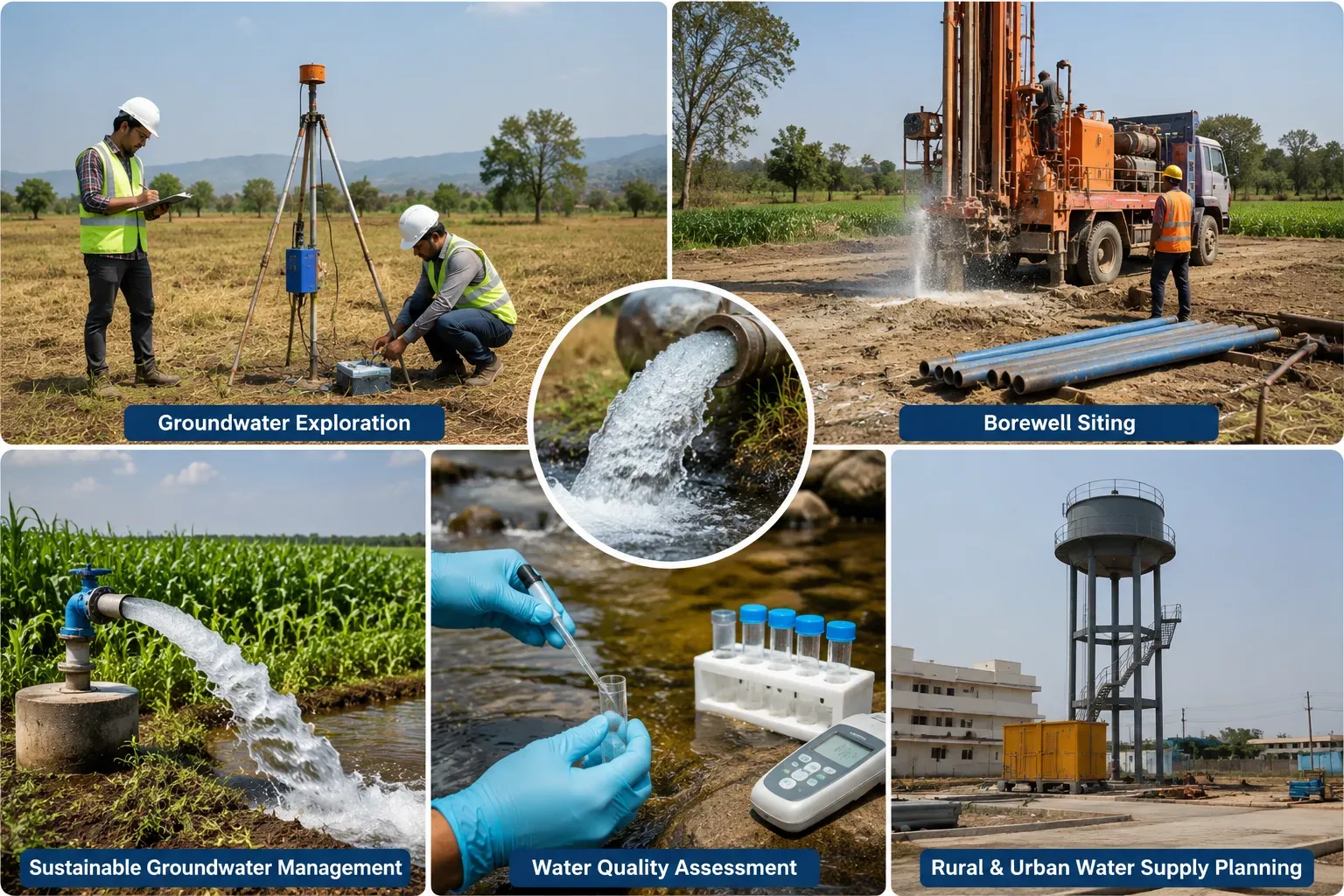
Access to reliable groundwater is becoming increasingly important for agriculture, industries, residential projects, institutions, and commercial developments. As surface water sources face growing pressure from climate variability and increasing demand, many property owners and organizations depend on borewells for a consistent water supply. However, drilling a borewell without proper scientific investigation can lead to significant financial losses, poor water yield, or even complete borewell failure. This is where a professional groundwater for borewell assessment and hydrogeological survey become essential.
Groundwater is not distributed uniformly beneath the earth's surface. The availability, depth, quality, and movement of groundwater vary depending on geological formations, rock structures, soil characteristics, and local hydrogeological conditions. A hydrogeological survey helps identify the most suitable locations for borewell drilling by studying these underground conditions. The information obtained through a scientific survey significantly improves the chances of locating productive groundwater zones and achieving a successful borewell.
Understanding Groundwater for Borewell Development
Groundwater is the water stored beneath the earth's surface in pores, fractures, and geological formations known as aquifers. These aquifers act as natural reservoirs that collect and store rainwater and other forms of recharge. When a borewell is drilled into a productive aquifer, groundwater can be extracted for various uses, including irrigation, industrial operations, drinking water supply, and construction activities.
Many people assume that groundwater exists everywhere beneath the ground. While groundwater may be present in many locations, the quantity and accessibility of water can differ significantly. Some areas may contain abundant groundwater reserves, while others may have limited or difficult-to-access water resources. Therefore, identifying the right drilling location is critical for achieving a sustainable water source.
What Is a Hydrogeological Survey?
A hydrogeological survey is a scientific investigation conducted to evaluate groundwater conditions within a specific area. The survey examines geological structures, rock formations, groundwater movement, recharge characteristics, and potential aquifer zones. The primary objective is to determine the most suitable location and depth for borewell drilling.
Hydrogeological surveys use a combination of field observations, geological mapping, groundwater data analysis, and advanced geophysical techniques. These methods provide valuable insights into subsurface conditions and help reduce the uncertainty associated with borewell drilling.
By understanding the underground environment before drilling begins, property owners can make informed decisions and avoid costly mistakes.
Importance of Hydrogeological Survey Before Borewell Drilling
Improved Borewell Success Rate
One of the biggest advantages of conducting a hydrogeological survey is the increased likelihood of borewell success. Random drilling often results in dry borewells or low-yield wells because the drilling location is selected without scientific evidence. A detailed survey identifies groundwater-bearing formations and productive aquifer zones, improving the probability of obtaining sufficient water.
Cost Savings
Borewell drilling requires a significant investment. Failed drilling attempts can result in substantial financial losses. A hydrogeological survey helps optimize drilling locations, reducing the chances of unsuccessful drilling and minimizing unnecessary expenses.
Sustainable Groundwater Utilization
Groundwater resources must be managed responsibly to ensure long-term availability. Hydrogeological investigations provide valuable information about groundwater recharge and aquifer capacity, supporting sustainable extraction practices.
Better Planning and Decision-Making
The survey provides essential data regarding groundwater depth, expected yield, and geological conditions. This information enables landowners, developers, and organizations to plan their water resource strategies more effectively.
Key Components of a Hydrogeological Survey
Geological Investigation
Geological studies help identify rock types, structural features, weathered zones, fractures, and faults that influence groundwater occurrence. Understanding the local geology is fundamental to locating productive aquifers.
Surface and Subsurface Analysis
Hydrogeologists evaluate surface conditions and subsurface formations to determine groundwater recharge potential and storage capacity. These analyses provide a clearer picture of the underground water system.
Groundwater Assessment
Groundwater levels, flow patterns, and aquifer characteristics are studied to estimate water availability and determine suitable borewell locations.
Geophysical Survey Techniques
Advanced geophysical methods are often used to investigate underground formations. These techniques help identify water-bearing zones without extensive excavation or drilling.
Data Interpretation
All collected information is carefully analyzed to prepare recommendations regarding borewell location, drilling depth, and expected groundwater potential.
Applications of Groundwater Surveys
Agriculture
Farmers rely heavily on groundwater for irrigation. A hydrogeological survey helps identify reliable water sources that can support crop production throughout the year.
Industrial Projects
Industries require consistent water supplies for manufacturing, processing, and operational activities. Groundwater assessments assist industries in developing dependable water infrastructure.
Residential Developments
Housing projects often depend on borewells for water supply. Conducting a groundwater survey before construction helps ensure adequate water availability for future residents.
Commercial Establishments
Hotels, institutions, offices, and commercial complexes benefit from scientific groundwater investigations to secure sustainable water resources.
Infrastructure Projects
Roads, industrial parks, educational institutions, and public facilities frequently require groundwater assessments during planning and development phases.
Factors Affecting Groundwater Availability
Several factors influence the availability of groundwater for borewell development:
Geological formations
Rock permeability
Fracture density
Soil characteristics
Rainfall patterns
Recharge conditions
Land use practices
Groundwater extraction rates
Because these factors vary from one location to another, site-specific hydrogeological studies are essential for accurate groundwater assessment.
Why Professional Expertise Matters
Groundwater exploration is a specialized field that requires scientific knowledge and technical expertise. Professional hydrogeologists understand how geological conditions affect groundwater occurrence and can interpret survey data accurately.
A qualified team uses systematic investigation methods rather than assumptions or traditional practices. This approach improves reliability and provides practical recommendations based on scientific evidence.
Bhoojal Survey for Groundwater Investigation
Bhoojal Survey specializes in groundwater investigation and hydrogeological survey services designed to support successful borewell development. By combining geological expertise with advanced survey techniques, Bhoojal Survey helps clients identify suitable groundwater zones and optimize borewell drilling decisions.
The goal is to provide accurate groundwater assessments that reduce drilling risks, improve water availability, and support sustainable resource management. Whether the project involves agriculture, industry, residential development, or commercial infrastructure, a professional hydrogeological survey can provide valuable guidance for long-term success.
Conclusion
Finding dependable groundwater for borewell projects requires careful planning and scientific evaluation. Since groundwater distribution varies according to geological and hydrogeological conditions, selecting a drilling location without proper investigation can lead to poor results and unnecessary expenses.
A comprehensive hydrogeological survey provides critical information about groundwater potential, aquifer characteristics, and suitable drilling locations. By improving borewell success rates, reducing costs, and supporting sustainable water management, hydrogeological investigations have become an essential step in modern groundwater development.
Choosing a professional groundwater assessment before drilling is a smart investment that can help ensure reliable water access for years to come.
FAQs
1. What is groundwater for borewell?
Groundwater for borewell refers to underground water stored in aquifers that can be accessed through borewell drilling for agricultural, industrial, residential, or commercial use.
2. Why is a hydrogeological survey important before drilling a borewell?
A hydrogeological survey helps identify productive groundwater zones, improves drilling success rates, and reduces the risk of borewell failure.
3. How does a hydrogeological survey save money?
The survey helps determine the best drilling location, minimizing unsuccessful drilling attempts and reducing unnecessary expenses.
4. Who should conduct a hydrogeological survey?
Qualified groundwater experts and hydrogeologists should perform the survey using scientific investigation methods and data analysis.
5. Why choose Bhoojal Survey for groundwater investigations?
Bhoojal Survey provides professional groundwater assessment and hydrogeological survey services that help clients make informed decisions regarding borewell development and water resource management.
Comments
Log in or sign up to join the conversation.