

Extend the Life of Your Grooving Inserts with Proper Machining Practices
In CNC machining, cutting tools are among the most valuable production assets, honestly. Their performance ties right into machining quality, productivity, and the whole manufacturing cost picture. One of the most effective approaches to raise operational efficiency is extending the useful lifespan of your grooving insert if you want fewer interruptions. A longer-lasting insert not only cuts down tooling expenses, but it also reduces machine downtime and keeps machining results more steady.
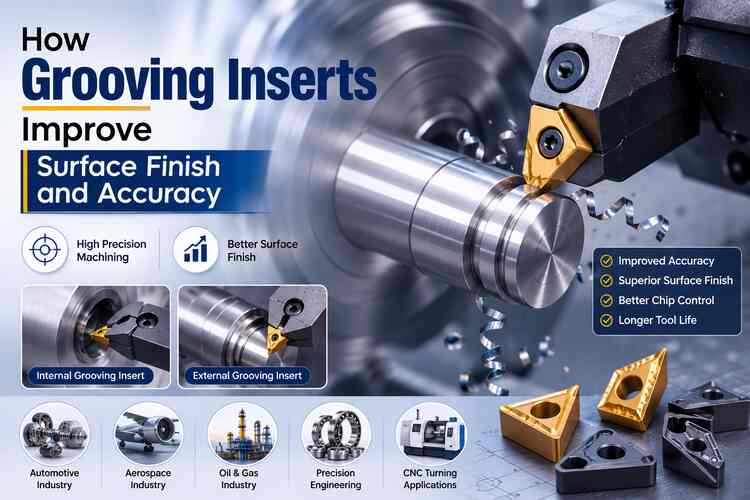
Grooving operations need high precision, and the inserts are basically under constant exposure to heat, pressure and friction. If you don’t manage tool selection, cutting parameters, and maintenance properly , insert wear can ramp up quickly . Then you start seeing poor surface finishing and dimensional inaccuracies, kind of immediately.
Why Tool Life Matters
Every insert has a limited cutting life. Once the cutting edge begins to wear, machining quality decreases, production slows down, and operating costs increase.
Longer tool life offers several advantages:
Lower tooling costs
Reduced machine downtime
Consistent machining quality
Better productivity
Improved dimensional accuracy
Higher production efficiency
Manufacturers that optimize insert life often achieve significant long-term cost savings.
Common Reasons Grooving Inserts Wear Out Quickly
Understanding why inserts fail helps prevent premature replacement.
The most common causes include:
Incorrect Cutting Speed
Excessively high cutting speeds generate excessive heat, leading to rapid wear and edge failure.
Improper Feed Rate
Very high feed rates increase cutting pressure, while extremely low feed rates may cause rubbing instead of cutting.
Both conditions shorten insert life.
Poor Chip Evacuation
Accumulated chips increase friction and heat around the cutting zone, accelerating insert wear.
Proper chip control is essential for efficient machining.
Using the Wrong Insert Grade
Different materials require different carbide grades.
Using the wrong carbide grooving insert often causes premature chipping and excessive wear.
Machine Vibration
Loose tool holders or unstable workpiece clamping create vibration that damages the cutting edge.
Reducing vibration significantly improves insert life.
Choose the Right Grooving Insert
Selecting the correct grooving insert for the machining application is the first step toward extending tool life.
Consider factors such as:
Workpiece material
Groove width
Cutting depth
Machine rigidity
Production volume
Coolant availability
Using the proper insert geometry reduces cutting forces and improves wear resistance.
Select the Correct Carbide Grade
Carbide grades vary depending on their hardness, toughness, and coating technology.
For example:
Tough grades perform better in interrupted cuts.
Harder grades offer excellent wear resistance during continuous machining.
Coated inserts provide better heat protection.
Matching the insert grade with the workpiece material significantly increases cutting performance.
Optimize Cutting Parameters
Cutting parameters have the greatest influence on insert life.
Manufacturers should carefully optimize:
Cutting speed
Feed rate
Depth of cut
Coolant flow
Machine stability
Following the manufacturer's recommendations prevents excessive heat generation and improves machining consistency.
Use High-Quality CNC Grooving Inserts
A premium CNC grooving insert is manufactured with advanced carbide grades and precision grinding techniques.
Compared to low-quality alternatives, premium inserts provide:
Better wear resistance
Improved chip control
Higher heat resistance
Longer service life
Better dimensional accuracy
Although premium inserts may cost more initially, they reduce machining costs over time by lasting significantly longer.
Ensure Proper Tool Holding
A rigid grooving insert tool setup is essential for stable machining.
Poor tool clamping causes:
Chatter
Insert movement
Edge chipping
Poor surface finish
Using a high-quality tool holder ensures better rigidity and improves overall cutting performance.
Improve Chip Control
Proper chip control reduces heat and prevents chips from damaging the cutting edge.
Manufacturers should:
Select inserts with effective chip-breaker geometry.
Use proper coolant pressure.
Adjust feed rates when necessary.
Remove chip buildup regularly.
Efficient chip evacuation extends insert life while improving machining quality.
Use the Right Coolant
Coolant plays an important role in maintaining insert performance.
It helps:
Reduce cutting temperature
Minimize friction
Improve chip removal
Prevent thermal cracking
Proper coolant application significantly increases insert durability during continuous machining.
Select the Correct Insert for the Application
Different machining operations require specialized inserts.
An internal grooving insert is designed for machining grooves inside bores where precision and accessibility are critical.
An external grooving insert performs best when machining grooves on shafts, cylinders, and other external surfaces.
Selecting the correct insert type reduces cutting stress and increases tool life.
Modern CNC Machining Demands Better Tooling
Today's grooving inserts for CNC applications are engineered to deliver longer life, higher productivity, and consistent machining accuracy.
When combined with premium CNC tools, manufacturers benefit from:
Stable cutting performance
Lower operating costs
Reduced downtime
Higher machining efficiency
Better surface finish
Preventive Maintenance Tips for Longer Insert Life
Even the highest-quality insert requires proper maintenance to perform at its best. Regular inspection and correct handling can significantly increase tool life while maintaining machining accuracy.
Follow these maintenance tips:
Clean the insert pocket before installing a new insert.
Tighten insert screws using the recommended torque.
Inspect cutting edges before every production run.
Replace damaged inserts immediately.
Keep tool holders free from chips and dirt.
Ensure proper coolant flow throughout machining.
Store inserts in a dry and dust-free environment.
Preventive maintenance reduces unexpected downtime and helps maintain consistent machining quality.
Mistakes That Reduce Insert Life
Many machining problems are caused by avoidable operator errors.
Some of the most common mistakes include:
Using Worn Inserts for Too Long
Continuing to machine with a worn insert increases cutting forces, damages the workpiece, and may even harm the tool holder.
Incorrect Tool Alignment
Improper alignment causes uneven cutting pressure, leading to premature edge wear and poor dimensional accuracy.
Ignoring Machine Vibration
Loose fixtures or unstable setups create vibration, resulting in insert chipping and poor surface finish.
Poor Coolant Application
Insufficient coolant causes excessive heat buildup, accelerating wear and reducing insert performance.
Selecting the Wrong Insert Geometry
Different groove widths and workpiece materials require different insert geometries. Using an unsuitable insert shortens tool life and reduces machining efficiency.
Industries That Benefit from Longer Tool Life
Extending insert life is valuable across many manufacturing sectors.
Automotive Industry
Used for machining shafts, pistons, transmission parts, brake components, and bearings where consistent groove quality is essential.
Aerospace Industry
Aircraft manufacturers require precision grooving with minimal tool wear when machining lightweight alloys and high-strength materials.
Oil & Gas Industry
Grooving operations are critical for producing seals, valves, couplings, and pipe fittings that demand high dimensional accuracy.
Heavy Engineering
Construction and mining equipment manufacturers rely on durable cutting tools to machine large components efficiently.
General Manufacturing
Machine shops producing precision parts benefit from lower tooling costs, improved productivity, and consistent machining quality.
Why Premium CNC Tools Matter
High-quality CNC tools play an important role in extending insert life and improving machining performance.
Premium tooling offers:
Better rigidity
Improved vibration control
Higher machining accuracy
Increased productivity
Longer service life
Lower operating costs
Combining premium tool holders with quality carbide inserts helps manufacturers achieve reliable and repeatable machining results.
Conclusion
Extending the life of your grooving insert is one of the smartest ways to reduce machining costs while improving productivity and component quality. Proper insert selection, optimized cutting parameters, regular maintenance, effective chip control, and stable machining conditions all contribute to longer tool life and better performance.
By following best machining practices and investing in high-quality tooling, manufacturers can minimize downtime, maintain excellent surface finish, and achieve consistent dimensional accuracy across every production cycle.
Jaibros is a trusted supplier of premium CNC machining solutions, offering high-performance grooving inserts, carbide inserts, turning tools, milling tools, drilling tools, and precision measuring instruments. Designed for durability, accuracy, and reliability, Jaibros products help manufacturers maximize tool life, improve machining efficiency, and achieve superior production results.
Comments
Log in or sign up to join the conversation.