

In 1965, India was begging. Not metaphorically — the Indian government was literally importing millions of tonnes of wheat from the United States just to prevent starvation. Droughts had failed the harvest two years in a row. Economists were writing about the "Hindu rate of growth" as if poverty and hunger were simply India's permanent condition.
Then, something remarkable happened.
Within a single decade, India transformed from a country dependent on food aid into one of the world's significant grain producers. That transformation is called the Green Revolution — and it remains one of the most dramatic agricultural turnarounds in modern history.
What Was the Green Revolution?
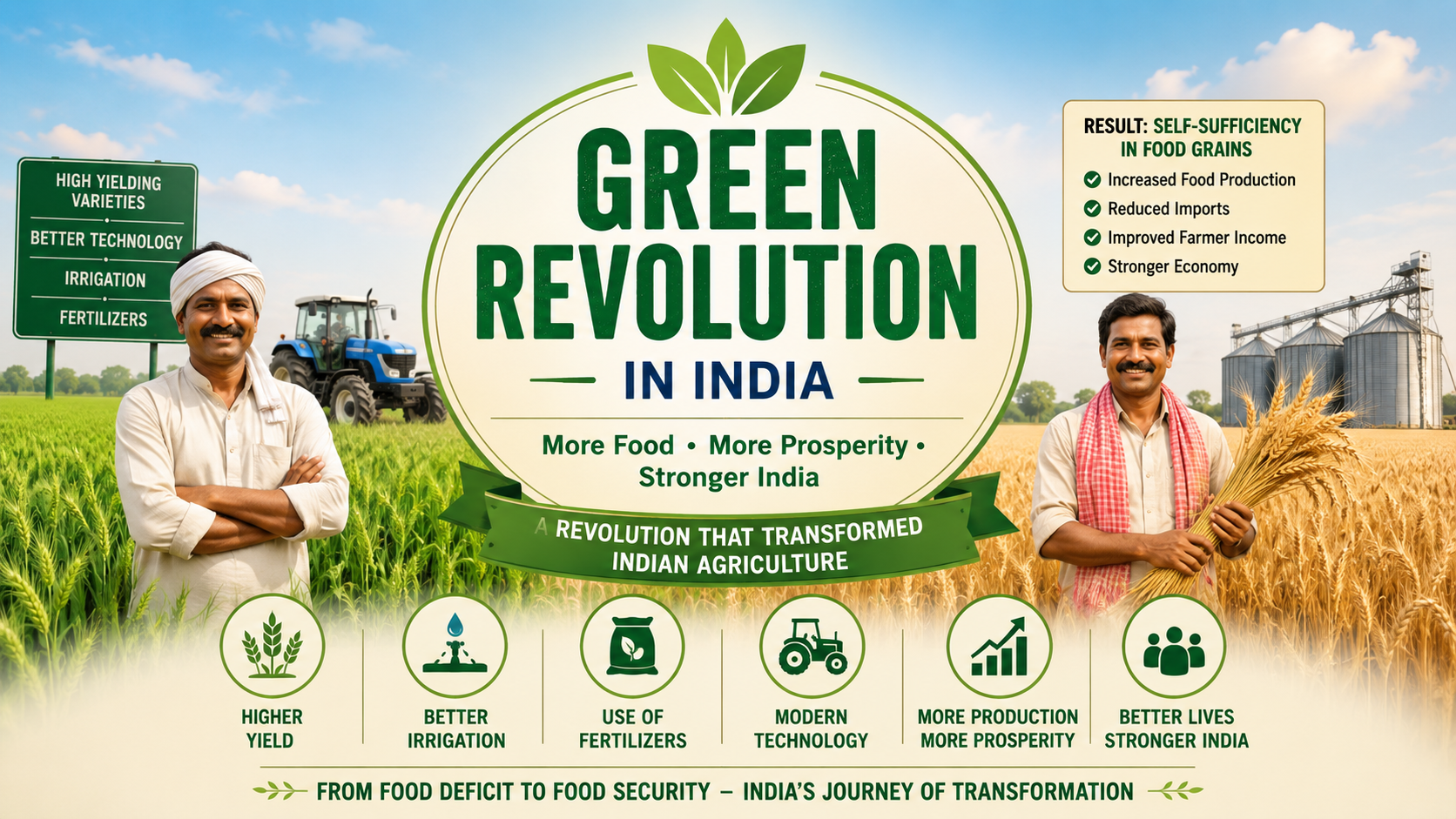
The Green Revolution refers to a series of agricultural breakthroughs introduced in developing countries between the 1960s and 1980s. It was not a single event. It was a package — new seed varieties, chemical fertilisers, expanded irrigation, modern machinery, and government policies — all working together to massively increase food production.
In India, the revolution arrived primarily through two crops: wheat and rice. The seeds that changed everything were called High-Yielding Varieties (HYVs) — dwarf plants engineered to produce far more grain per plant than traditional varieties. A regular wheat plant might give you 700 kg per hectare. An HYV plant, given the right inputs, could give you 2,200 kg or more. That difference was the difference between hunger and sufficiency.
The Man Behind the Miracle
No discussion of the Green Revolution in India is complete without Dr. M.S. Swaminathan, rightly called its father. Working at the Indian Agricultural Research Institute (IARI) in New Delhi, Swaminathan collaborated with American agronomist Norman Borlaug — who would go on to win the Nobel Peace Prize in 1970 — to adapt HYV wheat seeds to Indian soil and climate conditions.
This was harder than it sounds. Seeds developed in Mexico do not automatically grow well in Punjab. Swaminathan's team spent years testing, crossing, and adapting varieties until they found what worked. When they did, the results were extraordinary.
By 1968, India had produced so much wheat that there was no storage capacity. Grain was piled on school playgrounds and railway platforms. The country that had been surviving on American food ships was suddenly drowning in its own harvest.
How It Worked: The Key Pillars
The Green Revolution succeeded because several things happened simultaneously:
Better seeds were only the beginning. HYV plants are hungry — they need reliable water and fertiliser to deliver on their potential. So the government invested heavily in tube well irrigation, particularly in Punjab and Haryana, ensuring farmers could water their crops regardless of rainfall. Fertiliser use jumped from barely 0.07 million tonnes in 1960 to over 12 million tonnes by the mid-1980s.
Government policy made the whole system work. Banks were nationalised in 1969 and mandated to lend to farmers, replacing predatory moneylenders. A Minimum Support Price (MSP) guaranteed that farmers who produced more would be paid a fair price. The Food Corporation of India (FCI) bought and stored the surplus. Farmers finally had both the tools and the safety net to take the risk of changing how they farmed.
The Results — and the Real Cost
The numbers are staggering. India's food grain production rose from 72 million tonnes in 1965-66 to over 131 million tonnes by 1978-79. Wheat output tripled. The country built grain reserves exceeding 30 million tonnes. Famine, which had killed millions as recently as 1943, became a distant memory.
But the Green Revolution's legacy is not simple.
The states that benefited most — Punjab, Haryana, and western Uttar Pradesh — had reliable irrigation. Eastern India, southern India, and the Northeast were largely left behind. The revolution deepened regional inequality in ways that India is still dealing with today.
Environmentally, the damage is serious. Punjab's groundwater is being extracted far faster than it recharges. Decades of monoculture — growing the same wheat and rice year after year — have degraded soil quality. Thousands of traditional crop varieties, evolved over centuries, were abandoned and lost. Pesticide use contaminated water sources and affected farming communities' health.
And socially, large farmers with land and capital benefited far more than small and marginal farmers, widening the gap between India's agricultural winners and losers.
What It Means for India Today
India is now discussing a Second Green Revolution — one that must reach the states the first one missed, reverse the environmental damage, and bring small farmers into the picture from the start.
The first Green Revolution saved India. That is not an exaggeration. It fed hundreds of millions of people who might otherwise have starved, and it gave India the food sovereignty it needed to grow on its own terms.
But it was a solution built for a crisis — not a model for the long term. The lesson of the Green Revolution is not just what it achieved. It is what it left undone, and what the next generation of farmers, scientists, and policymakers must now get right.
Explore more study material on Indian history and agriculture at StudyLab24
Comments
Log in or sign up to join the conversation.