

Written by Ben Carlson
While everyone has been busy writing the obituary for actively managed funds, we’re not even close to seeing the grim reaper just yet. Here's why.
It seems like we can’t go a single day without seeing another article talking about how indexing or passive investing is taking over the fund industry. And looking at charts like this, one would assume that it is:
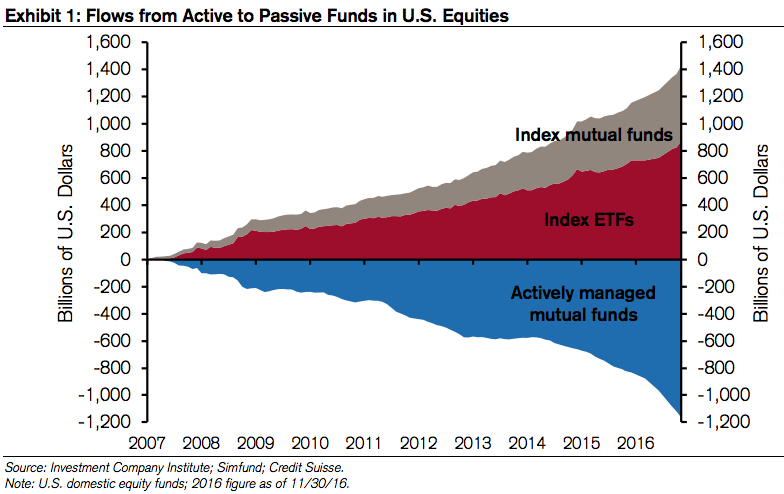
The tide has definitely turned and flows tell us what’s been happening lately, but they don’t tell the whole story. Actively managed funds still dominate U.S. stock market mutual fund assets:
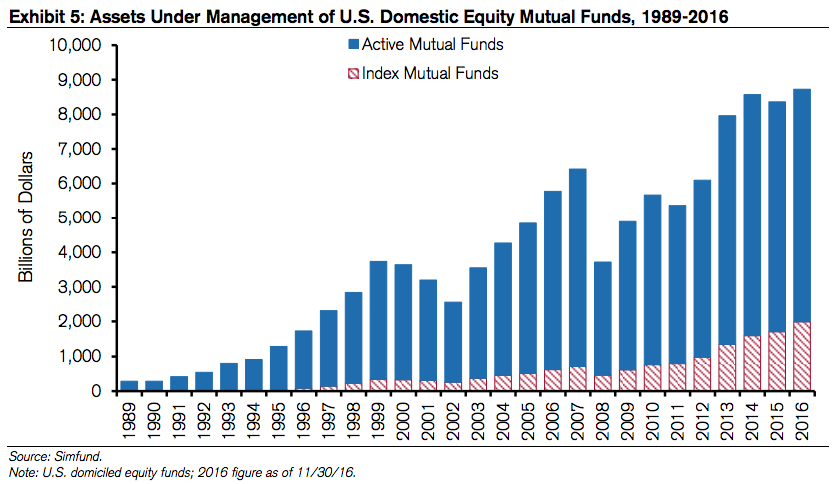
The availability heuristic is a mental shortcut that causes people to rely on recent examples that come to mind when evaluating certain concepts. I think there’s some of that going on in this instance because of the constant drumbeat of stories on the popularity of index funds and ETFs. People don’t realize that active management is still the dominant force in the markets. According to Vanguard’s CEO Bill McNabb, although indexing represents over 30% of the mutual fund world, it’s only 15% of the entire U.S. stock market while it’s less than 5% of the global market...
The average fund fees for actively managed funds still dwarf those of index funds and ETFs by about 400%, give or take. That means these fund firms are still raking in way more money in fees than their low-cost counterparts. You’re going to have to pry that revenue from their dead, lifeless hands in most cases. My guess is we’ll see a lot of captains in the fund world go down with their ship as many firms will die off or get bought out - but they’ll still be earning a decent living in the meantime...
The trend towards low-cost investment products is one of the best things to ever happen to investors - and I believe this trend is a secular change. There’s no going back now. Many of these highly-priced mutual funds and hedge funds will continue to charge high fees but eventually, this trend is going to overwhelm this business model and they’ll lose assets, have to lower their fees, get bought out by another firm or go out of business - but these things never happen overnight. It will take some time to see changes.
We’ll see some consolidation in the fund world in the years to come - and this tidal wave from active to passive products probably won’t slow down for some time - but don’t get it twisted — active management is not dead. It still dominates the markets, even if indexing is gaining ground in huge chunks.


.webp)
Comments
Log in or sign up to join the conversation.