

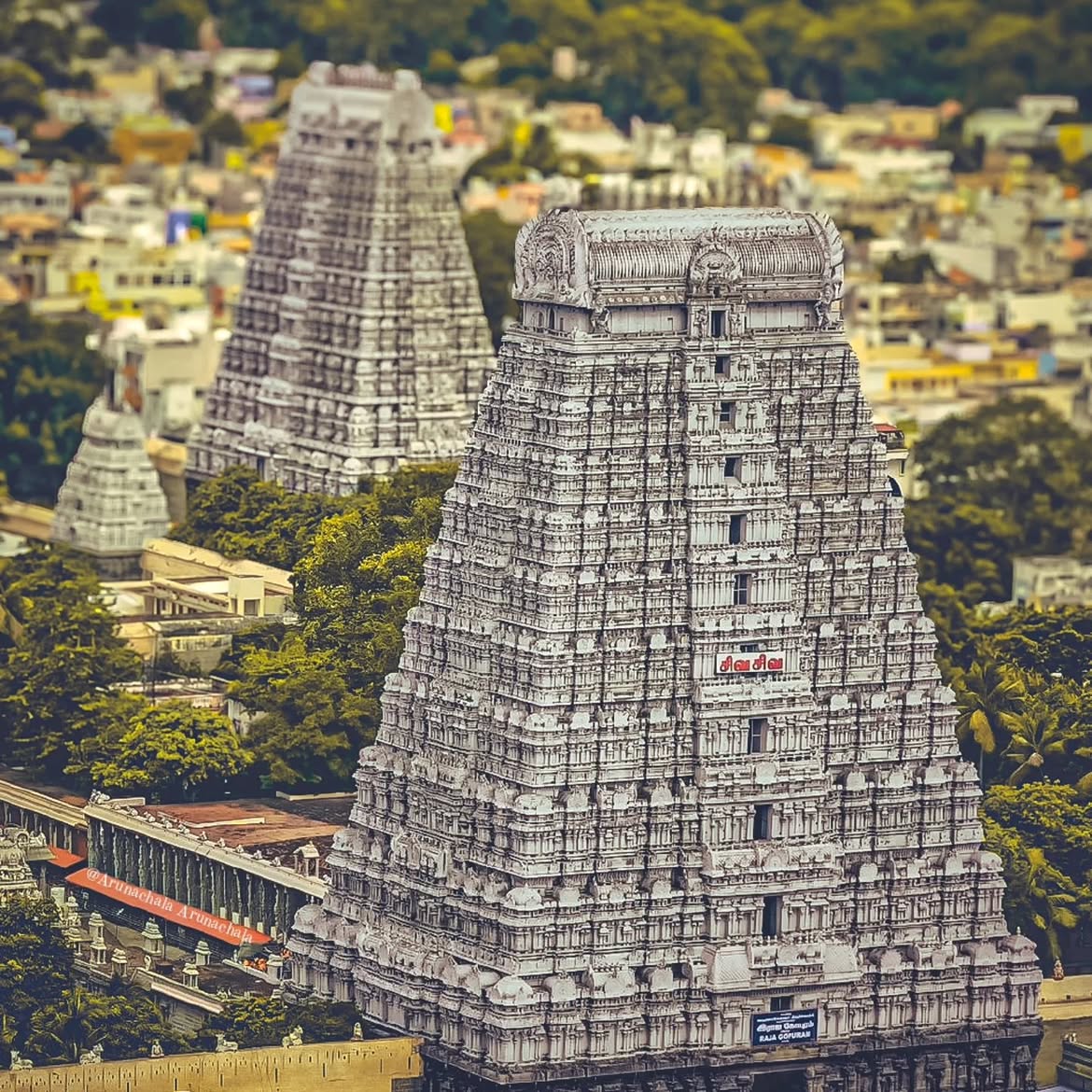
If you've ever seen a photo of a South Indian temple, chances are the first thing that caught your eye wasn't the temple itself. It was the giant, colourful tower rising above its entrance. That tower is called a gopuram, and it's one of the most striking symbols of Indian architecture and devotion.
Let's take a closer look at what makes gopurams so special.
What is Gopuram?
A gopuram is the monumental gateway tower that marks the entrance to a Hindu temple, especially in the Dravidian style of architecture found across Tamil Nadu, Andhra Pradesh, Karnataka, and Kerala. The word comes from the Tamil "kO((pu)ram," roughly meaning "cattle gate" a nod to the ancient temple complexes that once housed cattle and community life within their walls.
Unlike a simple doorway, a gopuram is often taller and more elaborate than the temple's main sanctum. Large temple complexes may have several gopurams, one for each direction, with the outermost tower usually being the tallest and most decorated.
The Architecture of Gopurams
A gopuram is built on a rectangular base and rises upward in a pyramid-like shape made of multiple tiers, or talas. Each tier gets progressively smaller as it goes up, giving the tower its distinctive tapering look.
Key architectural features include:
A stone base: The lower portion is usually made of solid granite, strong enough to support the massive superstructure above.
Tiered brick and stucco upper section: Above the stone base, the tower is typically built with brick, then covered in lime plaster and decorated with sculptures.
A crowning roof: The top of the gopuram is capped with a barrel-vaulted roof and a row of gold plating kalasams (pot-shaped finials), often made of copper or gilded metal.
A central passageway: At the base runs a doorway or corridor that pilgrims walk through to enter the temple grounds.
Some gopurams have as few as three tiers, while the grandest examples soar to thirteen or more storeys.
Symbolism and Spiritual Significance
Walking through a gopuram isn't just a physical entry. It's meant to be a spiritual transition. The tower represents the journey from the ordinary, outside world into the sacred space of the divine.
The gradually narrowing tiers are often seen as a visual representation of a devotee's ascent toward the higher self and, ultimately, toward the garbhagriha (inner sanctum), which by contrast is usually small, dark, and unadorned symbolising that true divinity lies in simplicity, not spectacle.
The tallest tower is frequently placed at the outer boundary rather than near the sanctum, reminding visitors that the deeper one goes into the temple, the more humble and inward the experience becomes.
Sculptures That Tell Stories
Gopurams are covered from top to bottom with sculpted figures of gods, goddesses, mythical creatures, dancers, musicians, and scenes from epics like the Ramayana and Mahabharata.
These aren't random decorations. Each panel is carefully placed to narrate stories, teach moral lessons, or depict cosmic order. In many temples, the sculptures are brightly painted, making the gopuram look like a living storybook when viewed from a distance.
For centuries, this was one of the primary ways for ordinary people. Many of whom couldn't read, learned scripture, mythology, and philosophy: simply by looking up.
Engineering Marvels of the Past
Building a gopuram that stands over 200 feet tall, without steel or modern machinery, is nothing short of remarkable. Ancient architects and craftsmen used precise geometry, load-bearing stone foundations, and interlocking brickwork to ensure these towers could withstand centuries of monsoons, earthquakes, and time itself.
Many gopurams took generations to complete, with construction sometimes spanning different dynasties. The Rajagopuram of the Ranganathaswamy Temple in Srirangam, for example, was begun centuries ago but was only finally completed in 1987. A project that outlived the kingdoms that started it.
The Grand Entrance Experience
Approaching a major South Indian temple, the gopuram is visible from far away, often long before the rest of the temple complex comes into view. This is intentional. It acts as a beacon, drawing pilgrims from across the region toward the sacred site.
Passing beneath the gopuram, visitors are enveloped in shade and shadow before emerging into the temple courtyard. A deliberate architectural rhythm of compression and release that heightens the sense of arrival.
Famous Gopurams in South India
Some of the most iconic gopurams include:
Sri Ranganathaswamy Temple, Srirangam (Tamil Nadu) — Home to the tallest gopuram in India, rising to about 236–239 feet across 13 tiers, and part of a temple complex with 21 gopurams in total.
Meenakshi Amman Temple, Madurai (Tamil Nadu) — Famous for its vividly painted towers covered in thousands of sculpted figures.
Annamalaiyar Temple, Thiruvannamalai (Tamil Nadu) — Known for its massive, unpainted gopurams at each cardinal direction.
Murudeshwara Temple, Karnataka — A modern gopuram-style tower, notable for housing a lift that takes visitors up for panoramic coastal views.
Srivilliputhur Andal Temple (Tamil Nadu) — So iconic that its gopuram is used as the emblem of the Tamil Nadu state government.
Timeless Heritage
Gopurams are more than architectural showpieces. They are living monuments that connect the present to a deep spiritual and artistic tradition. Every carved figure, every tier, and every painted surface reflects centuries of devotion, skill, and storytelling.
Even today, as these towers continue to rise above temple towns across South India, they remain what they've always been: a grand, unmistakable invitation to step from the everyday world into something sacred.
Comments
Log in or sign up to join the conversation.