


Gold price (XAU/USD) falls to around $4,135 during the early Asian session on Tuesday. The precious metal extends its downside as US bond yields stayed elevated despite falling energy prices. Traders continue to assess the outlook for US interest rates ahead of next week’s Federal Reserve (Fed) policy meeting.
The 2-year Treasury note yield, which more closely follows short-term Fed rate decisions, increased more than 3 basis points (bps) at 4.778%. Meanwhile, the 10-year US Treasury yield climbed more than 4 bps to 5.144%. The 30-year US Treasury bond yield rose more than 4 bps higher at 5.476%.
Higher US bond yields also came from a selloff in French bonds following a weekend of violent unrest. Higher rates are generally a headwind for gold as it pays no interest.
The Fed raised interest rates by a quarter of a percentage point in September, marking its first rate hike since 2023. Nonetheless, traders calibrate the US central bank’s next move after comments by Chairman Kevin Warsh were interpreted as supporting the case to keep rates steady this month.
The Fed is widely expected to hold interest rates steady in its October policy meeting despite last week’s strong US inflation readings. Fed funds futures are pricing in an implied 82.8% odds that the US central bank stays on hold at its next two-day meeting on October 28, according to the CME FedWatch tool.
Inflation swaps climb as markets digest last week’s US data
Strategists at Deutsche Bank highlight that, in the US, a relatively light data calendar this week “should leave markets continuing to digest last week’s much stronger-than-expected inflation numbers.” They note that “AI-related growth concerns helped to drive a decent rally for sovereign bonds, with the US 10yr Treasury yield down -16.5bps last week (+1.5bps Friday) to 5.07%.” At the same time, inflation expectations have moved higher on both sides of the Atlantic, with Deutsche Bank pointing out that this “exacerbated inflation concerns in Europe and saw the 1yr Euro inflation swap rise another +21bps last week to +3.69%,” while “similarly in the US, the 1yr inflation swap was up +17bps last week to +2.74%.”
Warsh flags investment surge and AI demand risk while avoiding 2026 policy pre-commitments
Fed Chair Warsh delivered a moderately constructive but slightly less forceful message, with a 5.6/10 FXS Speechtracker score compared to the established baseline of 6.1/10. The admission of being “over-scarred from the global financial crisis” underscores a cautious bias even as Warsh highlights structural growth and an investment surge driven by “good policies,” while stressing that key policy decisions will crystallize at the October and December meetings without pre-judging outcomes. Warsh’s focus on AI as a near-term demand shock with uncertain employment effects, alongside new Fed task forces and a field hearing, signals growing attention to technology-driven macro and financial stability risks that could ultimately shape Dollar dynamics via the policy path.
The FXS Fed Sentiment Index was unchanged on the speech, moving 0.00 points to a still-elevated 127.51, indicating that the overall policy tone remains firmly in hawkish territory despite the slightly softer FXS Speechtracker score. The combination of confidence in delivering price stability, emphasis on an investment-led upswing, and caution about negative tailside risks suggests that, for now, the FXS Fed Sentiment Index continues to flag upside risk for the Dollar relative to a neutral 100 benchmark.
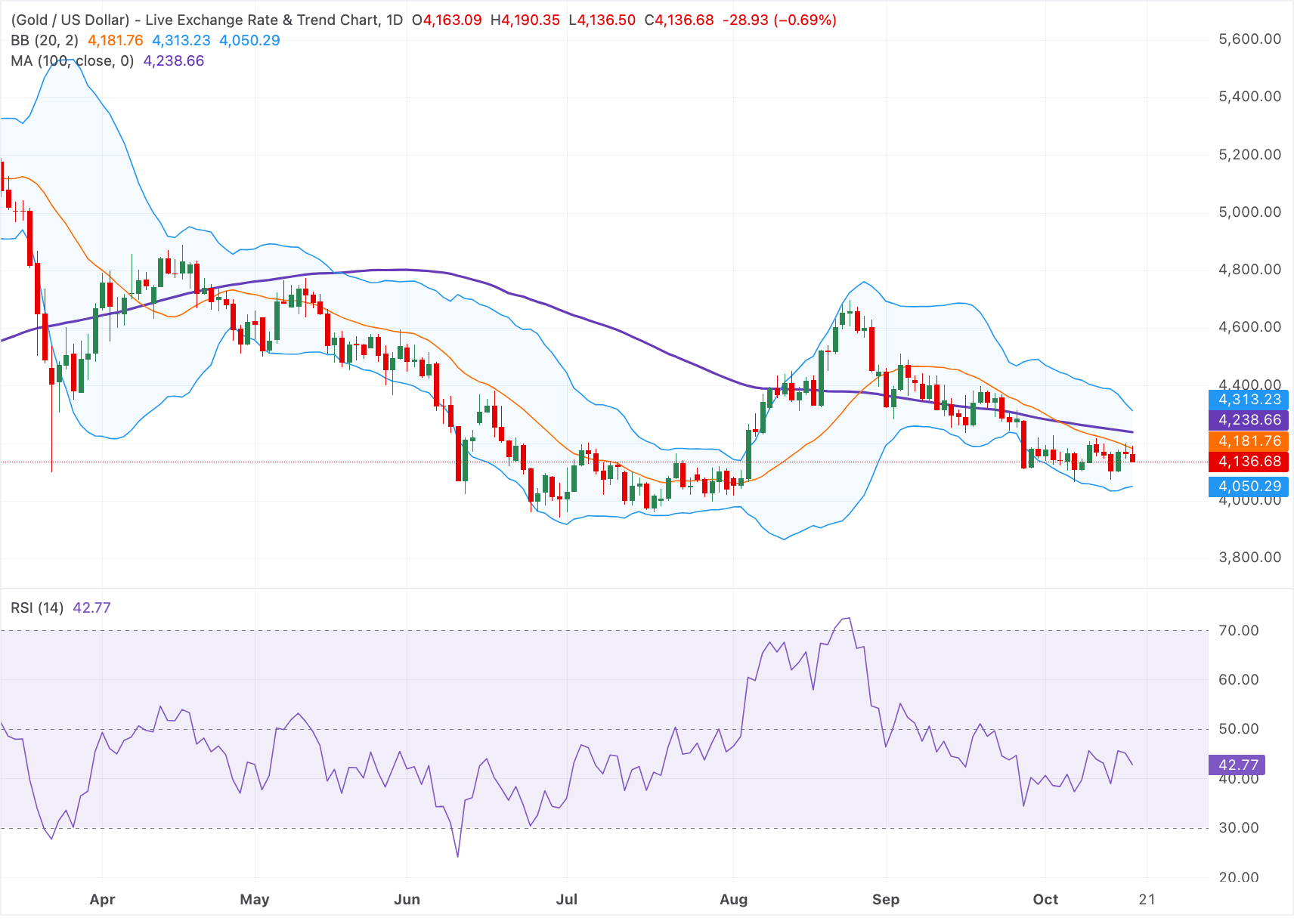
Technical Analysis: Gold remains capped under the key 100-day SMA
In the daily chart, XAU/USD holds a bearish near-term bias as spot remains lodged beneath the 100-day Simple Moving Average (SMA). Price also trades under the Bollinger Bands’ 20-day middle band, reinforcing a capped tone, while the Relative Strength Index (14) near 42 points to weak momentum rather than outright oversold conditions.
On the topside, initial resistance emerges at the Bollinger middle band near $4,180, followed by the 100-day SMA at $4,240 and then the upper Bollinger band close to $4,315, where a break would be needed to ease the current downside pressure. On the downside, the lower Bollinger band offers next support around $4,050; a sustained drop toward or through this band would signal an extension of the corrective phase.


Comments
Log in or sign up to join the conversation.