


Gold (XAU/USD) treads water on Thursday as a stronger US Dollar (USD) and elevated US Treasury yields limit the upside. At the time of writing, XAU/USD trades around $4,155, little changed on the day, as traders assess the latest US economic data and its implications for the Federal Reserve’s monetary policy path.
The US Dollar Index (DXY), which tracks the Greenback’s value against a basket of six major currencies, trades around 101.75 after climbing to a fresh year-to-date high of 101.99 earlier in the day. Meanwhile, the benchmark 10-year US Treasury yield stands at 5.32% after reaching 5.34%, its highest level since 2002.
Higher Treasury yields increase the opportunity cost of holding non-yielding assets such as Gold, while a stronger US Dollar makes the precious metal more expensive for buyers using other currencies.
US manufacturing activity remained firm in September, although growth slowed slightly. The ISM Manufacturing Purchasing Managers' Index (PMI) eased to 54.5 from 54.6, missing the 55.0 forecast. Meanwhile, the Prices Paid Index jumped to 77.9 from 71.1, much higher than the 72.3 expected, showing that factories continue to face strong cost pressures.
Other data released on Thursday showed that the US labour market remains on a solid footing. Initial Jobless Claims fell to 197K in the week ending September 26, below expectations of 200K and the previous reading of 198K. The four-week moving average also declined to 200K from 202.5K.
The figures follow Wednesday’s ADP report, which showed that private-sector employment increased by 90K in September, beating the 70K forecast and accelerating from 36K in August.
Minneapolis Fed President Neel Kashkari said on Thursday, “4.1% unemployment rate is good, labor market is healthy,” while noting that “consumer spending is strong across the economy.” Kashkari added, “We will do what we need to get inflation to the goal,” but cautioned, “If we keep raising rates, it will put different pressure on different parts of the economy.”
However, markets have scaled back expectations that the Federal Reserve (Fed) will raise interest rates this month following softer-than-expected US Personal Consumption Expenditures (PCE) inflation data released on Wednesday. Core PCE inflation rose 0.2% MoM, below the 0.3% forecast, while the annual rate remained unchanged at 3.0%, undershooting expectations of 3.3%.
The CME FedWatch Tool shows that traders now see about a 36% chance that the US central bank will raise interest rates at its October 27-28 meeting, down from 70% earlier this week. The dovish repricing offers some support to Gold, although traders are not ruling out another rate hike later this year.
An upward revision to US economic growth highlighted the continued resilience of the world’s largest economy. Annualized Gross Domestic Product (GDP) expanded by 2.2% in the second quarter, above economists’ forecast of 1.5%. Resilient economic growth and firm labour-market conditions give the Fed more room to tackle inflation, which remains above its 2% target.
Meanwhile, the lack of progress in US-Iran negotiations to reopen the Strait of Hormuz keeps Oil prices elevated and inflation risks tilted to the upside, supporting the case for tighter monetary policy.
Looking ahead, traders await the US ISM Manufacturing Purchasing Managers’ Index (PMI) and speeches from Fed officials later in American trading hours, followed by the Nonfarm Payrolls (NFP) report due on Friday.
Technical Analysis: Bearish bias holds as RSI remains below 50
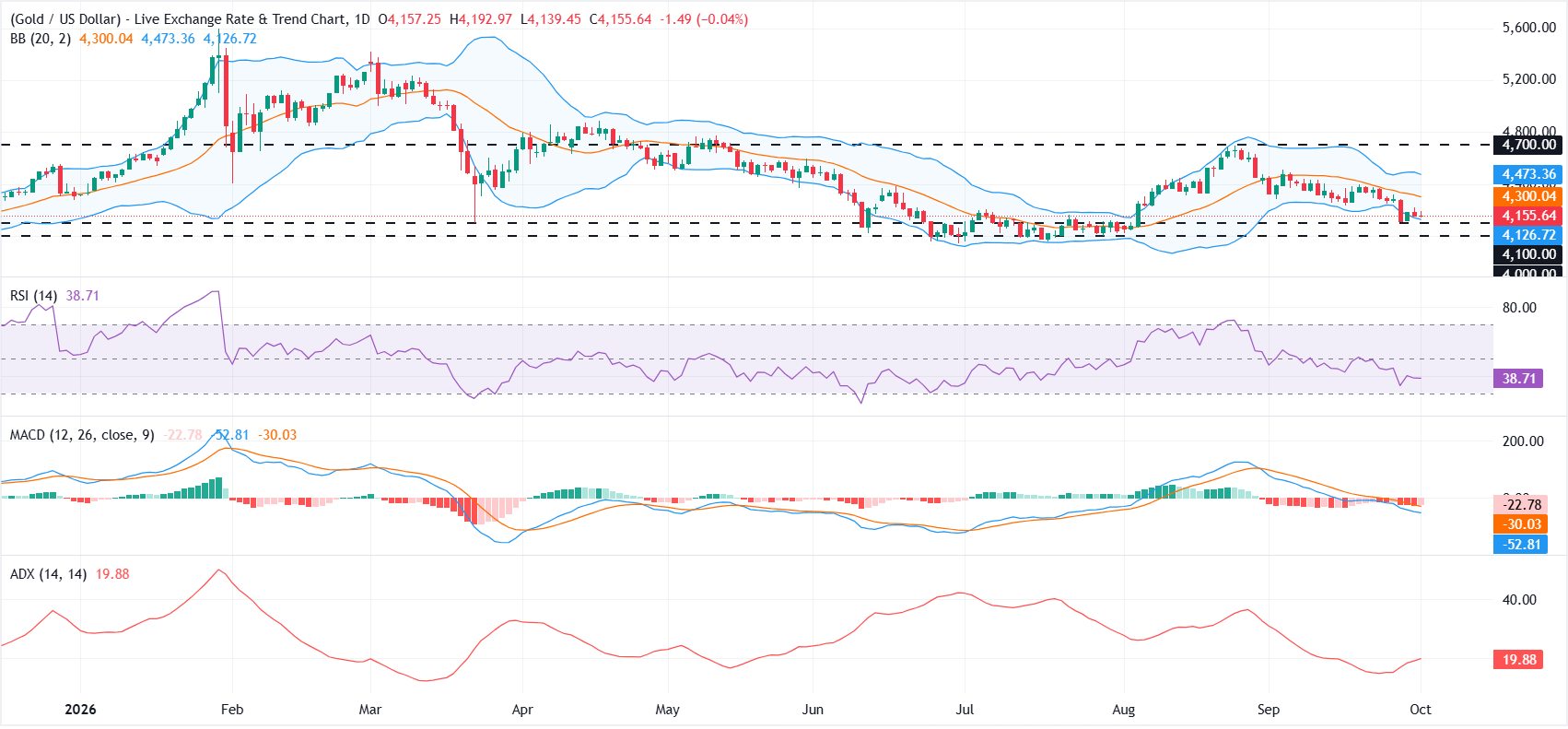
On the daily chart, XAU/USD maintains a bearish near-term bias as it sits below the 20-day Bollinger Simple Moving Average (SMA) at $4,301. The metal is also capped well beneath the upper Bollinger band at $4,471, keeping rallies contained, while the Relative Strength Index (RSI) is around 40 and a negative Moving Average Convergence Divergence (MACD) reading both hint at limited bullish momentum and a corrective tone within a weakening trend, as suggested by the Average Directional Index (ADX) near 19.
On the downside, immediate support emerges at the lower Bollinger band near $4,131, ahead of the horizontal floor at $4,100, with a deeper bearish extension exposing the $4,000 level. On the topside, recovery attempts would first face resistance at the 20-day Bollinger SMA at $4,301, followed by the upper band at $4,471, while a stronger bullish reversal would only take shape on a sustained break above the structural barrier at $4,700.



Comments
Log in or sign up to join the conversation.