

Gold (XAU/USD) recovers slightly from the $4,300 neighborhood heading into the European session on Friday, though it remains in negative territory for the second straight day. Moreover, a mixed fundamental backdrop warrants some caution before positioning for an extension of the retracement slide from $4,450, or the highest since June 5, set the previous day.
Data released on Thursday showed that the US Producer Price Index (PPI) was unchanged in July, falling short of expectations for a 0.2% rise. Adding to this, the yearly rate decelerated from 5.5% in June to 4.7%, also coming in below the 4.9% estimate. This, along with the US Consumer Price Index (CPI) released on Wednesday, points to a slowdown in overall inflation and gives the US Federal Reserve (Fed) room to keep interest rates unchanged, which keeps US Dollar (USD) bulls on the defensive and offers some support to the non-yielding bullion.
Economists at DBS Group Research highlight that the latest US inflation print did little to shift the broader Dollar narrative, with "US CPI inflation came in very much in line with market expectations, not strong enough or weak enough to break the DXY Index out of its lower 99.4-100.1 range set after USD/JPY’s sell-off from the joint US-Japan interventions." According to DBS, the softer data backdrop has also fed directly into the policy outlook, as "the markets reduced the probability of a September Fed hike to 40% overnight from 72% at the end of July, driven by last Friday's negative nonfarm payrolls and slower CPI inflation readings."
Adding to this, comments from influential FOMC members forced traders to scale back expectations for an immediate policy tightening. Chicago Fed President Austan Goolsbee pointed out that recent price spikes are largely driven by temporary tariff and energy factors, favoring patience rather than aggressive monetary tightening. However, Cleveland Fed President Beth Hammack argued that progress on inflation is still insufficient, asserting that further interest rate increases may be needed to secure price stability.
Nevertheless, Fed funds futures indicate just over a 65% probability of a rate hike by year-end, down from nearly 85% a week earlier, though geopolitical uncertainties could support the safe-haven buck. Treasury Secretary Scott Bessent said that the US is going to apply measures that have never been seen on Iran. Meanwhile, a senior IRGC adviser Mohammad Reza Naqdi said that Tehran's strategy is to make any conflict so costly that future US administrations think twice before taking military action against Iran.
This comes on top of rising tensions over the Strait of Hormuz, which keeps the war-risk premium in play and supports the USD. President Donald Trump again claimed that the US has "total control" over the strategic waterway, while Iran pledged to keep the strait closed until all its demands are met. Moreover, the Iran-backed Houthis in Yemen escalated attacks on vessels in the Red Sea and Bab el-Mandeb Strait, and also claimed a drone strike on a Saudi Aramco refinery. This raises the risk of a broader regional conflict and favors USD bulls.
The aforementioned mixed fundamental backdrop, in turn, warrants some caution before placing aggressive directional bets on the Gold price. Nevertheless, the XAU/USD pair, for now, seems to have stalled the monthly upswing from the vicinity of the $4,000 psychological mark, though the downside potential seems limited. Traders now look forward to the US macro data – monthly Retail Sales and the Preliminary University of Michigan Consumer Sentiment Index for some impetus later during the North American session.
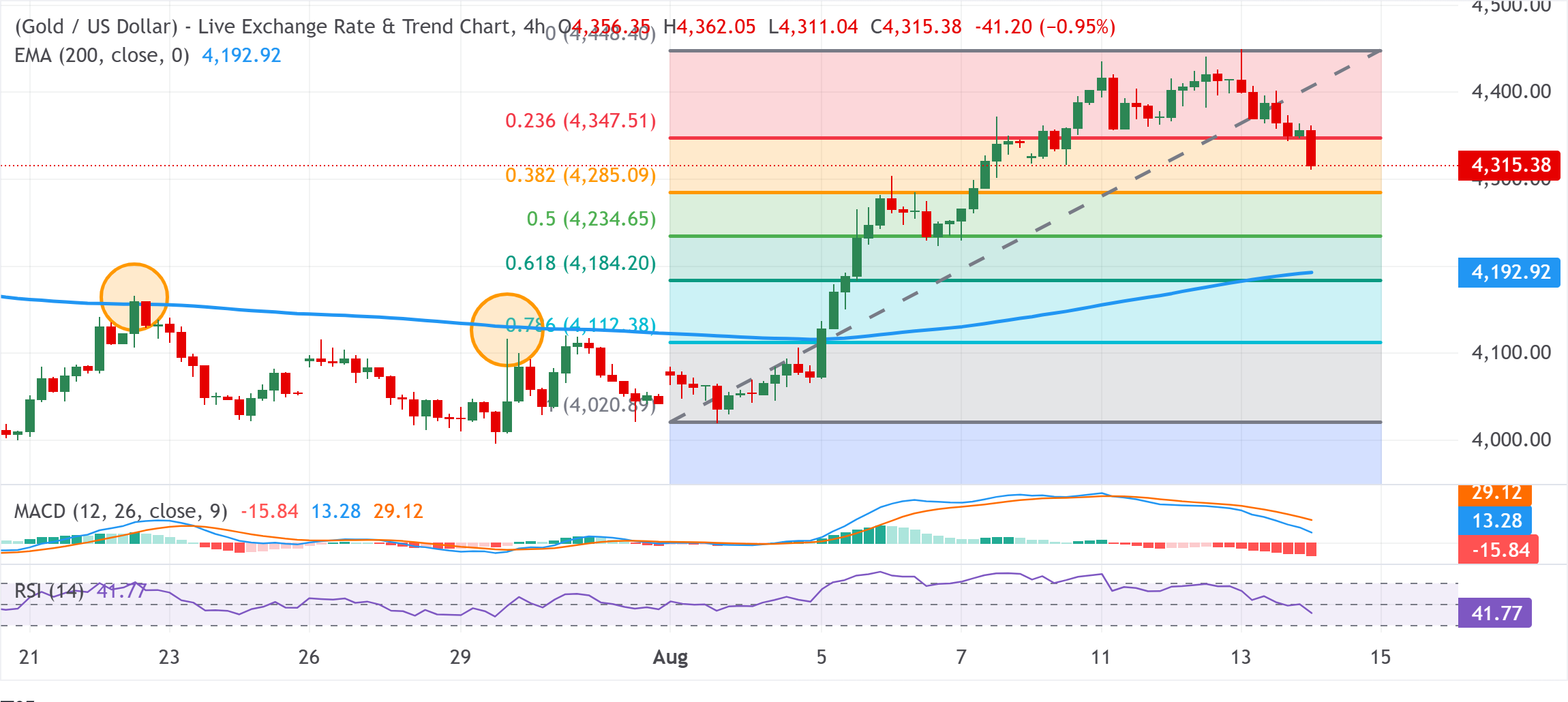
XAU/USD 4-hour chart
Technical Analysis
The precious metal holds above the 200-period Exponential Moving Average (EMA) on the 4-hour chart, and a dense cluster of Fibonacci supports, suggesting the broader uptrend is still intact despite the latest pullback. However, momentum has softened, with the Moving Average Convergence Divergence (MACD) below zero and its signal line, and the Relative Strength Index near 42, hinting that upside impulses are waning.
Meanwhile, immediate support appears at the 38.2% Fibonacci retracement of the latest leg up from the August swing low, at $4,285. This is followed by deeper structural floors at the 50.0% retracement near $4,234 and the 61.8% level at $4,184, with the 200-period EMA reinforcing demand slightly below. On the topside, initial resistance is seen at the 23.6% retracement at $4,347, ahead of the cycle high anchor around $4,448.40, where a sustained break would reopen the path toward additional gains.
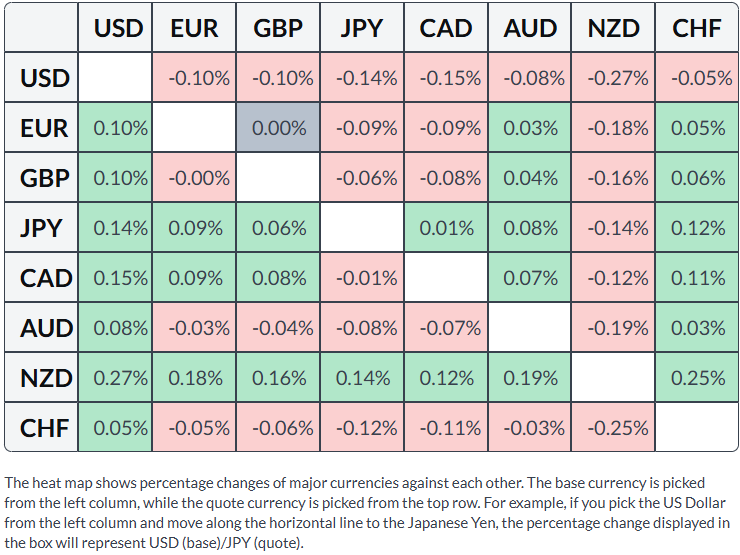
US Dollar Price Today
The table below shows the percentage change of US Dollar (USD) against listed major currencies today. US Dollar was the strongest against the Swiss Franc.



Comments
Log in or sign up to join the conversation.