

Gold loses ground as the US Dollar extends its gains following last week’s Fed rate hike.
Lower Oil prices offer little relief as inflation concerns keep US Treasury yields elevated.
XAU/USD tests the lower Bollinger Band near $4,305, with $4,350 as initial resistance.

Gold (XAU/USD) trades on the back foot on Wednesday as expectations of further Federal Reserve (Fed) interest rate hikes lift the US Dollar (USD) and weigh on the non-yielding metal. At the time of writing, XAU/USD trades around $4,281 during American trading hours, down 1.75% on the day.
The US Dollar extends its gains following the preliminary S&P Global Purchasing Managers' Index (PMI) release, climbing to a fresh two-month high. The US Dollar Index (DXY), which tracks the Greenback against a basket of six major currencies, trades around 101.00, up 0.40% on the day.
The Composite PMI rose to 58.4 from 56.0 in August. Manufacturing PMI climbed to 57.0, beating the 53.5 forecast, while Services PMI rose to 58.7 against expectations of 56.0. The stronger readings gave the US Dollar another lift and pushed Gold lower.
The data reinforces expectations that the Fed can afford to raise rates again. The central bank lifted the federal funds rate by 25 basis points (bps) last week to a range of 3.75%-4.00%. Its updated projections pointed to one more hike this year. Richmond Fed President Thomas Barkin struck a hawkish tone on Tuesday, saying that “economic conditions are, if anything, firming” and warning that passing shocks from tariffs and energy are not fading. Barkin added that high inflation today risks affecting future inflation. The CME FedWatch Tool puts the chance of an October hike at around 53%.
On the Middle East front, US President Donald Trump told reporters at the United Nations General Assembly in New York on Tuesday that US officials had a very good, three-hour meeting with Iranian representatives. A senior Iranian official told Reuters on Wednesday that reopening the Strait of Hormuz and lifting the US blockade were discussed, adding that “many differences remain between the Iranian and US positions, but diplomacy continues.”
West Texas Intermediate (WTI) Oil has snapped a five-day losing streak but remains near a more than two-week low around $92. Oil prices are well above pre-war levels, and the renewed diplomatic efforts have yet to produce a meaningful breakthrough. That keeps inflation concerns in play and US Treasury yields elevated. The US Treasury plans to buy back up to $6 billion of longer-dated debt on Thursday, above the $4 billion minimum it had previously announced for such operations.
The rate-sensitive 2-year yield stands around 4.88%, near levels last seen in 2024, while the 10-year yield climbs to around 5.08%, its highest level since 2007.
The combination of a strong US Dollar, rising Treasury yields and expectations of higher borrowing costs leaves Gold vulnerable to further losses.
Technical analysis: XAU/USD slips below lower Bollinger Band
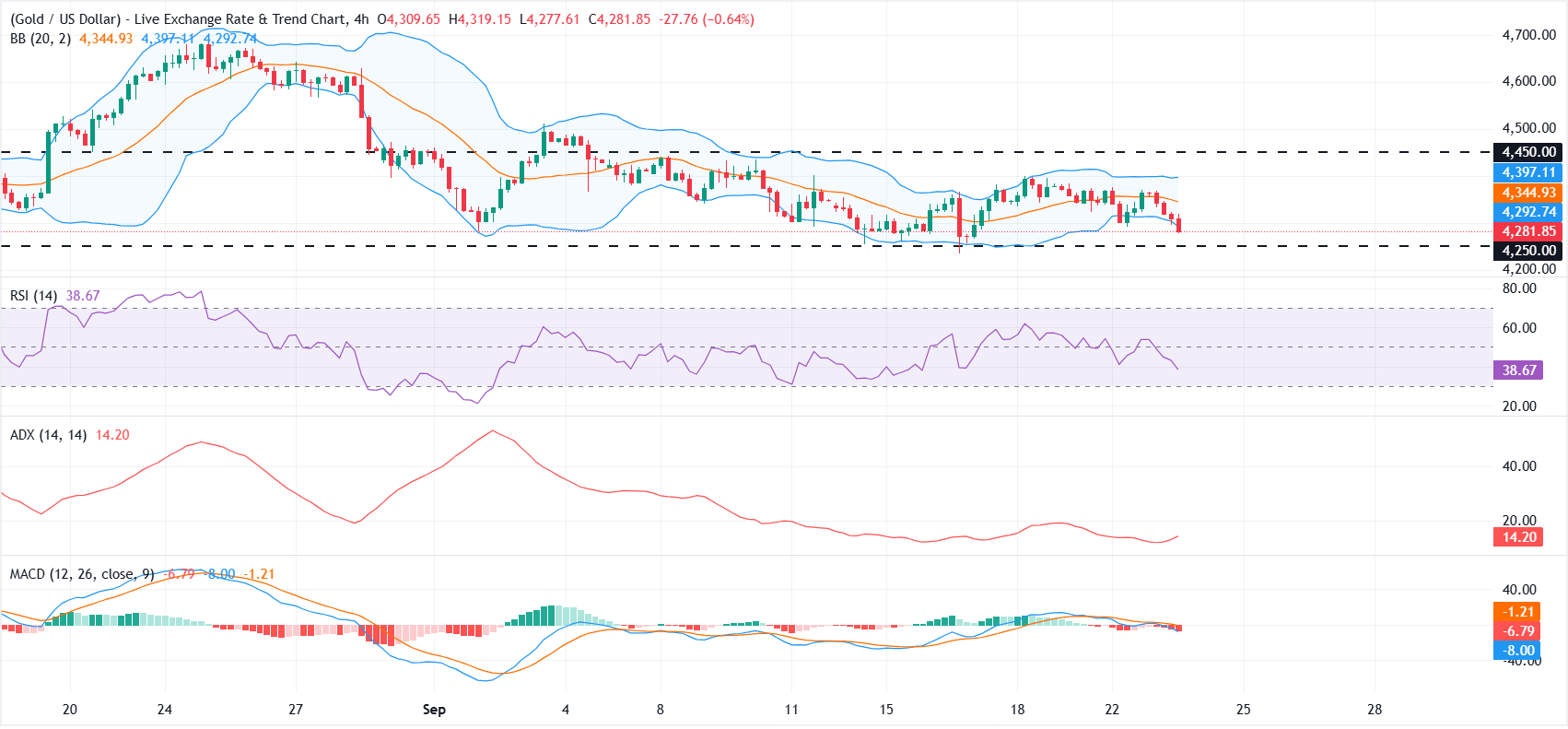
On the 4-hour chart, XAU/US retaining a bearish near-term bias as price holds beneath the 20-period simple moving average (SMA) Bollinger middle band at $4,344 and the lower band at $4,292. The Relative Strength Index (RSI) at 38 drifts toward oversold territory, while the Moving Average Convergence Divergence (MACD) indicator extends deeper into negative territory, together suggesting persistent downside pressure rather than an imminent recovery, with the weak Average Directional Index (ADX) at 14 hinting at a fragile trend rather than a strong directional move.
On the topside, initial resistance appears at the Bollinger lower band near $4,292, followed by the Bollinger 20-period SMA at $4,344, with the upper band at $4,397 acting as a higher barrier before the more distant horizontal resistance at $4,450.
On the downside, immediate support is seen at the horizontal level of $4,250, ahead of a deeper structural floor near $4,150, and as long as price holds below the Bollinger middle band cluster, rallies are likely to remain corrective within a broader bearish context.



Comments
Log in or sign up to join the conversation.