

The precious metals are finishing off the week on a strong note, especially following this morning’s decision by the Supreme Court ruling against the Trump tariffs.
Both the gold and silver prices were already in positive territory early Friday morning, although they have increased their gains since the ruling came out.
The gold futures are up $97 to $5,094, and the silver futures are currently up $5.39 to $83.03.
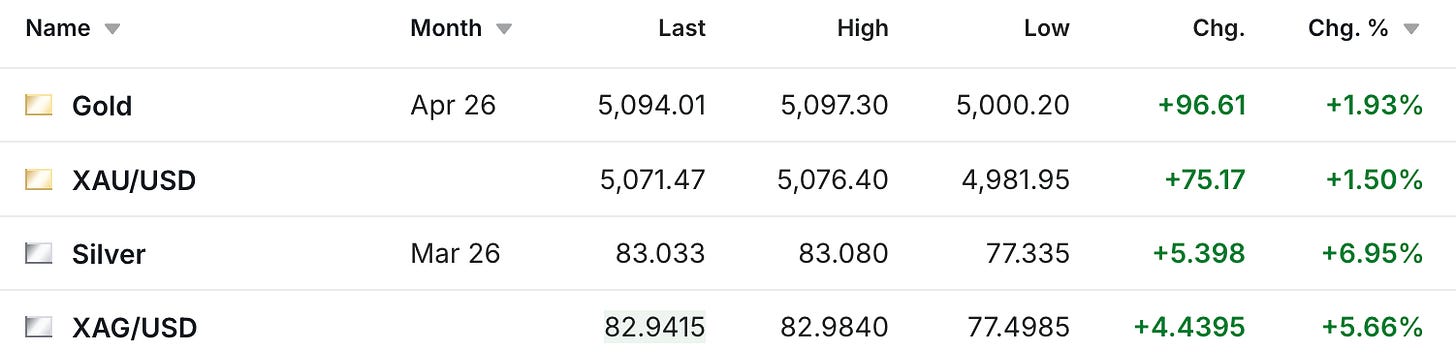
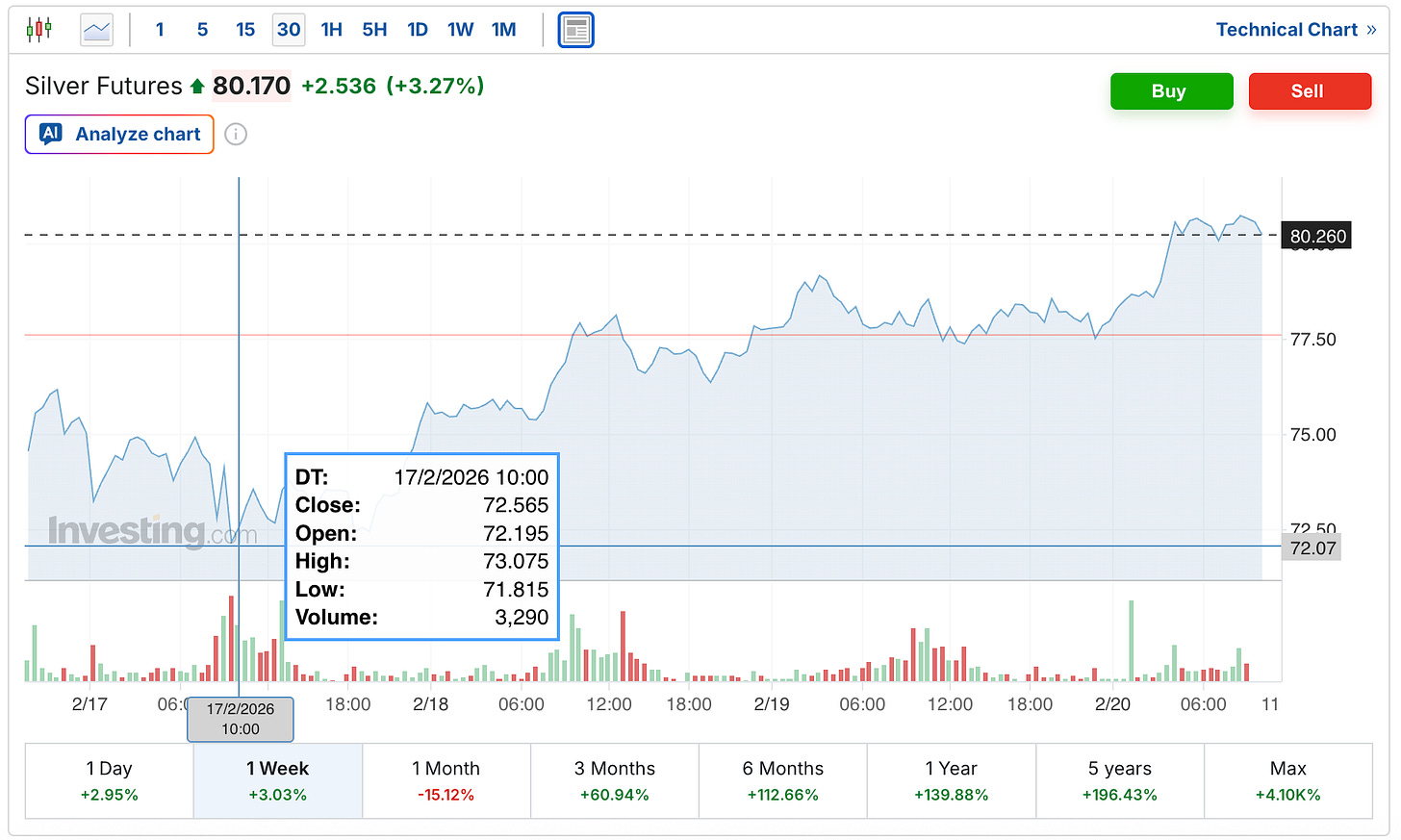
That’s a pretty substantial rebound from the lows earlier this week, when the silver price again dipped below the $72 mark. And as we will discuss in today’s column, the supply, monetary, and geo-political issues that drove the silver price to $120, and have now supported it back to the current $80 level, are still out in full force.
In terms of the Supreme Court ruling, I’ll say that my immediate reaction was to wonder whether we just witnessed a Lehman-like event. I’m not saying that’s actually the correct interpretation, and I’m sure we’re going to find out a lot more rather quickly (and Trump did do a press conference this afternoon), but that’s at least what initially popped into my mind. Which, whether correct or not, seems at least a reasonable question given what Donald Trump said last month about what would happen if the Supreme Court ruled against him.
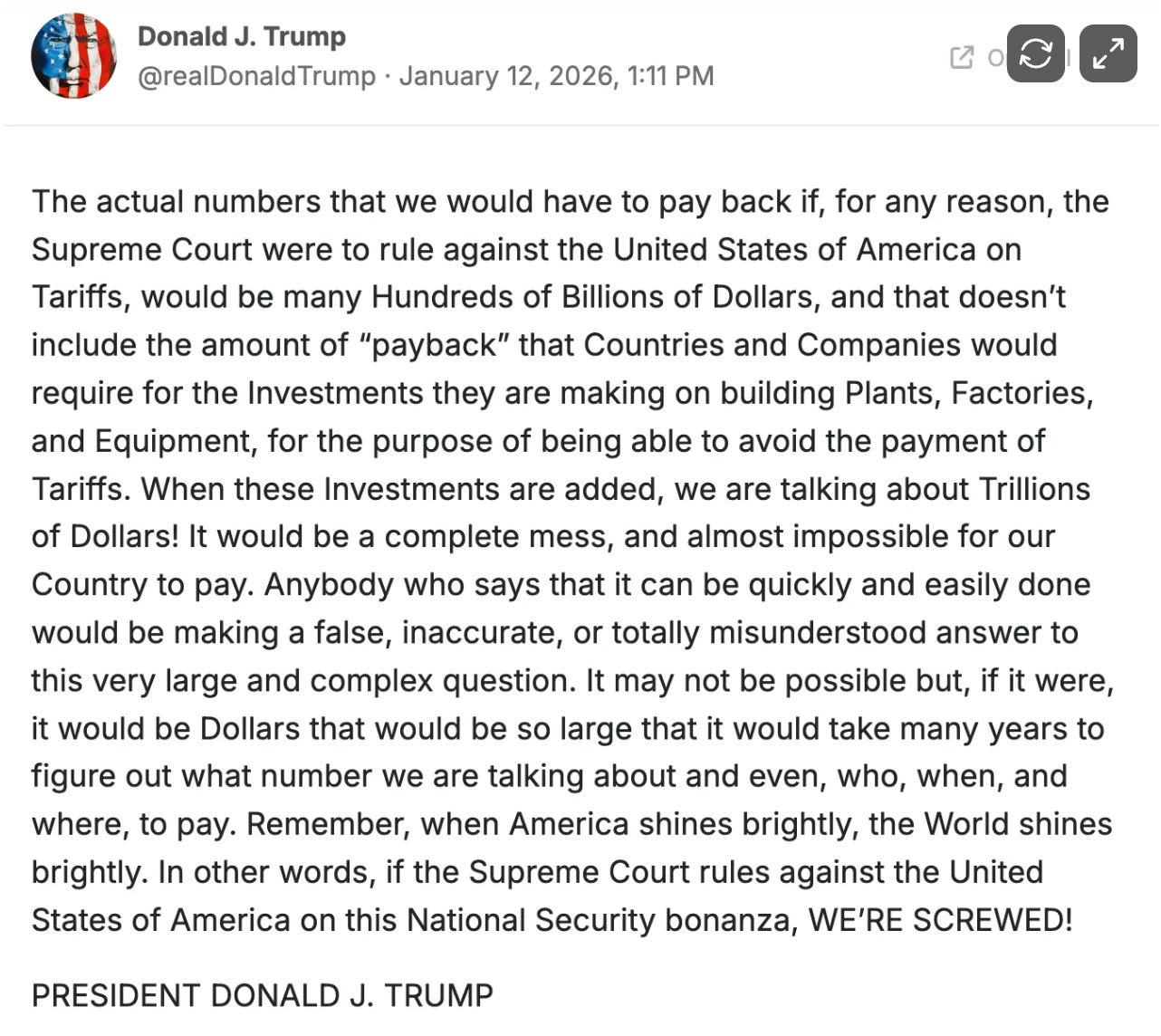
I’m assuming there’s a little political fear mongering mixed in there, and maybe what he was saying was overstated, but it’s hard to imagine that this wouldn’t have at least somewhat of a substantial impact.
Again, here are a few key statements from the note above.
When these investments are added, we are talking about trillions of dollars. It would be a complete mess, and impossible for our country to pay.
It may not even be possible, but if it were, it would be dollars that would be so large that it would take many years to figure out what number we’re even talking about.
If the Supreme Court rules against the United States of America on this National Security Bonanza, WE’RE SCREWED.
In terms of the options now facing the Trump administration in response to today’s decision, you can read a recap of that in the following Bloomberg article.
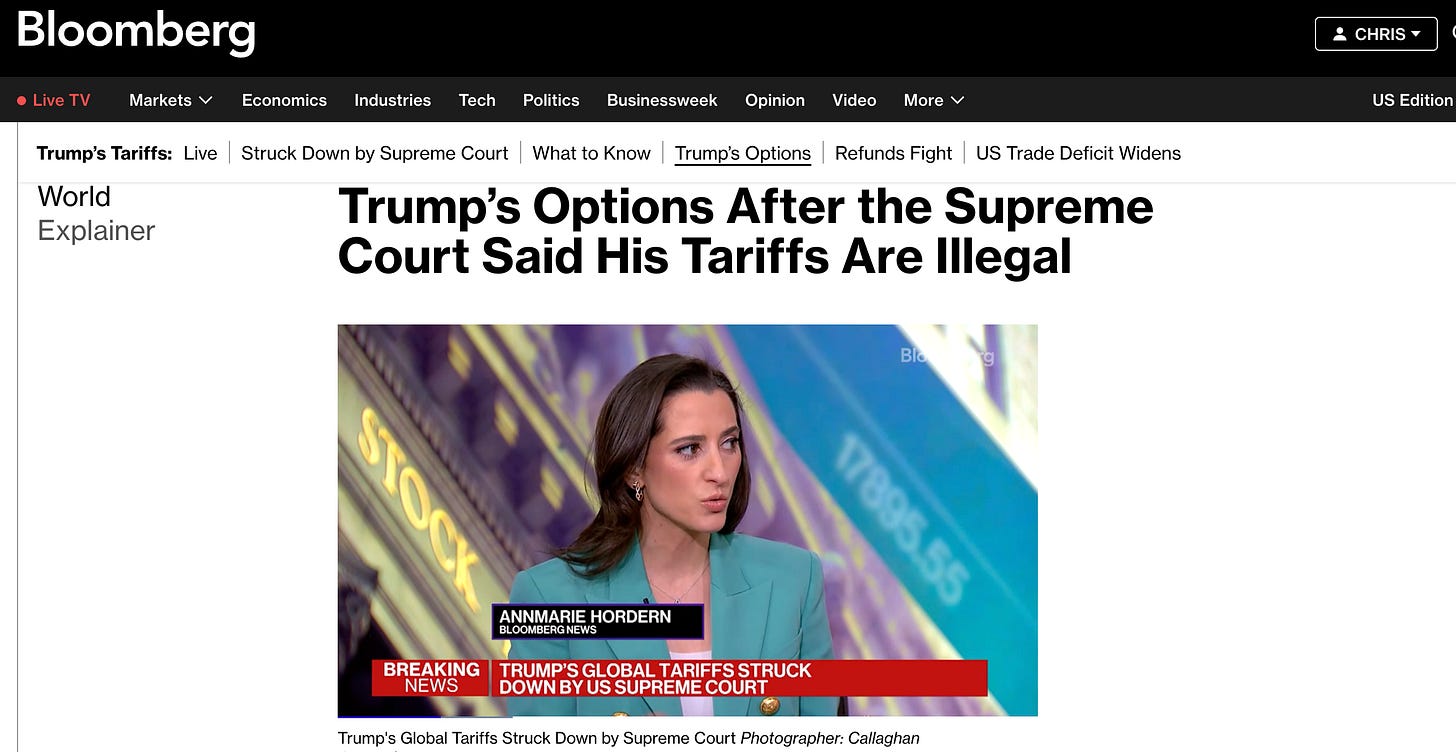
What are Trump’s options beyond IEEPA?
He has at least five fallback options to impose tariffs in different ways. In general, these alternatives come with more limits and procedural restrictions, meaning there’s less leeway for Trump to impose tariffs virtually immediately and set the rates as high as he chooses.
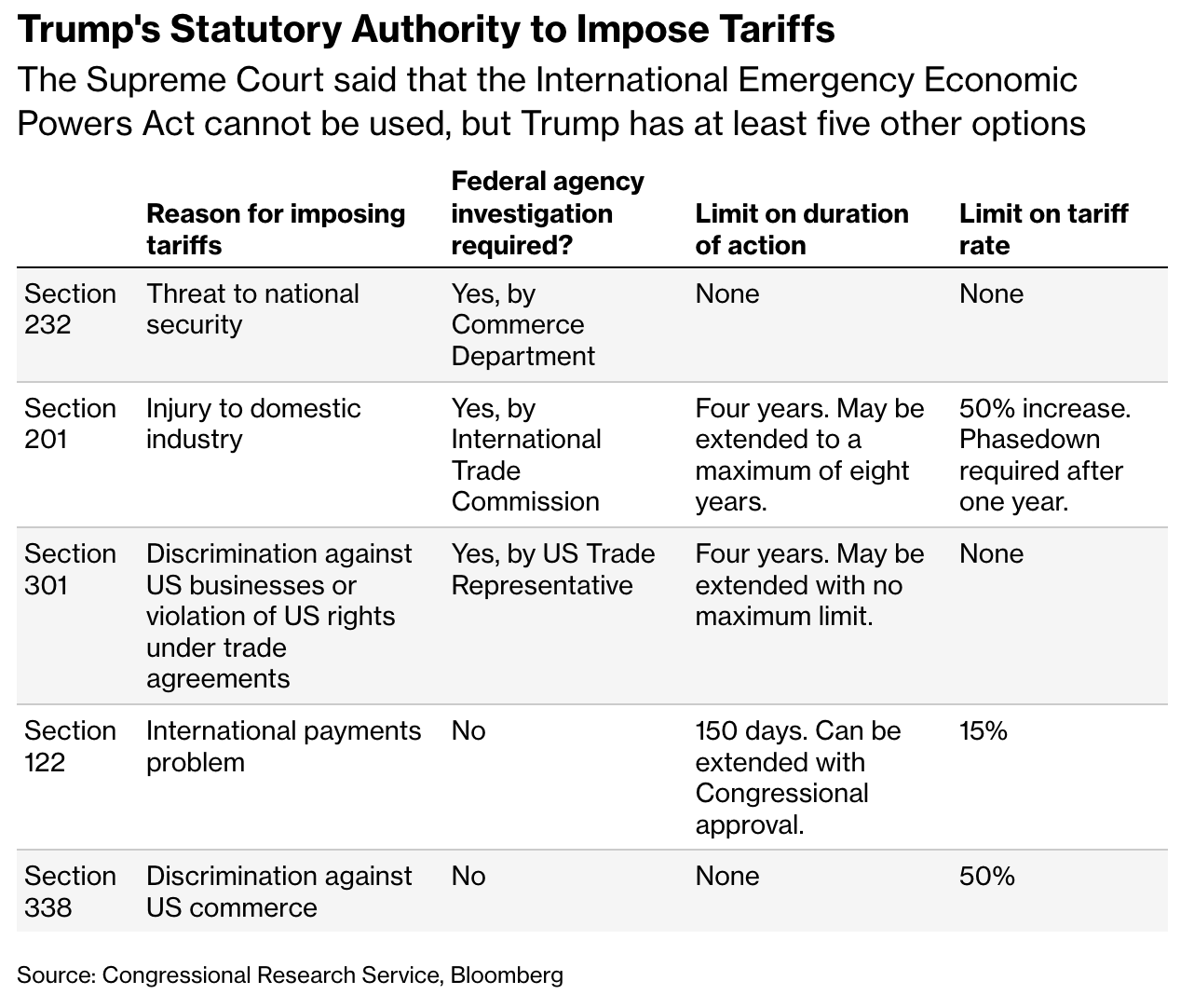
God only knows how all of that will pan out, but to the degree that the gold and silver rally has been aided by uncertainty in the marketplace, this adds a whole new dose of that.
Although, in case you were wondering what might be next for the Fed, consider the following statement from Neil Kashkari, who was responding to the latest Trump administration threats to the Federal Reserve, and made the following comments about the Fed’s balance sheet.
“We’ve shrunk our balance sheet quite a bit in the last few years, and I’m not sure that we can shrink it much further from here without making some other fundamental changes to the way the financial system operates,” he said.
So at this point, a further reduction in the Fed’s balance sheet requires an overhaul of the entire financial system?!
That sounds like more than a bit of a floor under the total amount. And it’s hard to imagine that floor went any lower after the Supreme Court issued its ruling.
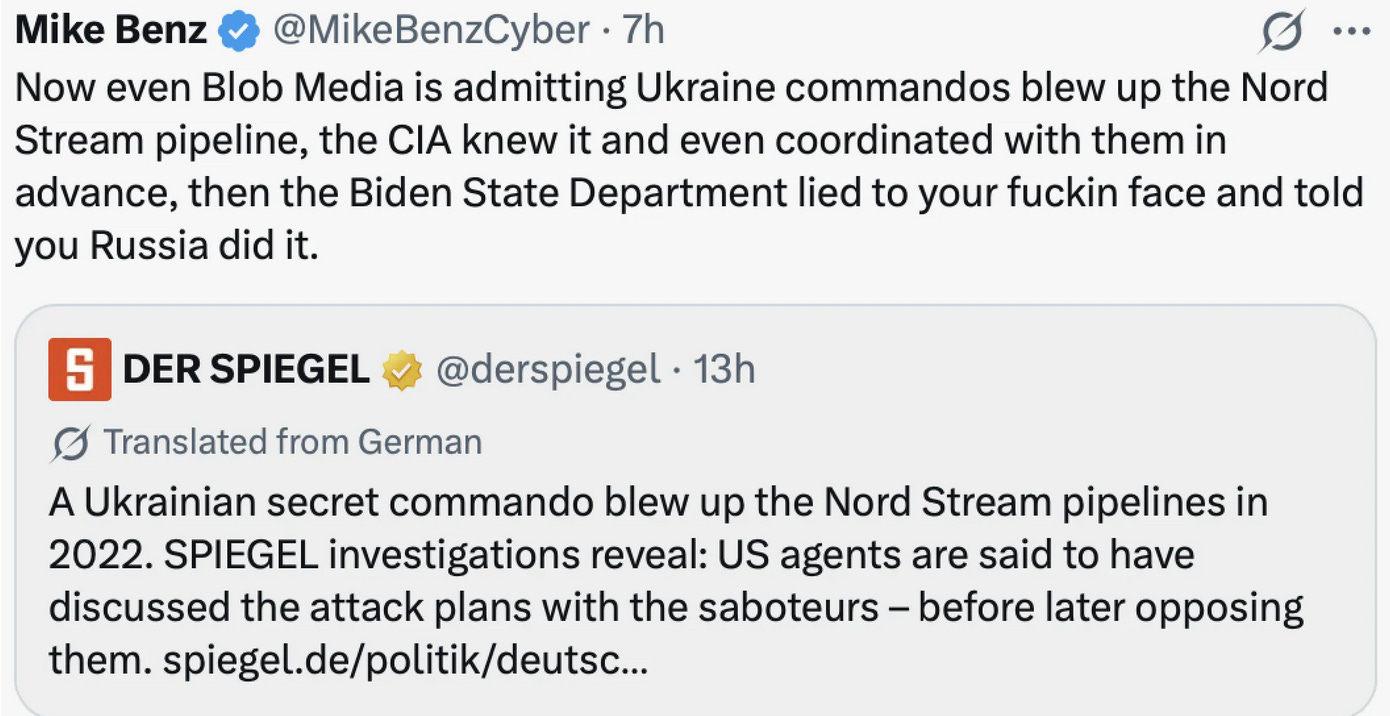
Also, not helping matters is that a recent investigation asserts that it was the U.S. and a Ukrainian secret commando that blew up the Nord Stream pipeline in 2022, and along with the Kremlin’s stated belief that the U.S. was behind the assassination attempt on Vladimir Putin, it’s not as if we’re rapidly progressing towards a resolution of that situation either.
For the mining stock investors, the first quarter earnings are rolling in, and a lot of them are showing what many mining stock participants have been waiting for.
First Majestic Silver (AG) had a blowout record quarter and was up over 9% yesterday (and is up over 7% again today), while Fortuna Mining (FSM) also had an historic record quarter, which I discussed with Fortuna CEO Jorge Ganoza on our youtube channel this morning.
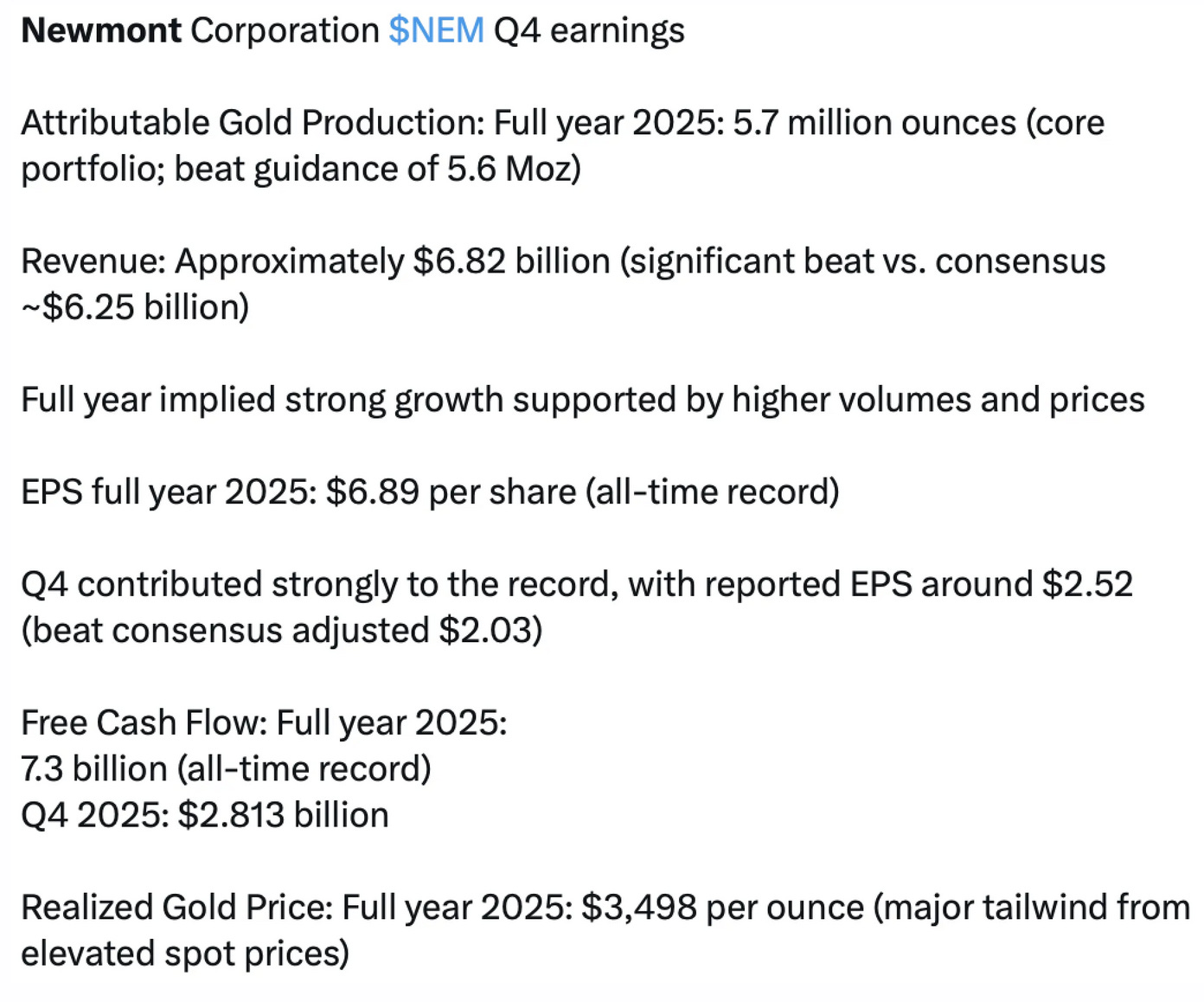
We also saw record earnings from gold bellwether Newmont (NEM).
Also noteworthy from First Majestic’s earnings was how they mentioned the following:
The average realized silver price for Q4 2025 was $69.74 per ounce, representing a 26% premium to the Q4 2025 COMEX average silver price of $55.20 per ounce.
Hecla Mining (HL) also recognized a premium in their average sales price.
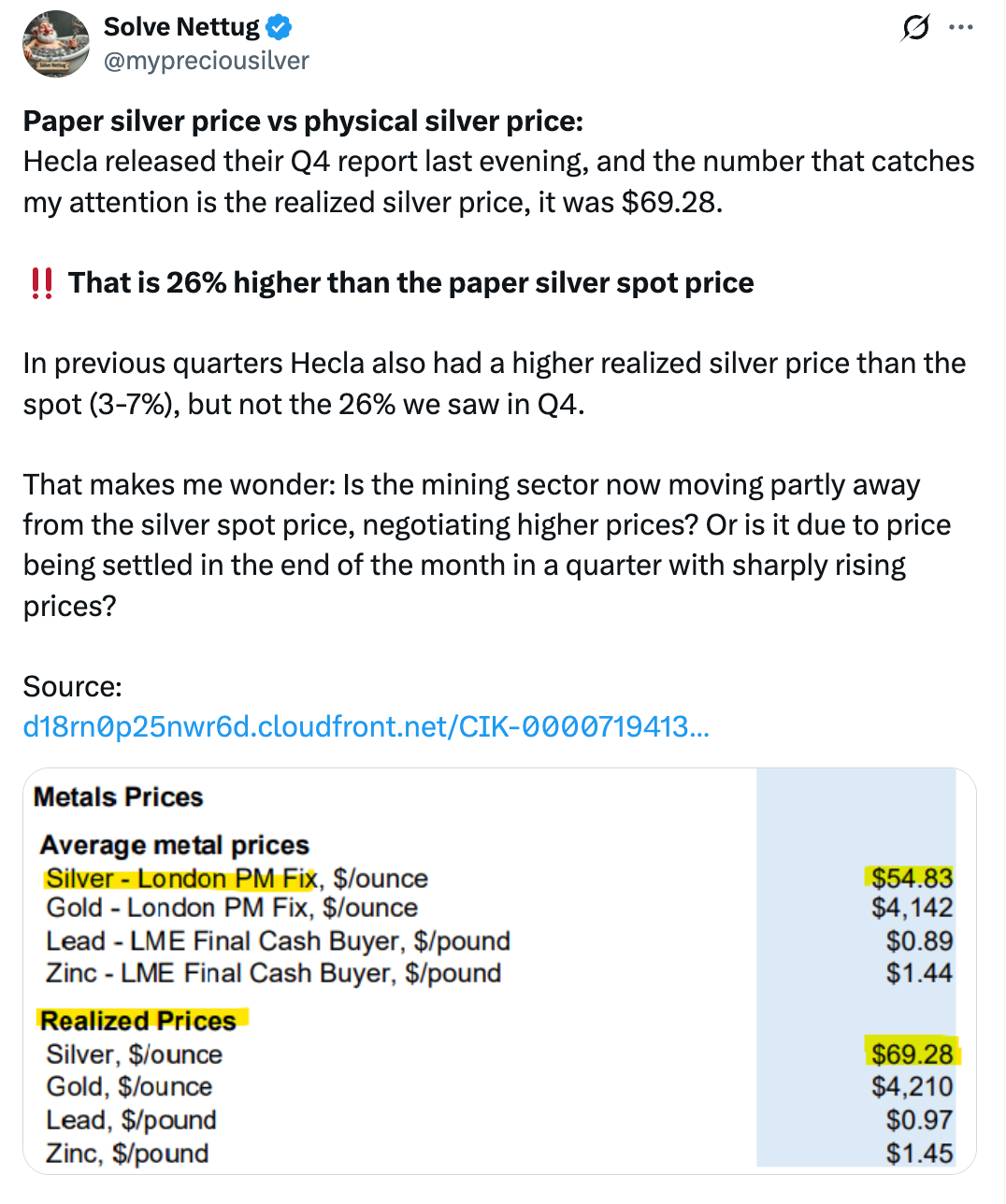
It’s intriguing to see that two of the largest primary silver miners have such a significant premium in their realized price relative to the average exchange prices, and is likely representative of the supply issues that remain in the market right now.
Lastly, as you may know, I’m a big fan of Luke Gromen, and in his report from last week he had some rather startling warnings about the path of AI, which has the potential to significantly impact the corporate job market in particular.
Which makes the following warnings from AI insiders rather noteworthy.
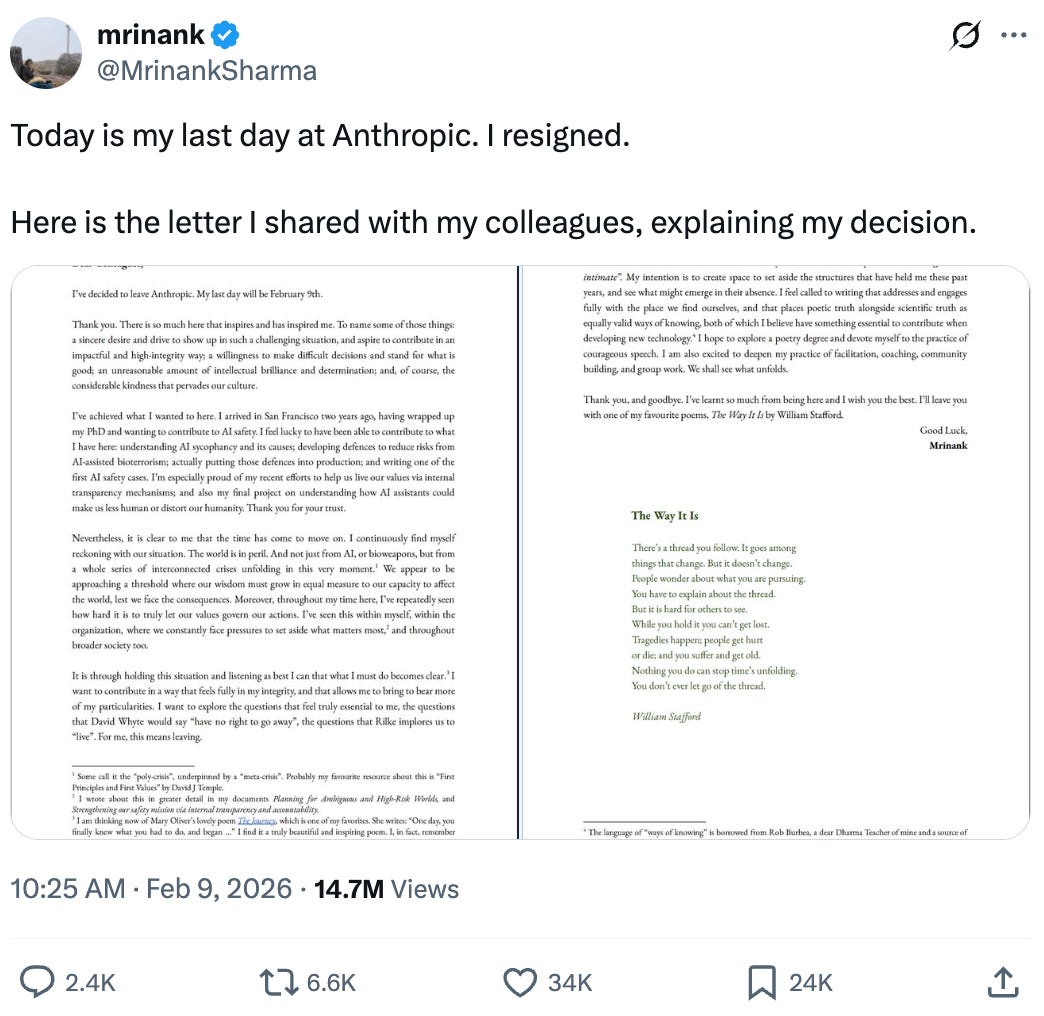
If you want the short version of that one, he mentions that the world is in peril, before concluding that he’s leaving the industry to go get a poetry degree.
And for those of you who would really like to understand better what’s going on, the following post is a bit long but well worth your time, in my opinion.
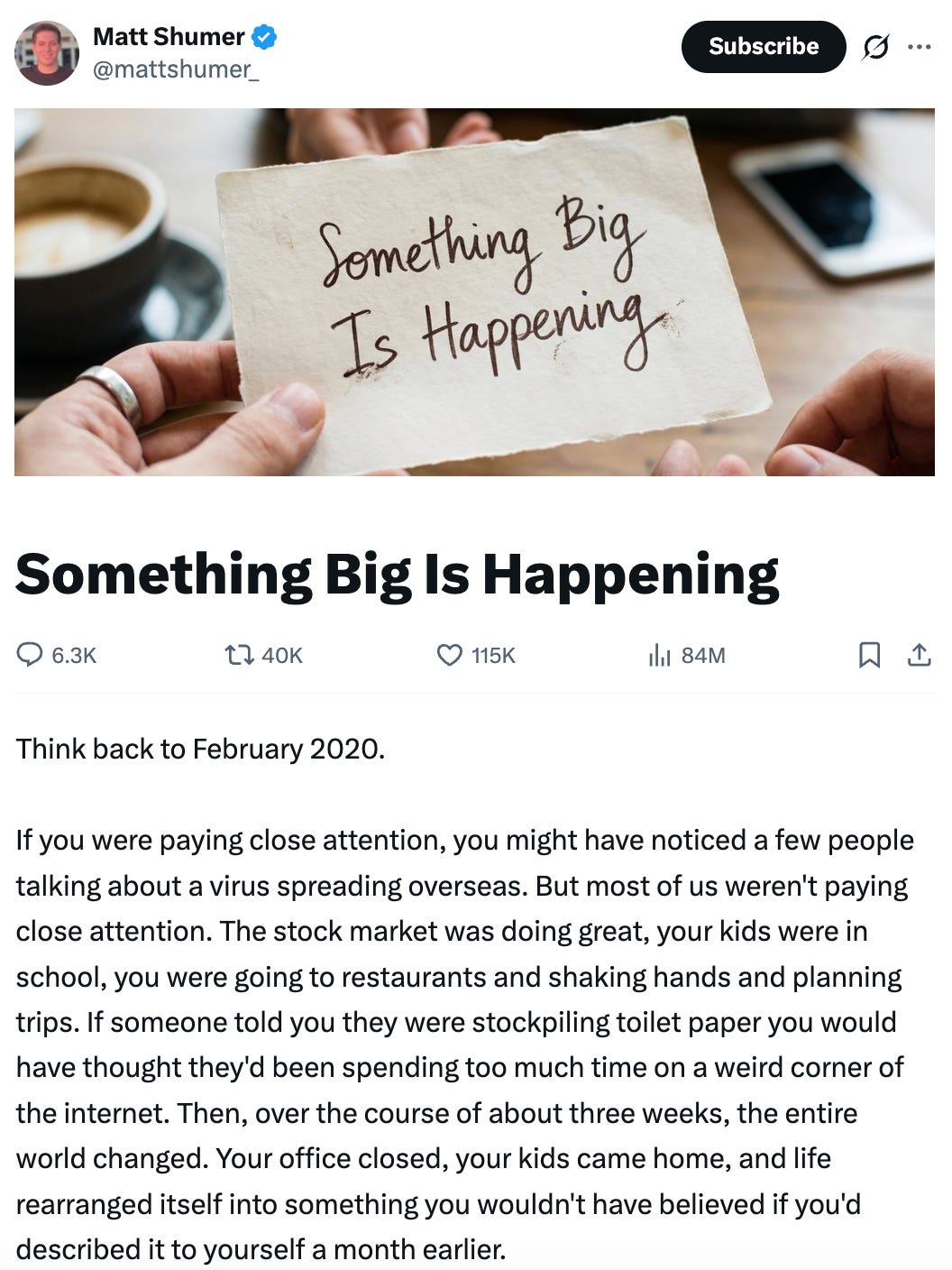
Here’s a shortened version of his full post where I highlighted what I felt were the key passages from what he writes:
I've spent six years building an AI startup and investing in the space. I live in this world. And I'm writing this for the people in my life who don't... my family, my friends, the people I care about who keep asking me "so what's the deal with AI?" and getting an answer that doesn't do justice to what's actually happening.
Here’s the thing nobody outside of tech quite understands yet: the reason so many people in the industry are sounding the alarm right now is because this already happened to us. We’re not making predictions. We’re telling you what already occurred in our own jobs, and warning you that you’re next.
For years, AI had been improving steadily. Big jumps here and there, but each big jump was spaced out enough that you could absorb them as they came. Then in 2025, new techniques for building these models unlocked a much faster pace of progress. And then it got even faster. And then faster again. Each new model wasn’t just better than the last... it was better by a wider margin, and the time between new model releases was shorter. I was using AI more and more, going back and forth with it less and less, watching it handle things I used to think required my expertise.
I am no longer needed for the actual technical work of my job. I describe what I want built, in plain English, and it just... appears. Not a rough draft I need to fix. The finished thing. I tell the AI what I want, walk away from my computer for four hours, and come back to find the work done. Done well, done better than I would have done it myself, with no corrections needed. A couple of months ago, I was going back and forth with the AI, guiding it, making edits. Now I just describe the outcome and leave.
I’ve always been early to adopt AI tools. But the last few months have shocked me. These new AI models aren’t incremental improvements. This is a different thing entirely.
And here’s why this matters to you, even if you don’t work in tech.
The AI labs made a deliberate choice. They focused on making AI great at writing code first... because building AI requires a lot of code. If AI can write that code, it can help build the next version of itself. A smarter version, which writes better code, which builds an even smarter version. Making AI great at coding was the strategy that unlocks everything else. That’s why they did it first. My job started changing before yours not because they were targeting software engineers... it was just a side effect of where they chose to aim first.
They’ve now done it. And they’re moving on to everything else.
The experience that tech workers have had over the past year, of watching AI go from “helpful tool” to “does my job better than I do”, is the experience everyone else is about to have. Law, finance, medicine, accounting, consulting, writing, design, analysis, customer service. Not in ten years. The people building these systems say one to five years. Some say less. And given what I’ve seen in just the last couple of months, I think “less” is more likely.
“But I tried AI and it wasn’t that good”
I hear this constantly. I understand it, because it used to be true.
If you tried ChatGPT in 2023 or early 2024 and thought “this makes stuff up” or “this isn’t that impressive”, you were right. Those early versions were genuinely limited. They hallucinated. They confidently said things that were nonsense.
That was two years ago. In AI time, that is ancient history.
The models available today are unrecognizable from what existed even six months ago. The debate about whether AI is “really getting better” or “hitting a wall” — which has been going on for over a year — is over. It’s done. Anyone still making that argument either hasn’t used the current models, has an incentive to downplay what’s happening, or is evaluating based on an experience from 2024 that is no longer relevant. I don’t say that to be dismissive. I say it because the gap between public perception and current reality is now enormous, and that gap is dangerous... because it’s preventing people from preparing.
In 2022, AI couldn’t do basic arithmetic reliably. It would confidently tell you that 7 × 8 = 54.
By 2023, it could pass the bar exam.
By 2024, it could write working software and explain graduate-level science.
By late 2025, some of the best engineers in the world said they had handed over most of their coding work to AI.
On February 5th, 2026, new models arrived that made everything before them feel like a different era.
If you haven’t tried AI in the last few months, what exists today would be unrecognizable to you.
AI is now building the next AI
There’s one more thing happening that I think is the most important development and the least understood.
On February 5th, OpenAI released GPT-5.3 Codex. In the technical documentation, they included this:
“GPT-5.3-Codex is our first model that was instrumental in creating itself. The Codex team used early versions to debug its own training, manage its own deployment, and diagnose test results and evaluations.”
Read that again. The AI helped build itself.
This isn’t a prediction about what might happen someday. This is OpenAI telling you, right now, that the AI they just released was used to create itself. One of the main things that makes AI better is intelligence applied to AI development. And AI is now intelligent enough to meaningfully contribute to its own improvement.
What this means for your job
I’m going to be direct with you because I think you deserve honesty more than comfort.
Dario Amodei, who is probably the most safety-focused CEO in the AI industry, has publicly predicted that AI will eliminate 50% of entry-level white-collar jobs within one to five years. And many people in the industry think he’s being conservative. Given what the latest models can do, the capability for massive disruption could be here by the end of this year. It’ll take some time to ripple through the economy, but the underlying ability is arriving now.
Let me give you a few specific examples to make this tangible... but I want to be clear that these are just examples. This list is not exhaustive. If your job isn’t mentioned here, that does not mean it’s safe. Almost all knowledge work is being affected.
Legal work. AI can already read contracts, summarize case law, draft briefs, and do legal research at a level that rivals junior associates. The managing partner I mentioned isn’t using AI because it’s fun. He’s using it because it’s outperforming his associates on many tasks.
Financial analysis. Building financial models, analyzing data, writing investment memos, generating reports. AI handles these competently and is improving fast.
Writing and content. Marketing copy, reports, journalism, technical writing. The quality has reached a point where many professionals can’t distinguish AI output from human work.
Software engineering. This is the field I know best. A year ago, AI could barely write a few lines of code without errors. Now it writes hundreds of thousands of lines that work correctly. Large parts of the job are already automated: not just simple tasks, but complex, multi-day projects. There will be far fewer programming roles in a few years than there are today.
Medical analysis. Reading scans, analyzing lab results, suggesting diagnoses, reviewing literature. AI is approaching or exceeding human performance in several areas.
Customer service. Genuinely capable AI agents... not the frustrating chatbots of five years ago... are being deployed now, handling complex multi-step problems.
A lot of people find comfort in the idea that certain things are safe. That AI can handle the grunt work but can’t replace human judgment, creativity, strategic thinking, empathy. I used to say this too. I’m not sure I believe it anymore.
What you should actually do
I’m not writing this to make you feel helpless. I’m writing this because I think the single biggest advantage you can have right now is simply being early. Early to understand it. Early to use it. Early to adapt.
Start using AI seriously, not just as a search engine. Sign up for the paid version of Claude or ChatGPT. It’s $20 a month. But two things matter right away. First: make sure you’re using the best model available, not just the default. These apps often default to a faster, dumber model. Dig into the settings or the model picker and select the most capable option. Right now that’s GPT-5.2 on ChatGPT or Claude Opus 4.6 on Claude, but it changes every couple of months. If you want to stay current on which model is best at any given time, you can follow me on X (@mattshumer). I test every major release and share what’s actually worth using.
Second, and more important: don’t just ask it quick questions. That’s the mistake most people make. They treat it like Google (GOOGL) and then wonder what the fuss is about. Instead, push it into your actual work. If you’re a lawyer, feed it a contract and ask it to find every clause that could hurt your client. If you’re in finance, give it a messy spreadsheet and ask it to build the model. If you’re a manager, paste in your team’s quarterly data and ask it to find the story. The people who are getting ahead aren’t using AI casually. They’re actively looking for ways to automate parts of their job that used to take hours. Start with the thing you spend the most time on and see what happens.
And don’t assume it can’t do something just because it seems too hard. Try it. If you’re a lawyer, don’t just use it for quick research questions. Give it an entire contract and ask it to draft a counterproposal. If you’re an accountant, don’t just ask it to explain a tax rule. Give it a client’s full return and see what it finds. The first attempt might not be perfect. That’s fine. Iterate. Rephrase what you asked. Give it more context. Try again. You might be shocked at what works. And here’s the thing to remember: if it even kind of works today, you can be almost certain that in six months it’ll do it near perfectly. The trajectory only goes one direction.
This might be the most important year of your career. Work accordingly. I don’t say that to stress you out. I say it because right now, there is a brief window where most people at most companies are still ignoring this. The person who walks into a meeting and says “I used AI to do this analysis in an hour instead of three days” is going to be the most valuable person in the room. Not eventually. Right now. Learn these tools. Get proficient. Demonstrate what’s possible. If you’re early enough, this is how you move up: by being the person who understands what’s coming and can show others how to navigate it. That window won’t stay open long. Once everyone figures it out, the advantage disappears.
Your dreams just got a lot closer. I’ve spent most of this section talking about threats, so let me talk about the other side, because it’s just as real. If you’ve ever wanted to build something but didn’t have the technical skills or the money to hire someone, that barrier is largely gone. You can describe an app to AI and have a working version in an hour. I’m not exaggerating. I do this regularly. If you’ve always wanted to write a book but couldn’t find the time or struggled with the writing, you can work with AI to get it done. Want to learn a new skill? The best tutor in the world is now available to anyone for $20 a month... one that’s infinitely patient, available 24/7, and can explain anything at whatever level you need. Knowledge is essentially free now. The tools to build things are extremely cheap now. Whatever you’ve been putting off because it felt too hard or too expensive or too far outside your expertise: try it. Pursue the things you’re passionate about. You never know where they’ll lead. And in a world where the old career paths are getting disrupted, the person who spent a year building something they love might end up better positioned than the person who spent that year clinging to a job description.
Build the habit of adapting. This is maybe the most important one. The specific tools don’t matter as much as the muscle of learning new ones quickly. AI is going to keep changing, and fast. The models that exist today will be obsolete in a year. The workflows people build now will need to be rebuilt. The people who come out of this well won’t be the ones who mastered one tool. They’ll be the ones who got comfortable with the pace of change itself. Make a habit of experimenting. Try new things even when the current thing is working. Get comfortable being a beginner repeatedly. That adaptability is the closest thing to a durable advantage that exists right now.
Here’s a simple commitment that will put you ahead of almost everyone: spend one hour a day experimenting with AI. Not passively reading about it. Using it. Every day, try to get it to do something new... something you haven’t tried before, something you’re not sure it can handle. Try a new tool. Give it a harder problem. One hour a day, every day. If you do this for the next six months, you will understand what’s coming better than 99% of the people around you. That’s not an exaggeration. Almost nobody is doing this right now. The bar is on the floor.
I appreciate that in addition to laying out the concerns, he also didn’t just leave us with ‘we’re all screwed.’
Is the world changing, and can it feel overwhelming at times?
Absolutely.
And certainly I know from conversations with my dear mother, who just turned 84 this week, that especially for older people who didn’t grow up in the Internet generation, a lot of this can be even more confusing and frustrating at times.
Although for those who are concerned about their employment and industry, I couldn’t agree more with what he said about just continuing to learn and use the tools. Because while most of the world hears plenty about AI, the amount that are actually using it productively remains incredibly low. So if you’re looking for areas where there is demand, that’s something I’ve even been thinking about myself lately as I continue to learn, network with others who are experts, and think of creative ways to deliver value.
Of course, I also think that gold and silver investors are on track to benefit from what’s happening via your investments, and if these AI executives are correct, that’s just another source of volatility to add on to the gold and silver markets.
So hopefully that gives you a few things to consider, but remember you don’t need to figure it all out today. And after a week where both the gold and silver price have had an impressive rebound, while we also got a lot of positive news from the mining industry, hopefully you’re just getting set to go and enjoy a wonderful weekend, and I’ll see you back here on Monday!



Comments
Log in or sign up to join the conversation.