


Gold price (XAU/USD) jumps to around $4,065 during the early Asian session on Wednesday, bolstered by lower oil prices. Traders await the Federal Reserve's (Fed) policy meeting later on Wednesday for signals on the future path of US interest rates.
Crude oil prices fall for the second consecutive day as attention turns to Middle East peace talks. However, any signs of renewed tensions surrounding the US-Iran and the Houthi-Saudi Arabia conflicts could boost energy prices and raise inflation concerns. This, in turn, could create a headwind for yellow metal as it could reinforce central banks to tighten their monetary policy.
"Softer oil prices will probably provide some lift for gold because it relieves the inflation worries and arguably moderates Fed hawkishness to some degree," said Peter Grant, vice president and senior metals strategist at Zaner Metals.
All eyes will be on the Fed interest rate decision later in the day. The US central bank is likely to leave interest rates unchanged at the conclusion of its October policy meeting.
Markets are now pricing in only a 6.6% chance that the Fed will lift rates on Wednesday, although elevated energy prices are still prompting bets on a hike before year-end. The odds of a US rate hike in December stand at 84.4%. Higher rates increase the opportunity cost of holding non-yielding gold.
Traders will closely watch the US Personal Consumption Expenditures (PCE) data due on Thursday, the gauge the Fed watches most closely as it targets 2% inflation.
Gold vulnerability contrasts with copper recovery as crude consolidates and equities diverge
Strategists at Scotiabank observe a mixed picture across commodities and risk assets. They note that “copper is tentatively extending its recovery from the lower end of its flat range,” even as “gold appears increasingly vulnerable as it attempts to hold on to the psychologically important $4000/oz level.” In their view, “easing geopolitical concerns (US/Iran, Russia/Ukraine) remain a major risk for precious metals and the continued decline in silver leaves the balance clearly tilted to the downside.”
In energy markets, Scotiabank highlights that “the price(s) of crude look to have settled into tight consolidation ranges with WTI steady just above $100/bbl and Brent above $115/bbl.” On the equity side, they point out that “global equity indices have been mixed however, with notable weakness in China’s CSI offering a stark contrast to the 3% gain in the Kospi,” while “performance across European bourses has been generally soft.”
Warsh flags investment surge and AI risks but avoids pre-committing on policy
Fed Chair Warsh’s speech scores 5.6/10 on the FXS Speechtracker, modestly softer relative to the historical average of 6.1/10, reflecting a cautious tone despite upbeat references to structural growth and an investment surge. The admission of being “over-scarred from the global financial crisis” underscores a strong risk-management bias, even as Warsh highlights policy-driven investment strength and refuses to pre-judge upcoming FOMC decisions, keeping Dollar traders focused on data-dependent outcomes. Warsh’s emphasis on AI as a demand-side force and a tool to bolster confidence in monetary policy data adds a forward-looking, nuanced layer to the Fed’s reaction function, but without clear guidance on the near-term employment impact.
The FXS Fed Sentiment Index was unchanged, moving 0.00 points to a still-elevated 127.51, signaling that the speech leaves the broader policy narrative firmly in hawkish territory despite the slightly softer FXS Speechtracker score. With the index well above the neutral 100 mark, markets are likely to interpret Warsh’s combination of investment optimism, AI focus, and crisis-scarred caution as consistent with a Fed that remains biased toward maintaining or tightening policy rather than pivoting dovish.
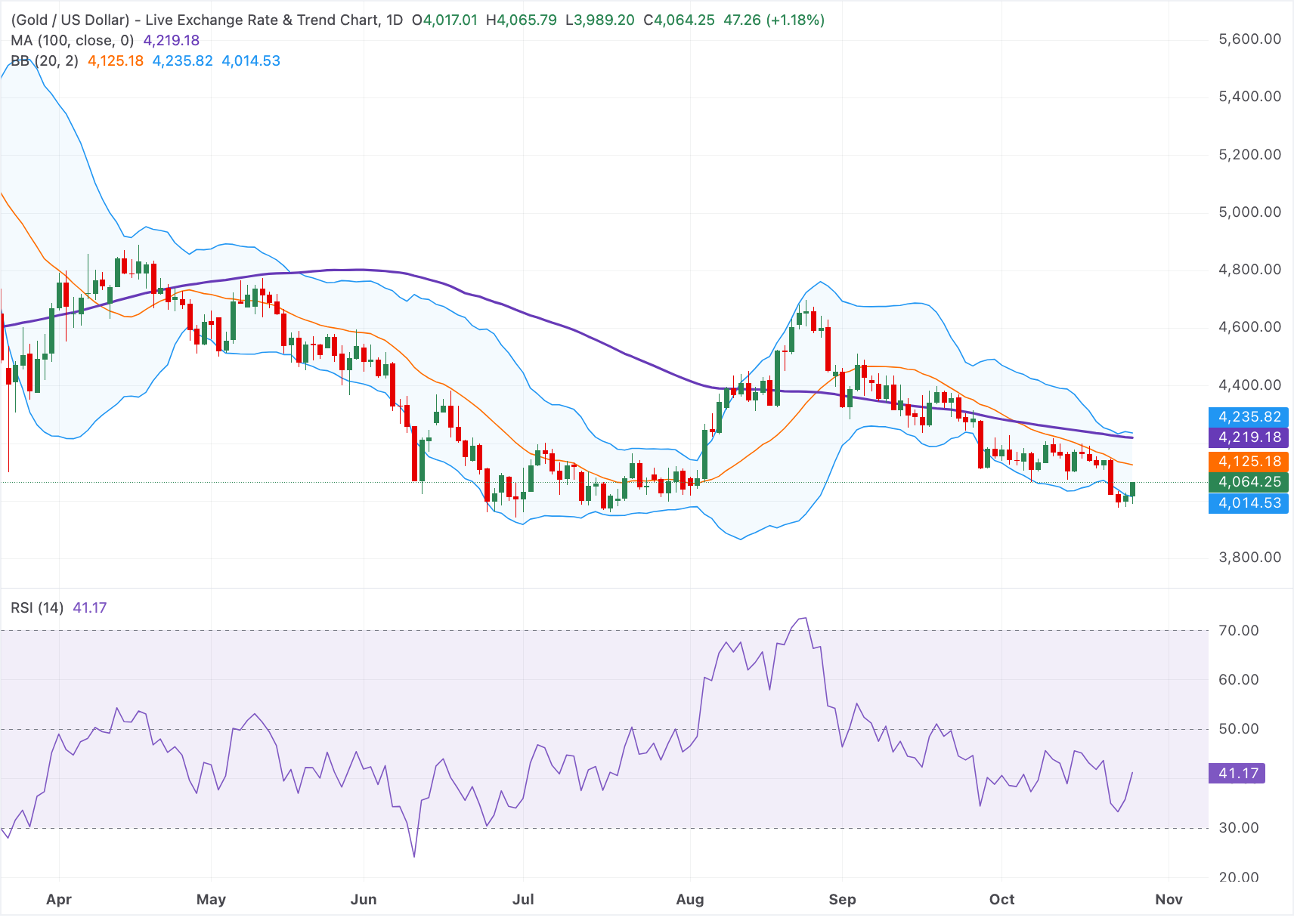
Technical Analysis: Gold
In the daily chart, XAU/USD is under a bearish near-term bias, holding below the 20-day Moving Average (middle Bollinger band) and the 100-day Moving Average, which together cap the topside and suggest the broader uptrend is losing traction. Price also trades well beneath the upper Bollinger band, underscoring a market that has retreated from prior extremes, while the Relative Strength Index (14) at 41 leans slightly negative, hinting that selling pressure still dominates on bounces.
On the topside, initial resistance appears at the 20-day simple Bollinger midline near $4,125, followed by the 100-day Moving Average around $4,220 and the upper Bollinger band at $4,235, where a break would be needed to revive a stronger bullish tone. On the downside, the lower Bollinger band at $4,015 offers immediate support; a daily close below this band would open the door to a deeper correction, while holding above it keeps XAU/USD in a consolidative pullback rather than a full trend reversal.



Comments
Log in or sign up to join the conversation.