

Three months ago, we presented a snapshot of how differently gold prices have come to behave since 16 March 2022, when the Fed finally acted to hike U.S. interest rates after allowing the inflation unleashed by the Biden administration to get out of control. In that update, we noted how the price of gold had effectively decoupled from the yield of 10-year inflation-indexed constant maturity U.S. Treasury. In the years since that date, it had come to rise and fall independently of how the Fed set interest rates.
We even likened it to "High Striker", the carnival game where a player seeking to show off their strength swings a mallet on a see-saw that launches a weight up a vertical rail as high as they can. The rising and falling weight was a metaphor for the escalating and plunging price of gold, which was happening without any change in the inflation-indexed Treasury.
Something other than expectations about inflation was obviously driving the price of gold. Today, we know that something else is the policies of central banks around the world.
We know that because of the plunge in gold prices that took place in March 2026, the cause for which has since been identified. A media report published on 26 March 2026 indicates Turkey's central bank acted to sell over 58 tons of its gold reserves to prop up the nation's currency over a two week period in March 2026. Their fire sale sent the global price of the commodity plunging.
Before that date, several nations' central banks had set out to aggressively buy up gold to stock their reserves, which had become a major contributor to the escalation in its price since March 2022.
But it's not just Turkey who has been a big seller in recent months. Russia's central bank similarly sold off a significant portion of its reserves in April 2026 to "fill a budget hole" to support its government's spending, contributing to the downward plunge in gold prices at that time.
Since mid-May, the price of gold has resumed falling, turning into a steep log flume carnival ride-like plunge in the last several weeks. The following chart updates our previous one.
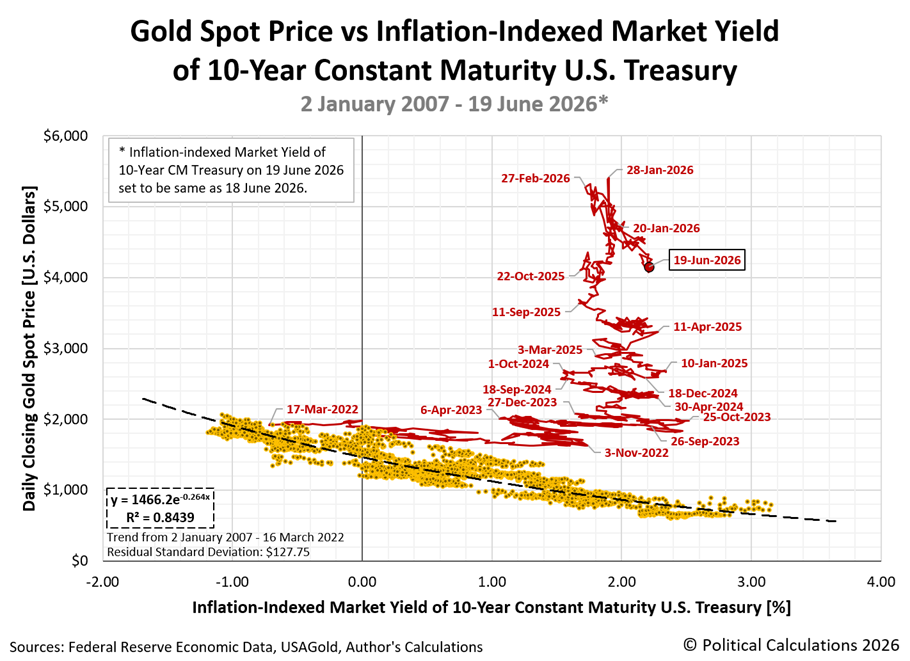
Since 19 June is a U.S. holiday that doesn't affect trading in gold markets, but does affect whether the U.S. Treasury is open for business, we've set the yield of the 10-year inflation-indexed constant maturity U.S. Treasury to be the same as was recorded for the day before. What we find is that between 27 February 2026, just before the Turkish central bank's gold sale, and 19 June 2026, the price of an ounce of gold has fallen by $1,123 to $4,155, a 21% decline.
Meanwhile, we see the 10-year inflation-indexed Treasury yield has increased by almost half a percent to 2.21%. Although it has increased, it still falls well within the range it has swung since April 2024.
What we don't have yet is an explanation for why gold prices have resumed falling over the last four weeks, and especially since the start of June. That we don't suggests it may be another central bank cashing out their gold because those events are often reported well after they occur.
Or not. Sooner or later, someone will do the accounting that explains why gold prices have fallen so much during this period. All we know for now is that the old wives' tale narrative of higher interest rates acting to rein in inflation doesn't explain it.
Comments
Log in or sign up to join the conversation.