

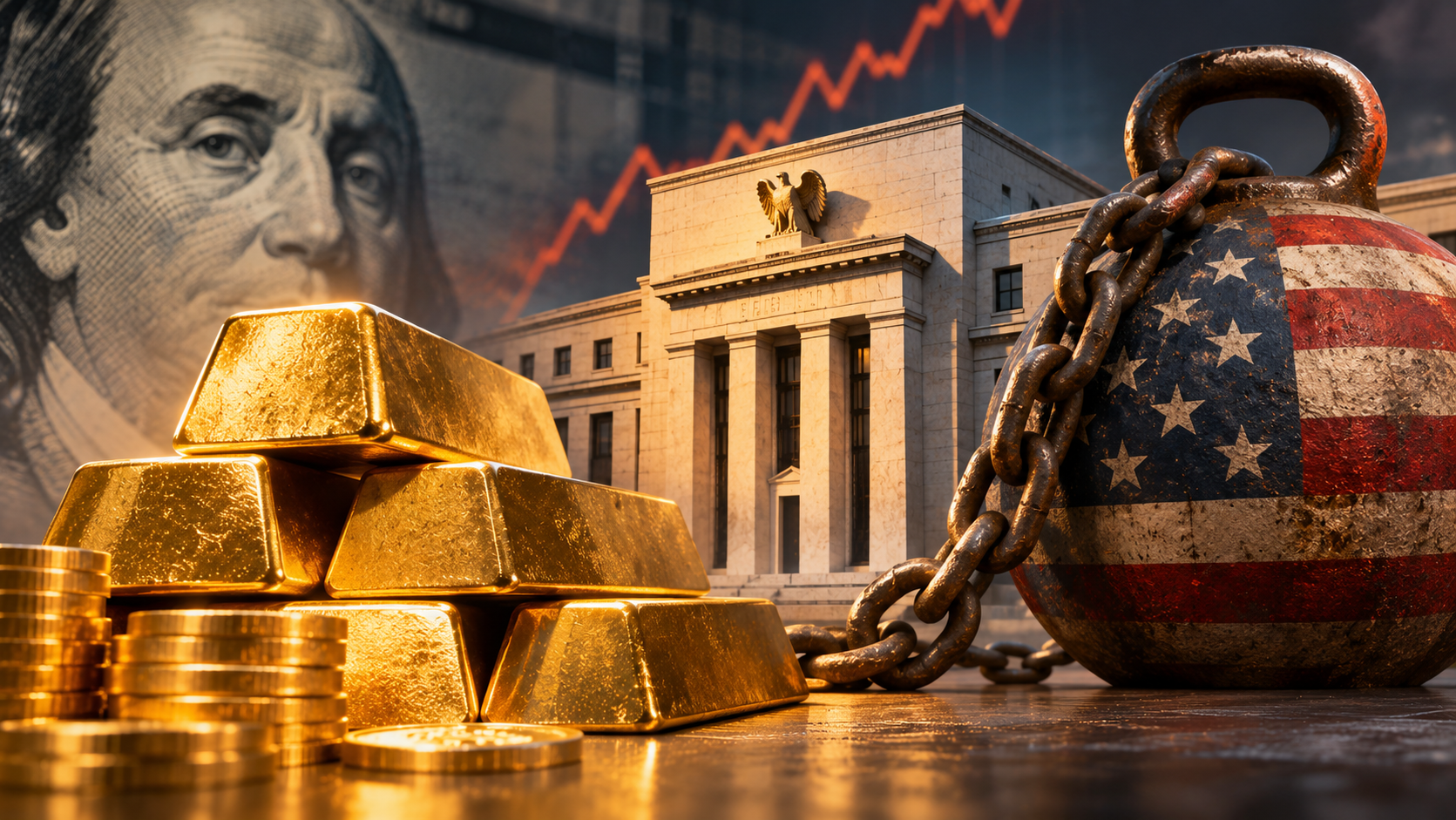
Hot inflation is usually seen as bad news for gold. When prices rise faster than expected, investors anticipate higher interest rates, which can pressure gold and silver. But on the latest Money Metals Midweek Memo, host Mike Maharrey argued that markets may be overlooking a bigger question. Can the Federal Reserve keep raising rates when government debt already exceeds $40 trillion?
Maharrey’s answer is doubtful. He believes the Fed is caught between fighting inflation and protecting a debt-heavy economy, and that the tension could eventually bring rate cuts and renewed money creation, even as inflation persists.
Hot CPI Data Keeps Rate Hike Fears Alive
The latest Consumer Price Index report showed prices rising 0.4% in October, above the 0.3% forecast. Core CPI, which excludes food and energy, increased 0.3%, also above expectations of 0.2%. It was the third consecutive month with a 0.3% core increase, a pace that annualizes to about 3.7%.
The Bureau of Labor Statistics did not publish a year-over-year CPI comparison because the government shutdown prevented it from releasing an October report the previous year. Monthly figures nevertheless showed price pressure across several categories.
Energy prices rose 0.7% in October after jumping 5.2% in September. Gasoline climbed another 1%, following a 9.3% increase the month before. Shelter rose 0.3%, while food prices gained 0.5%. Beef increased 0.9%, snacks 1%, and poultry, fish, and eggs 0.5%. Transportation services rose 0.8%, and new vehicle prices increased 0.2%.
Maharrey said the report helps explain why investors expect more Fed rate hikes and why gold recently came under pressure. But he argued that CPI captures only changes in consumer prices, not the full picture of inflation.
Money Supply Growth Points to More Inflation
Maharrey focused on the growth of the M2 money supply, describing monetary inflation as an increase in the supply of money and credit. From September 2025 to September 2026, he said, M2 climbed from $22.15 trillion to $23.41 trillion, an annual increase of 5.7%.
The money supply grew by $13 billion in September. So far in 2026, it has increased by an average of $136 billion per month, 89% more than the average monthly increase in 2025. Maharrey warned that monetary expansion may eventually push consumer prices higher or appear in asset prices such as stocks and real estate.
He also pointed to the Federal Reserve’s balance sheet, which began rising again in December 2025. It increased by about $5 billion in October and stood at $212.4 billion above its December 1 low. Maharrey characterized the Fed’s bond purchases as quantitative easing, arguing that they add money to the economy and help hold down government borrowing costs.
The Chicago Fed’s National Financial Conditions Index added another piece to his case. For the week ending October 30, the index stood at negative 0.45, which Maharrey said signaled historically loose financial conditions. It never turned positive during the Fed’s tightening cycle. Its high was 0.09 in October 2022.
The Fed’s Rate Hike Dilemma
Hot CPI data has fueled expectations of another rate hike in December, with some analysts discussing a possible 50-basis-point increase. Maharrey considered a 25-basis-point hike more likely, though he said stronger employment data could raise the possibility of a larger move.
But he questioned whether rate hikes can meaningfully slow inflation while money-supply growth and the Fed’s balance sheet continue to expand. Higher interest rates could also strain the government and broader economy, given the more than $40 trillion national debt and rising borrowing costs.
Maharrey described the Fed as caught in a policy trap. It could raise rates to fight inflation, but doing so risks recession or financial instability. If a crisis follows, he expects the Fed to cut rates and expand its balance sheet to support the economy, even if that means accepting more inflation.
He also doubted that new Fed leadership would allow a deep economic downturn in pursuit of lower inflation. In his view, central bankers have repeatedly chosen easier money when financial stress threatens the economy.
Why Gold Is Falling and Why Maharrey Sees Opportunity
Gold had climbed back above $4,100 after dropping below $4,000 in the weeks before the midterm elections. As Maharrey prepared the episode, gold was down about $120 and nearing the $4,000 level again. He said a move below $4,000 would not surprise him.
The immediate pressure came from expectations of higher interest rates, which can weigh on gold because it does not pay interest. Maharrey argued, however, that investors may be focusing too closely on rate forecasts and the latest headlines while overlooking the longer-term risks of money creation, debt, and currency debasement.
Even if the Fed managed to control inflation without triggering a crisis, Maharrey said, cash would continue to lose purchasing power. At 2% annual inflation, money loses more than 10% of its purchasing power over five years. He presented physical gold and silver as potential long-term hedges against that erosion.
The episode also highlighted a Money Metals offer on American Silver Eagles at $7.97 over melt value. Maharrey described the coins as .999 fine silver, with their weight and purity backed by the U.S. government. He also cited a report that about 60% of Paraguay’s population could not access their money during a banking crisis, arguing that physical silver can provide a backup when electronic banking is unavailable.
Midterm Elections Add to Gold and Silver Uncertainty
Maharrey said Democrats had won control of both chambers of Congress, with some races still outstanding. He cited a 54–44 Democratic advantage in the Senate and a 254–165 lead in the House. He expected divided government, with President Donald Trump able to veto legislation and Congress able to constrain parts of his agenda.
Gold and silver rose after the election results. Gold recovered above $4,000, and silver climbed above $53 an ounce. Maharrey cautioned that these post-election market moves may be short-lived.
Citing the World Gold Council, he said the election’s lasting effect on gold will depend on whether policy changes are significant enough to outweigh broader global forces. He also referenced Metal Focus, which described the results as a new source of uncertainty for precious metals.
Congressional gridlock could limit additional fiscal stimulus and temper expectations for further rate hikes, potentially supporting gold. But continued government borrowing could keep long-term yields high, while slower growth could weaken industrial demand for silver and platinum-group metals.
Maharrey said meaningful deficit reduction remains unlikely given existing spending commitments, rising interest costs, and the difficulty of agreeing on tax increases or spending cuts. He also discussed the ongoing U.S.–Iran war, saying its direction could affect inflation expectations, interest rates, and precious metals. An escalation could intensify inflation concerns and rate pressure, while a lasting resolution could remove some headwinds for gold and silver.
Maharrey’s Gold and Silver Outlook
Maharrey described himself as short-term and midterm bearish on gold and silver. He said the metals could remain under pressure until the war’s direction becomes clearer or markets recognize that the Fed may be unable to keep raising interest rates. Still, he viewed lower prices as a potential buying opportunity for long-term investors.
His central argument is that inflationary pressure is likely to persist because of money-supply growth, government debt, and the Fed’s response to financial stress. He sees physical gold and silver as potential hedges against currency debasement and useful parts of a broader investment strategy, while cautioning against putting everything into precious metals.


Comments
Log in or sign up to join the conversation.