

Gold is indelibly inked onto the human psyche. It has been prized as an asset for thousands of years and is universally accepted as an ultimate store of wealth. Armies have fought and died for it, empires have been founded upon it, and many of our oldest and most historically important buildings are lavishly adorned with it. With this kind of history you can understand why it attracts a hard-core following within the investment arena, despite the fact that it has very little practical use in today's society.
Gold as a metal has no special qualities to distinguish it among its peers, in fact its complete lack of elemental personality is its most attractive characteristic - it does not react with other elements, does not corrode or tarnish, and is non-hazardous to human health. In essence it is a pretty, shiny metal that in both metaphorical and literal terms has managed to retain its lustre throughout the ages.
Of course it does have some industrial use as a conductor of information and electricity, but there are other materials out there (silver and copper come to mind) that do the job equally well if not better, and don't command such a high price in the open market. In fact don't shoot the messenger here, but you were probably ripped off when you paid five times the standard price for your gold tipped stereo leads.
I actively trade within the gold market (among others), and I therefore pay attention to what happens within this sphere as it affects my investing decisions. Over the years I must have read thousands of articles written about gold, and have read thousands more of the comments written to the authors of those articles.
There are a number of pervasive mal-theories that tend to do the rounds within the gold circuit, so this week I thought I would explore the 3 biggest and most widely discussed myths that surround gold in order that we may get a better handle on its role in the modern world. Enjoy!
Myth #1 - Gold Is Money
The problem with a barter system is that you can never be sure the item you receive in payment will be worth the same value of goods or services you gave away should you come to exchange it in the future. For this reason a monetary system is a fine solution, as the prices of goods tend to remain relatively stable over short periods, and you can be fairly sure that the $100 you accept in payment will buy you a certain amount in the market when you come to spend it.
Money itself is simply a medium of exchange - a method of paying for goods and services in an easy fashion, since you are using a token that is accepted by everybody. Gold used to be money. The authorities fashioned coinage using gold stamped with markings to show its value and who had issued it. The stamp provided some semblance of a guarantee that it would have a value and could be easily exchanged within the realm at a future date.
Although important, it was not necessarily just the weight of the metal used in the coin that dictated the token value; it was the 'I promise to pay the bearer' type markings that gave you the assurance of its future worth - the coins themselves were frequently debased and reissued for the same value but with a lower metal content.
In modern society gold is not money in the strictest sense, since it is no longer taken by everybody as an acceptable form of payment. Many would disagree with this statement, but testing its validity is easy - just walk into McDonalds and try to buy a Big Mac Meal with a quarter gram sliver of gold. You may not think so, but I would hazard a guess that the result would be a dubious stare and an empty stomach, similar to when you try to buy a round in a London bar with a Scottish £20 note.
Saying gold is money is akin to saying your car is money, or your house is money - under those terms a box of Hershey bars in fat camp is money, since you would have an item of value and a 'crash' of willing takers.
A more formal test of the 'gold is money' theory is to gauge whether or not it rises or falls with inflation. Since asset inflation necessarily means that the purchasing power of currency declines, if gold truly was money it would not be rallying along with other commodities and general assets, and it would certainly not be so widely accepted in the investments arena as an inflation hedge. Instead it would be losing ground in relation to its commodity cousins, and falling in value as they moved up in price.
In times of crisis gold can be more popular than currencies with those seeking capital preservation, since it has a verifiable value which is recognised globally and that 'worth' can certainly be utilised in the future, but in terms of a primary medium of exchange it just does not fulfil that role anymore.
Sorry folks, but in the futuristic world of today you have to take your golden splinter to a dealer and exchange it for actual money before you can purchase something else.
Myth #2 - The Gold Price Is Suppressed
In very recent times it has come to light that some of the major banks have colluded to push price around with the intent of making trading profits. The media jumped on the story and the world quite rightly reacted with shock and horror, but the investment community collectively yawned since if you weren't sure this practice was prevalent you at least suspected it might be going on.
First we had the LIBOR scandal, and then we were told that the investigation was spreading further afield into the precious metals arena. Loud cheers were heard as the hard-core gold contingent reacted with unrestrained glee, the smug virtually exploding from their goldbug pores as they yelled "I told you so!!" in unison on the cover of ZeroHedge. And the traders and hedge fund managers just laughed and laughed..
Now I am obviously making light of what is undoubtedly a serious issue, and there is definitely a growing concern that a certain amount of price manipulation may have taken place (remember that the investigation is ongoing, nobody has been formally charged, and no hard evidence has yet been made public), but wholesale price suppression is an entirely different thing and the two should not be confused.
Part of the initial investigation into potential precious metals price manipulation was carried out by a consultancy called Fideres who, in an article dated Feb 23rd 2014 and published by the Financial Times (which has since been removed but is listed in the journalist's article gallery here and covered by Marketwatch here), noted that 'the gold price frequently climbs (or falls) once a twice-daily conference call between the five banks begins, peaks (or troughs) almost exactly as the call ends and then experiences a sharp reversal, a pattern it alleged may be evidence of "collusive behaviour",' and quoted Fideres as saying:
"[This] is indicative of panel banks pushing the gold price upwards on the basis of a strategy that was likely predetermined before the start of the call in order to benefit their existing positions or pending orders.. This is not something you would expect to see if you take into account normal market factors."
Note that their investigation showed that the parties were apparently pushing the price higher rather than forcing it lower - not the actions you might expect of a global cabal of price suppressors is it? If price was being gamed as alleged, it was not done with any real directional bias; it was simply being pushed into a position that benefited either their existing trading positions or to where their orders were sat in place waiting to be filled.
I think most working within the industry would agree that a certain amount of 'gamesmanship' goes on, with some of the larger players having a what could be termed a competitive advantage, although the more cynical among us would say that allowing institutions to act as market maker and actively trade for themselves is the equivalent of putting Homer Simpson in charge of the donut factory.
Regardless, wholesale price suppression does nothing to entice people into the market, and without participants there would be no-one to compete with and thus no money to be made. I'm not going to go into the topic of if it can be done, suffice to say that it would require a huge organisational effort across many large institutions and in a world where government secrets are so regularly exposed in the media, you could well imagine that it would take a herculean effort to conceal.
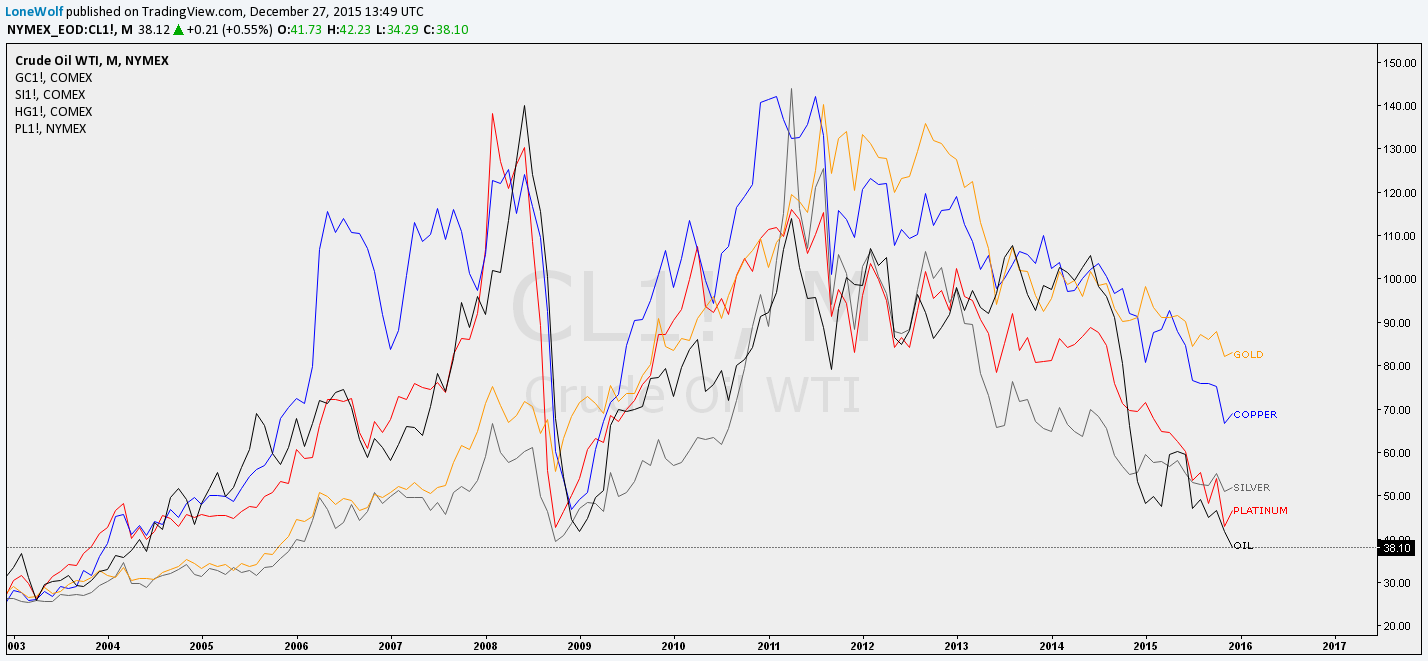
Additionally you have to wonder whether the benefit would outweigh the cost of operating what would effectively be an unofficial peg, and we have recently seen how disastrous that can turn out - just ask the Swiss National Bank - Instead I'm going to ask, have you actually looked at a chart of gold and compared it to the charts of its commodity cousins?
Can you not see the correlation, and does this honestly look like a price that is being purposely kept down? What about the 10+ year bull market we completed not so long ago? Did the 'suppressors' take a holiday in 1999 through 2011?
(Click on image to enlarge)
I'll avoid quoting some of the typically wacky comments you find on the gold blogosphere, but I will quote Chris Powell of the Gold Anti-Trust Action Committee [GATA] who at the very least writes eloquently, even if you don't agree with the rhetoric:
"..gold is a powerful competitive international currency that, if allowed to function in a free market, will determine the value of other currencies, the level of interest rates, and the value of government bonds. Gold's performance is usually the opposite of the performance of government currencies and bonds. Hence central banks fight gold to defend their currencies and bonds."
So the price suppression view is essentially predicated on the misguided belief that gold is money (see myth #1), a competing currency to rival Euros or Dollars, and therefore should have a far higher comparative value since its fiat peers have been steadily devalued over the years as more currency has been created; and since gold is money, governments must be tactically selling their reserves in bulk amounts or flooding the market with naked short contracts to artificially keep the gold price low, and prop up the relative worth of their paper money.
In my opinion that view should be filed under 'B' (for bin), as at this point in time gold acts more like a commodity than a currency (see the chart above), with the added characteristic of being a hyper-popular store of wealth in uncertain economic times, which explains why it has declined with other basic materials but has held up a little better overall.
Governments no longer need gold as collateral for their currencies since the creation of money is not limited by or tied to their physical asset reserves anymore. Sure, it is nice to have a stockpile you can sell in a jam, but in real terms governments just issue bonds when they want to replenish the coffers - gold is no longer an important consideration in a budget they effectively set and produce for themselves.
Short-term price manipulation may have taken place at times; but wholesale price suppression is just not logical, feasible or necessary in the modern world. More likely it is a myth used to sell gold to the public on the pretense that when the scheme is exposed and stopped, gold will suddenly rocket up in value. The more cynical among us would say that it is also an excuse for those that have publicly stated or advised that gold is about to rally much higher, only to watch it continue to drop:
"The rally didn't happen? Well it’s not my fault - it must be that gold prices are suppressed."
Myth #3 - The Paper Markets (Futures) Negatively Distort The Price Of Gold
Oh the life of a goldbug! You save up all your money for a shiny gold bar to play with, and then watch helplessly as it falls in value when some 'nefarious agent of the price suppression cabal' dumps a ton of paper contracts at a particularly illiquid hour and the price drops $50 in ten minutes. I can feel your pain as you stumble around your end-of-the-world survivalist shelter, knocking over tins of lima beans and shouting tearfully at the cat - 'Manipulation!! - nobody would do that unless they purposefully wanted the price to fall!!'
In truth there are many reasons why someone would sell their long contracts in the market place, and I am not so sure a large sell order necessarily constitutes manipulation. Gold has been steadily making new lows for the last four years, and despite brief rallies in that period it has failed to produce any kind of sustained upward trajectory. You could logically expect that the bulls would be nervous and have a tendency to give up their position at the first sign of trouble - people should not underestimate the sheer panic that sets in as your larger positions go against you, and I am talking from experience here.
Even if a large sale of long contracts at an illiquid hour was an attempt to push the price lower, so what? There is no law against buying or selling in this market place, and I would hazard a guess that the reason in that example would not be to suppress prices permanently, but more likely to benefit an even larger short position. Most logically these mass sales of long contracts are margin calls where the position is liquidated at once by the broker. Or then again it could simply have been some rich guy needing cash to buy the latest McLaren.
Let’s flip the scenario a second and ask about the times where someone buys a large number of long contracts in bulk. We never hear any "that was a blatant attempt to manipulate the price higher!" stories on the blogs, mostly because the people who contribute to these blogs have the viewpoint that gold can only ever increase in value - but the point is nobody really knows what motivates a large sale.
The paper markets are often characterized as the 'price suppression mechanism' by the hardcore gold crowd, but the reality is that the futures markets actually provide much needed liquidity. Without this mechanism we would not see the booms (or busts) in the gold market, as the ease at which people can buy or sell would be drastically reduced. Remove the paper markets and you would no longer see the kind of speculative rallies that tripled the price of gold in 3 years leading into 2011 - those moves are not fueled by mom and pop buying coins at the local bullion dealer.
Liquidity is essential to price ascent, and without it price tends to head south. We have seen how house prices fared globally when the credit punch-bowl was taken away in the wake of the 2008 crisis, and we are starting to see the same thing in the bond markets today as more and more people are beginning to appreciate the risk and are shying away.
Prices fall when there is no bid for a security, so a reduction in the ability or ease at which participants can make a purchase, for whatever reason, and we tend to get problems. Gold is not immune to these forces, and those preaching the demise of the paper markets should be careful what they wish for. Far from negatively distorting the price of gold, the paper markets played a big part in price rising 8-fold in 10 years as speculators bid it up in a frenzy, especially towards the end of the run. Of course when price began making lower highs on the daily chart, the speculators became less inclined to buy quite as fervently, and price has declined as a result.
The hardcore gold crowd often point to the statistics on physical demand and say gold prices should be rising, but the missing ingredient is the massive speculation that caused price to triple in that last wave higher. Now that the froth has dissipated, the price has come back down to earth a little - you just can't have it both ways.
I wish everyone a Happy New Year and a successful 2016.


Comments
Log in or sign up to join the conversation.