


Gold price (XAU/USD) holds steady around $4,125 during the early Asian session on Thursday. The precious metal fluctuated as traders continue to assess the outlook for the Federal Reserve’s (Fed) interest-rate path on the back of ongoing tensions in the Middle East.
Fed Chairman Kevin Warsh last week avoided signalling the outcome of this month’s policy meeting but noted that hotter-than-expected inflation had not changed his assessment of the US economy. According to the CME FedWatch tool, the chance of no change in rate at the October meeting now stands at 84%.
Even with a hold widely expected next week, markets continue to price in another increase at the December meeting, which keeps the policy outlook tilted toward tightening. This, in turn, could weigh on the yellow metal. Higher interest rates typically weigh on gold because the precious metal does not pay interest, making yield-bearing assets relatively more attractive.
Additionally, elevated energy costs increase the possibility that the US central bank will need to further adjust monetary policy to contain price pressures.
Escalating supply risks in the Middle East keep traders on edge. Iran’s Foreign Minister Abbas Araghchi said on Wednesday that “while Iran is firmly committed to seeking a dignified peaceful resolution to the conflict, we are also fully prepared to defend ourselves.” Meanwhile, Iranian President Masoud Pezeshkian stated that the US cannot expect dialogue with Iran while blockading and threatening it.
Risk appetite shifts as France unrest weighs on equities and Dollar firms
Analysts at Commerzbank highlight a clear divergence across markets, noting that "European equities declined amid political unrest in France, while US Treasury yields rose as the equity recovery reduced safe-haven demand." In this backdrop, they add that "the USD was slightly firmer," reflecting a modest shift back toward the Dollar as risk sentiment stabilised in US assets.
Commerzbank also points to softer commodity prices, reporting that "Brent crude oil prices fell 0.3% to USD109.55" and that "Gold fell 0.6% to USD4,141," underscoring how the combination of higher US yields and reduced safe-haven demand has weighed on traditional hedges.
Warsh cautious on crisis scars but upbeat on investment surge and AI
Fed Chair Warsh delivered a moderately constructive tone, with the FXS Speechtracker score at 5.6/10, slightly softer relative to the historical average of 6.1/10 and suggesting only modest incremental information for markets. The admission of being “over-scarred” by the Global Financial Crisis underscores a persistent bias toward caution on financial stability, even as Warsh highlights structural growth, an investment surge, and confidence in delivering price stability without pre-committing to October or December decisions. Warsh’s focus on AI as a near-term demand-side force and a tool to strengthen data and monetary policy signals a forward-looking stance that could ultimately support the Dollar if productivity and growth expectations firm.
The FXS Fed Sentiment Index was unchanged, moving by 0.00 points to a still-hawkish level of 127.51, indicating that the speech did not materially shift the perceived policy stance despite the slightly lower FXS Speechtracker score. The combination of elevated index readings and a neutral day-on-day change suggests that markets continue to view the Fed as firmly in hawkish territory, with Warsh’s cautious crisis scars balanced by optimism on investment and AI-driven growth.
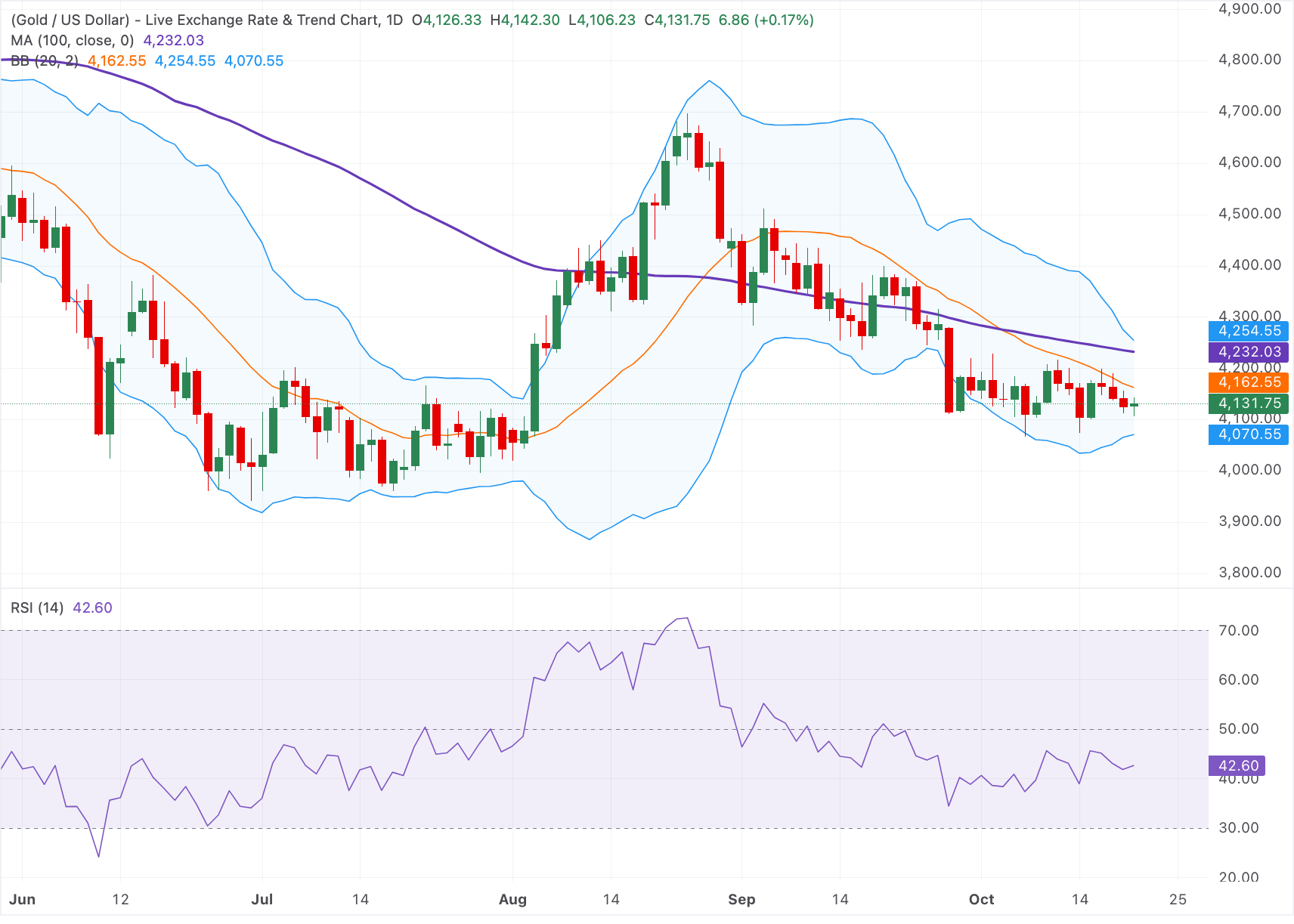
Technical Analysis: Gold remains capped under the 100-day SMA
In the daily chart, XAU/USD remains under pressure, with spot quoted below the 20-period Bollinger simple moving average and the 100-day moving average, which keeps the near-term bias bearish. Price is holding above the lower Bollinger Band, hinting at a short-term consolidation rather than a full-fledged breakdown, while the Relative Strength Index at 42.60 stays in neutral-to-soft territory, suggesting downside momentum is present but not overstretched.
On the topside, initial resistance emerges at the Bollinger midline near $4,160, followed by the 100-day moving average at $4,230, with the upper Bollinger Band at $4,255 acting as a stronger cap if bulls attempt a rebound. On the downside, immediate support is located at the lower Bollinger Band around $4,070; a sustained break beneath this floor would open the door for a deeper pullback, whereas holding above it would keep XAU/USD in a bearish but range-bound posture.

Comments
Log in or sign up to join the conversation.