

Precious Metals
The August COMEX gold on Friday closed up 21.9 or plus 1.27%, and July silver closed up 33 cents or 1.94%. The precious metals prices on Friday rallied to one-week highs. Comments on Friday from the Fed president supported the prices for precious metals when he said, “More support is likely to be needed from both monetary and fiscal policy.” With unemployment remaining above 10% and inflation persisting well below the Fed’s 2% target, precious metals prices gained Friday on the outlook for additional stimulus measures to be implemented as Eurozone leaders met by video conference to work out the details of a 750 billion euro program to help economies recover from the lockdown. Silver prices also gained additional support on Friday from a stronger-than-expected global economic data, which was positive for industrial metals demand. The UK May retail sales rose 10.2%, which was stronger than the expected 4.1% month to month, and the largest increase since the data began to be collected in 1988. Japan’s cabinet officer upgraded its estimate of the economy and said that the economy “has almost stopped deteriorating and private consumption is showing movements of picking up.” An easing of US-China tensions was negative for the safe-haven demand for precious metals. Bloomberg announced that China planned to increase purchases of US farm goods to comply with the phase I deal after purchases fell behind early this year due to the pandemic. The coronavirus pandemic continues to dampen the US and global economies, and is negative for economic growth and prospects in industrial metals demand. Confirmed cases of the virus have risen above 8.6 million globally, with deaths exceeding 457,000.
Safe-haven demand and dovish central bank expectations have sparked fund buying of precious metals in recent months. The long positions in ETFs on Wednesday rose to a new record high of 3,139.88 metric tons data since 2002. Also the long silver position ETFs rose to a new record high of 761.084 million ounces on Thursday.
Developing World EMs Risk
The fundamentals create a very ambiguous picture for precious metals. We have to look at the additional ripple effects that we are seeing on a global scale as the risk increases in some of the peripheral areas of the world economy. One area that I don’t believe we talk about enough or the media does not is the potential danger that the coronavirus is going to have on emerging markets. In Latin America, Brazil, Argentina, Venezuela, Colombia, and Ecuador are in a precarious situation because of their low US dollar reserves. The economic pressures have distorted the foundation of the country’s leadership and put into question that decision that was made when Ecuador, in particular, decided to use the US dollar as their currency. Dollarizing their local currency was a major decision with unforeseen consequences. Now it appears that it was a big mistake, especially for a developing country which does not have the ability to print unlimited dollars as the US Treasury can do, without any dollar reserves to withstand the impact of a continued devaluation of the US dollar as a consequence of the quantitative easing that is being applied to the US and global markets. The US and the Europeans can print as much currency as they need, but we have to deal with the issue of emerging countries as one potential risk to this policy of printing money. A major emerging country could default on their debt obligations.
Mohamed El-Erian, chief economic advisor at Allianz and a Bloomberg Opinion columnist, said he is worried about the impact of the Covid-19 pandemic on emerging markets.
“This is completely off the radar screen,” he said. The third phase of the pandemic, he said, will be in the Third World and emerging markets, where it will be harder to contain and harder to recover from.
“We are entering into a high risk of a paradigm of non-payments,” he said. Governments will have to make tough decisions between paying debt obligations and health-care payments. Countries with limited international reserves, limited domestic resources and which are running large deficits will be most likely to stop payment on their debt obligations. Investors are focused on liquidity, and they are not taking into account these other significant factors.
The Fed and other central banks are on the front edge of the yield curve. “There are lots of opportunities for investors,” El-Erian said, “but they are selective,” such as in rescue financing, structured credit, and other specific areas. The Fed and ECB are going to continue distorting the market, pushing capital around looking for returns, but what happens when the risk of default increases?
One of the bullish factors that seemed to be prevalent and continues to grow is the fact that this highly stimulative monetary policies by the world’s key central banks to prevent systemic stress in the world economic system is building an extremely bullish case for precious metals. Low global bond yields, which boost demand for gold as a store of value, and low global inflation are dovish for central bank policies. Fund buying of precious metals with long gold and silver positions in ETFs at all-time highs, safe-haven demand due to trade tensions, BREXIT risks, pandemic-affected trade tensions, and global risks involving Iran, North Korea, and Venezuela are additional bullish factors for the precious metals markets.
Some of the bearish fundamental implications that we have to consider is the fear of long-term deflation due to the massive economic damage caused by the pandemic. If we continue to see the implosion in industrial production, it could sharply reduce industrial metal demand, especially in silver.
Gold: Weekly VC PMI Report
Summary
The weekly trend-momentum of 1736 is bullish.
The weekly VC PMI of 1740 is bullish.
A close below 1740 stop, negates this bullishness neutral.
If long take profits 1774-1797.
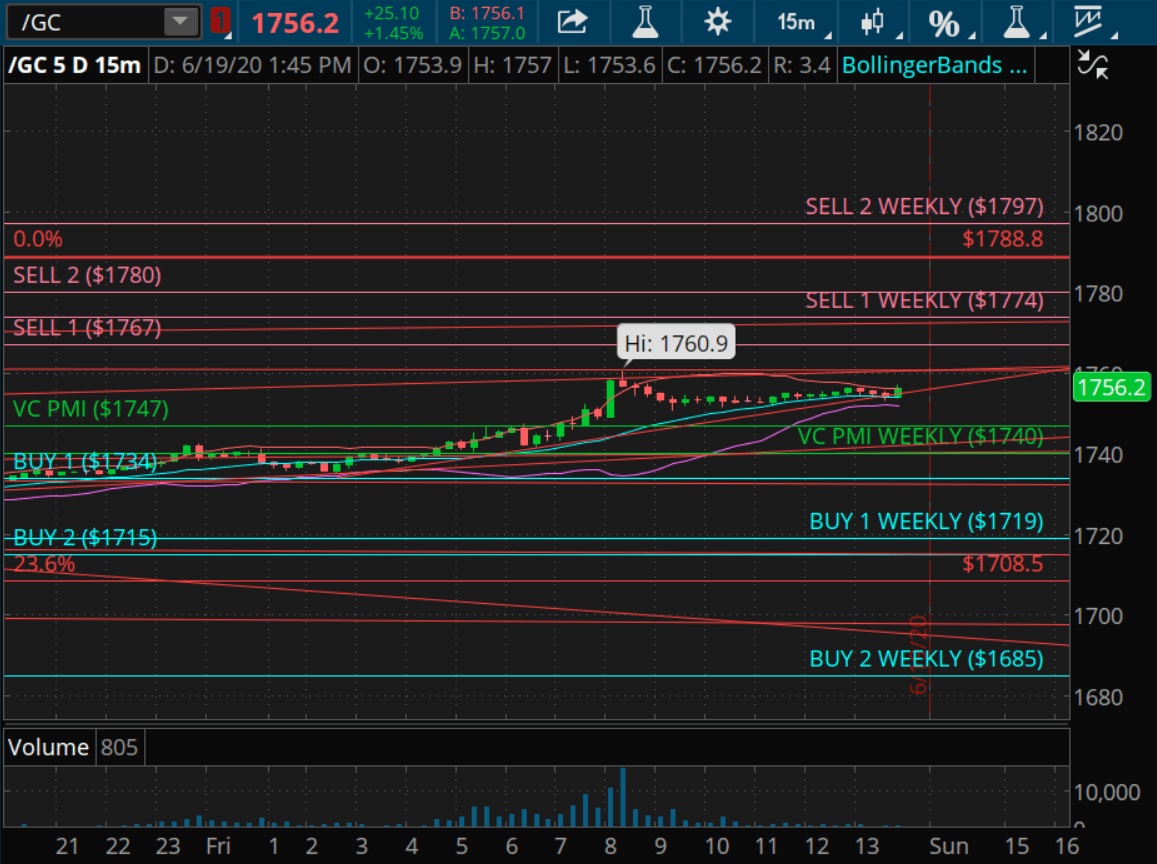
Gold closed on Friday at $1756.20. The Variable Changing Price Momentum Indicator (VC PMI) average price for next week is $1740. The fact that the market closed above the average price of $1740 means that it has activated a bullish price momentum for next week and has identified the targets of $1774 as the Sell 1 weekly target and $1797 as the Sell 2 weekly target. If the market reaches the Sell 1 level there is a 90% probability of the market reverting to the mean, while the Sell 2 level has a 95% probability of sellers coming into the market and the market reverting to the mean. Therefore, the $1794 to $1797 area is where supply or sellers will come into the market.
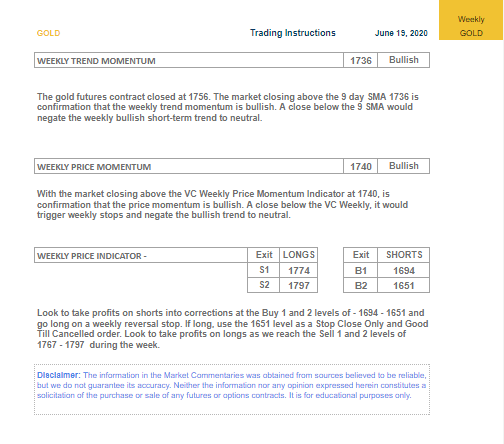
We are long gold. We are holding derivative positions in the gold market, such as GDX. For aggressive traders who are looking for a higher return, but want to eliminate the risk of a futures contract, to hold a position as a swing or long-term objective, we use instruments such as JNUG and NUGT to trade the long side of the market. We use these instruments based on the VC PMI extreme targets above or below the market. You can use the VC PMI information to day or swing trade the market or as a GPS to guide your long-term trading of the market. How you use the information depends on the type of trader that you are. The VC PMI is a contrarian signal and please use the information to fit your trading style and goals.


Comments
Log in or sign up to join the conversation.