


Gold (XAU/USD) gains some positive traction during the Asian session on Wednesday as early US midterm election results heighten political uncertainty and weigh heavily on the US Dollar (USD). In fact, early trends show the possibility of Democrats securing control of both the House of Representatives and the Senate. This raises the prospect of gridlock in Washington and limits government spending. Moreover, a Democratic sweep could be potentially negative for tech stocks and economic growth, boosting demand for safe-haven assets and triggering a fresh leg down in US bond yields. This turns out to be another factor that contributes to the USD's intraday slump to its lowest level since late September.
However, hawkish US Federal Reserve (Fed) expectations fail to assist gold in building on the modest intraday uptick. According to the CME Group's FedWatch Tool, traders are currently assigning a nearly 80% chance that the US central bank will raise borrowing costs again at the next policy meeting in December. The bets were lifted by the Labor Department's Job Openings and Labor Turnover Survey, or the JOLTS report, on Tuesday, which showed that hiring held relatively steady in September. In fact, job openings rose to 7.523 million during the reported month. This comes on, up from August's upwardly revised reading of 7.190 million. This comes on top of resilient economic growth and persistent price pressures, and solidifies bets for an imminent Fed rate hike, keeping the non-yielding bullion below the $3,970 resistance zone.
Meanwhile, the geopolitical risk premium remains in play despite efforts for a diplomatic resolution to end the eight-month-old US-Iran war. In the latest developments, President Donald Trump told the Financial Times on Tuesday that the US has no immediate plans to strike Iran despite Israeli Prime Minister Benjamin Netanyahu hinting at an attack later this week. Meanwhile, a senior Iranian official told Reuters that the Strait of Hormuz will reopen only if sanctions are waived and the US naval blockade ends. Furthermore, Iran's Islamic Revolutionary Guard Corps (IRGC) said that four tankers were destroyed after striking mines south of the Strait of Hormuz. This fuels oil supply risks and inflation fears stemming from volatile energy prices, which underpin prospects for further Fed policy tightening.
Traders now look forward to Wednesday's US economic docket – featuring the release of the ADP report on private-sector employment and ISM Services PMI. Apart from this, the incoming geopolitical headlines could provide some impetus to gold. Meanwhile, the focus remains glued to the closely watched US monthly employment details, popularly known as the Nonfarm Payrolls (NFP) report on Friday, which will influence USD demand and determine the near-term trajectory for the precious metal. Nevertheless, the aforementioned fundamental backdrop makes it prudent to wait for a sustained move beyond the $3,970 hurdle before confirming that the XAU/USD pair has bottomed out and positioning for any meaningful recovery from the lowest level since September 2025, touched last Friday.
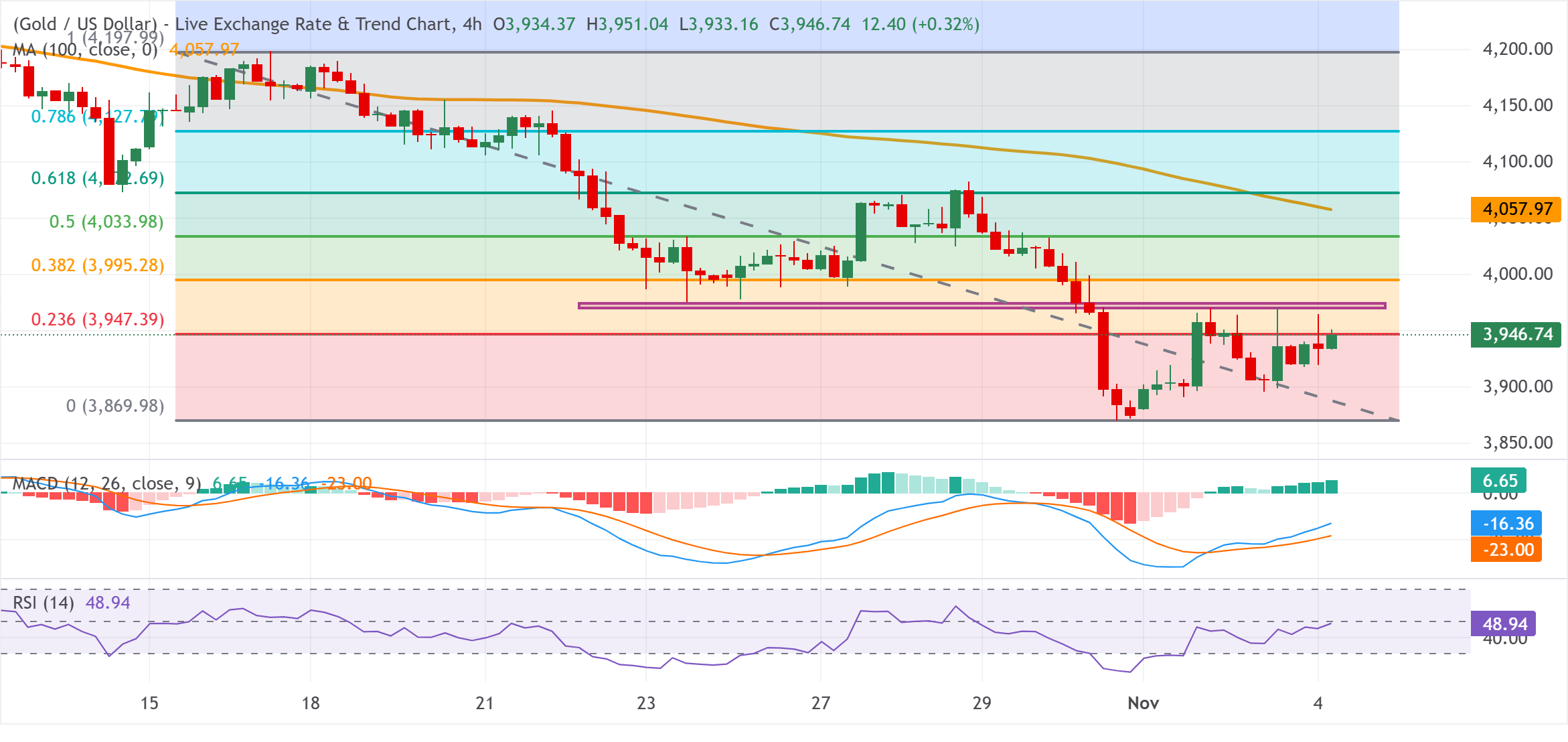
XAU/USD 4-hour chart
Technical Analysis
The XAU/USD maintains a bearish bias below the 100-period Simple Moving Average (SMA) on the 4-hour chart and all key Fibonacci retracement levels of the fall from the mid-October highs, with the 23.6% retracement at $3,947 acting as immediate overhead resistance ahead of the $3,970 zone. Meanwhile, the Relative Strength Index (RSI) at 48.94 sits near neutral while the Moving Average Convergence Divergence (MACD) remains positive at 6.65, hinting at some stabilizing momentum but not yet strong enough to challenge the prevailing downside structure.
In the meantime, a sustained strength beyond the $3,970 hurdle would expose the 38.2% level at $3,995 before the Gold price climbs to the 50.0% retracement at $4,033. Above these, the 100-period SMA at $4,057 and the 61.8% and 78.6% retracements at $4,072 and $4,127, respectively, precede the cycle high near $4,197. On the downside, the main structural support is seen at the Fibonacci anchor around $3,869, where buyers could attempt to reassert a floor if bearish pressure extends.



Comments
Log in or sign up to join the conversation.