

Gold price (XAU/USD) edges lower to near $4,120 during the early Asian session on Wednesday. The precious metal extends its decline as elevated oil prices raise concerns about persistent US inflation and the prospect that the Federal Reserve (Fed) could keep interest rates higher for longer.
The Iranian military said on Monday that Tehran has not yet completely closed the Strait of Hormuz and can expand the scope of the blockade to the Bab al-Mandeb Strait and the Suez Canal. The Houthis claimed to have attacked King Khalid International Airport in Riyadh, Saudi Aramco facilities in Yanbu on the Red Sea Coast, the Shaybah oilfield, and Saudi naval forces.
Ongoing tensions in the Middle East and possible disruptions to energy shipments through the Persian Gulf could drive oil-driven inflation concerns, weighing on the yellow metal.
Traders are now pricing in nearly a 16.1% odds of another quarter-point increase at the Fed’s October 27-28 meeting, after comments last week from Chairman Kevin Warsh were interpreted as reinforcing expectations for a pause.
However, inflation remains above the Fed’s 2% target, leaving traders focused on whether policymakers pause this month before resuming tightening later in the year. Gold is often used as a hedge against inflation but does not yield interest, making it less attractive when interest rates are high.
Risk assets diverge as French unrest weighs on Europe and Dollar firms
Analysts at Commerzbank highlight a growing divergence in risk assets, noting that "European equities declined amid political unrest in France, while US Treasury yields rose as the equity recovery reduced safe-haven demand." In this backdrop, the bank adds that "the USD was slightly firmer," with shifting risk appetite also reflected in commodities as "Brent crude oil prices fell 0.3% to USD109.55" and "Gold fell 0.6% to USD4,141."
Warsh flags investment surge and AI focus but keeps Fed options open into year-end
Fed Chair Warsh’s speech scores 5.6/10 on the FXS Speechtracker, modestly below the 6.1/10 historical average, signaling a slightly less impactful but still constructive tone. The admission of being “over-scarred from the global financial crisis” underscores a cautious bias even as Warsh highlights structural growth and an investment surge driven by “good policies,” while refusing to prejudge the October and December meetings. The emphasis on AI as a demand-side force and on field hearings and task forces suggests the Fed is actively building new intellectual capital, but without offering explicit guidance that would materially shift the policy outlook relative to the established baseline.
The FXS Fed Sentiment Index was unchanged, moving 0.00 points to a still-elevated 127.51, confirming that the overall policy tone remains firmly in hawkish territory despite the lack of incremental signal. The combination of a flat index reading and a below-average speech score indicates that Warsh’s remarks largely validated existing expectations for the Dollar-positive Fed stance rather than introducing new hawkish or dovish surprises.
Technical Analysis: Gold remains capped under the key resistance levels
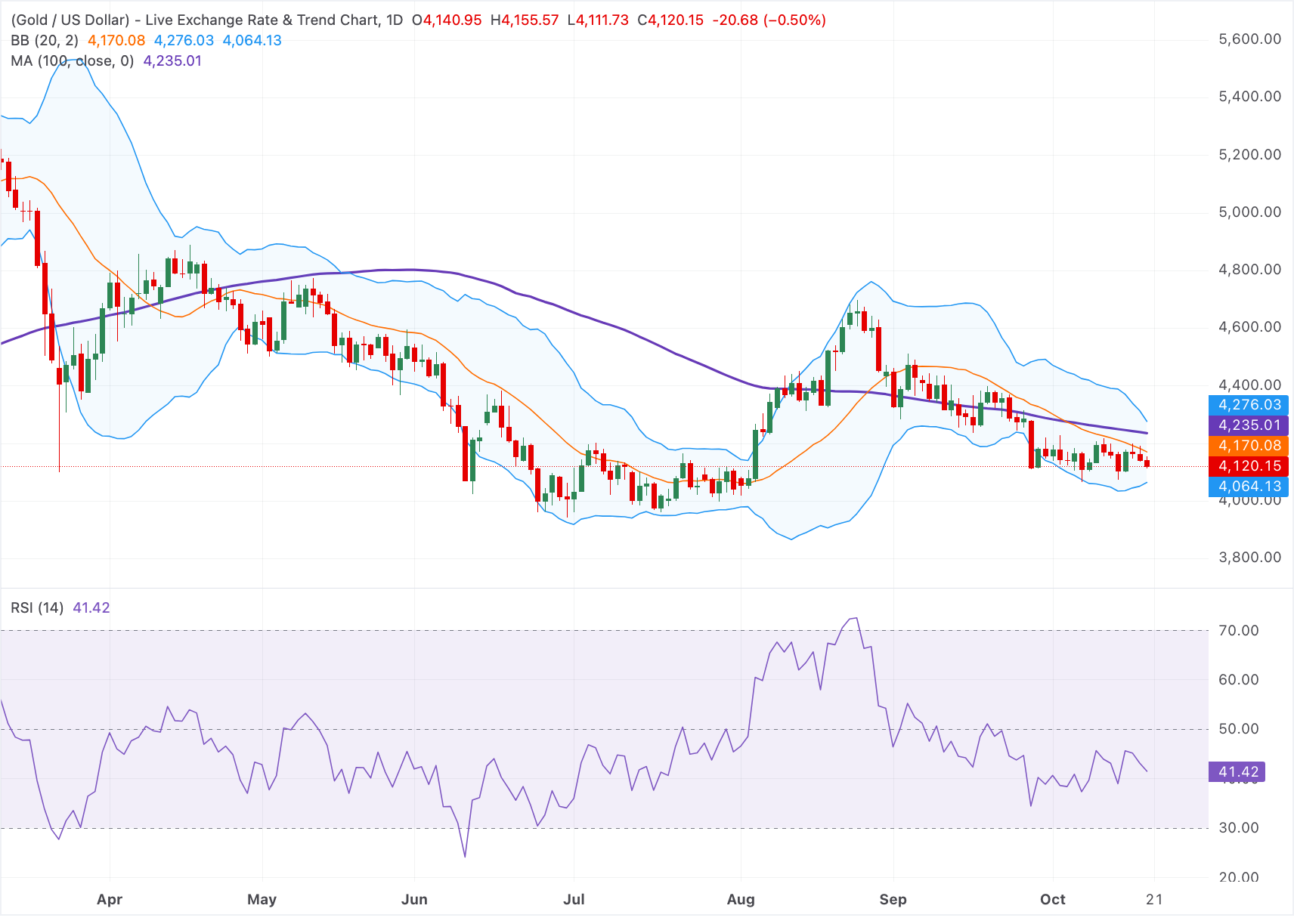
In the daily chart, XAU/USD opens at a pivotal level and holds below the 20-day Bollinger band middle line and the 100-day simple moving average (SMA), keeping the near-term tone bearish as rallies remain capped by these overhead levels. The lower reading of the 14-day Relative Strength Index (RSI) around 41 reinforces a weak momentum backdrop, suggesting downside risks while not yet signaling oversold conditions.
On the topside, initial resistance aligns at the Bollinger band middle line near $4,170, followed by the 100-day SMA around $4,235 and the Bollinger upper band at $4,275, forming a broad supply zone that could limit recoveries. On the downside, the next meaningful support emerges at the Bollinger lower band near $4,065, where buyers may attempt to slow the decline if bearish pressure extends.

Comments
Log in or sign up to join the conversation.