


Gold price (XAU/USD) declines to near $3,930 during the early Asian session on Wednesday, pressured by a firmer US dollar (USD) and higher Treasury yields. Traders await the outcome of US midterm elections for fiscal policy clues.
The US Dollar edges slightly higher as markets gauged uncertainty over a possible US-Iran deal and the outcome of the midterm elections, while Treasury yields also edged higher. This, in turn, undermines the USD-denominated commodity price. The outcomes of US elections will be closely monitored, with polls and nonpartisan analysts favoring Democrats to wrest control of the House from Republicans, while control of the Senate remains uncertain.
“A Democratic clean sweep could potentially put pressure on the US dollar by making it harder for the administration to pass law, including measures related to the debt ceiling. If the dollar falls, that’s one way gold could potentially find some support,” said Fawad Razaqzada, market analyst at forex.com.
The World Gold Council report released on Tuesday showed that central banks bought gold at the fastest pace since the end of 2024 in the third quarter (Q3), even as the metal faced pressure from higher oil prices and interest rates. The institutions accumulated a net 321 tons in the three months through September. However, the World Gold Council cut its forecast for growth in gold investment this year to 200 metric tons from 400 tons previously estimated.
Gold slide seen as excessive despite higher US rate expectations
Analysts at Commerzbank highlight that the gold price "fell by 3.7% on Friday to USD 3,870 per troy ounce, its lowest level in more than a year," leaving "a substantial monthly loss of almost 7% in October, which was even slightly larger than that recorded in September." They attribute much of the recent pressure to shifting monetary expectations, noting that "given the robust US economy and inflation running well above target, a further rate hike in December is highly likely." Commerzbank argues that "expectations of rate hikes have led to rising bond yields and (real) interest rates, which in turn increase the opportunity cost of holding gold and, conversely, reduce the attractiveness of holding gold."
However, the bank stresses that rate dynamics "can only explain the current fall in the price of gold to a limited extent," pointing out that "following last week’s Fed meeting – at which, as expected, the Fed left interest rates unchanged – interest rate expectations have eased and both nominal and real bond yields have subsequently fallen." Against this backdrop, Commerzbank concludes that "we consider the price decline in gold to be excessive and unwarranted. The arguments in favour of a rising gold price remain valid."
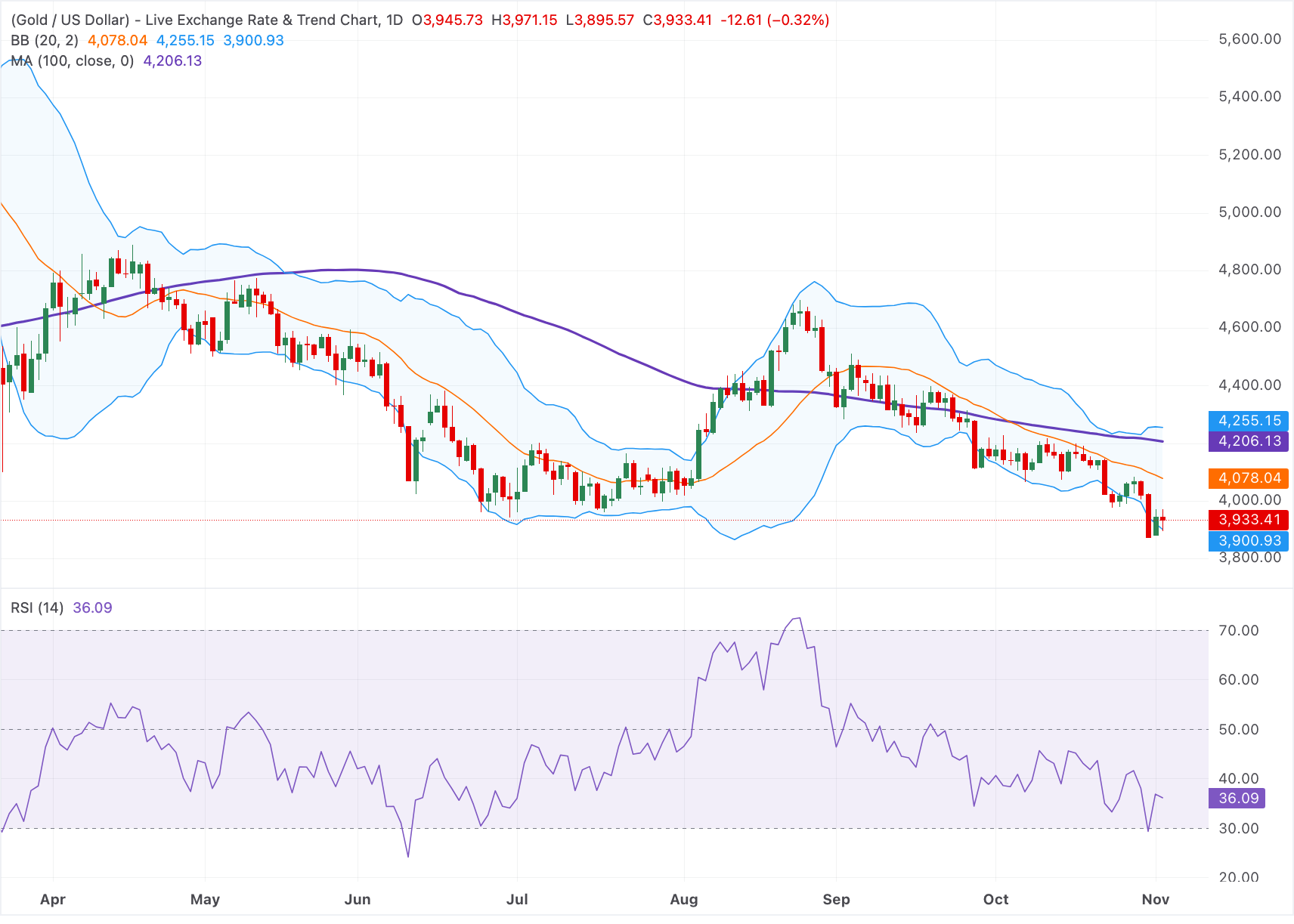
Technical Analysis: Gold retains a negative outlook below the 100-day SMA
In the daily chart, XAU/USD extends its retreat below key trend and volatility markers, which keeps the near-term bias bearish. Spot holds under the 100-day simple moving average (SMA) and the Bollinger Bands’ middle line, suggesting rallies remain capped within a broader corrective phase. The Relative Strength Index (RSI) at 36.09 hovers just above oversold territory, hinting at lingering downside pressure but also the risk of intermittent corrective bounces rather than a clear exhaustion low.
On the topside, initial resistance emerges at the Bollinger middle band near $4,080, followed by the 100-day SMA at $4,205, while a more distant cap is seen at the upper Bollinger band around $4,255. On the downside, immediate support aligns with the lower Bollinger band at $3,900; a decisive break beneath this floor would expose fresh bearish space, whereas holding above it could see gold consolidating within the current band structure before any attempt to challenge the overhead resistance cluster.


Comments
Log in or sign up to join the conversation.