

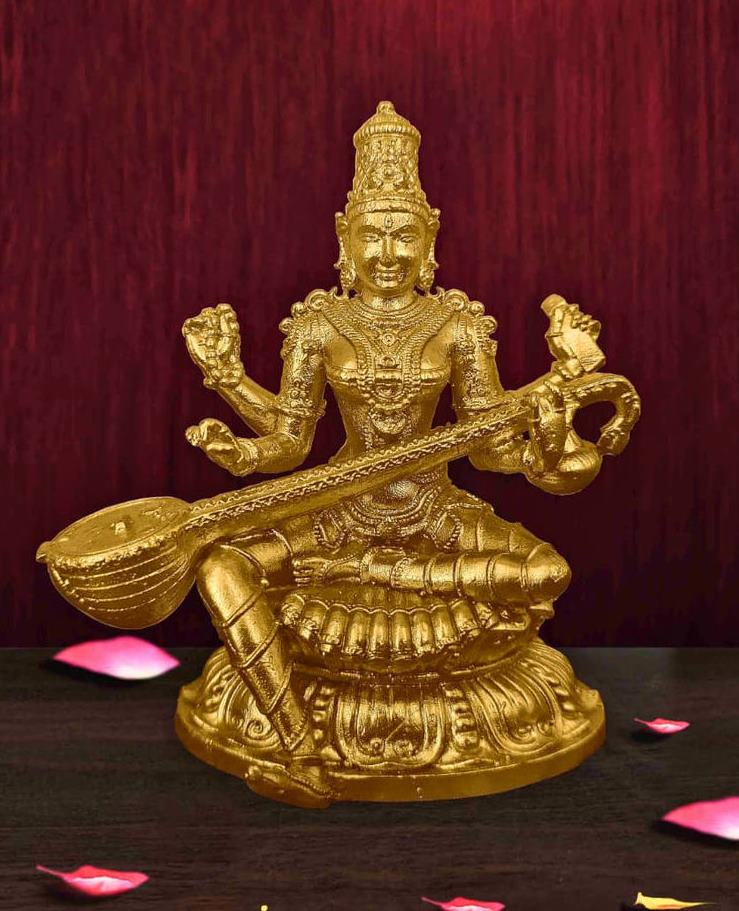
Saraswathi Amman is revered throughout the Hindu tradition as the goddess of knowledge, wisdom, speech and the arts, and many devotees seeking to invite her blessing into their homes turn to a brass Saraswathi idol as a daily reminder of clarity, learning and creative grace. As one of the three great goddesses of the Tridevi, she occupies a place in Hindu worship unlike almost any other deity - approached not primarily for wealth or protection, but for the pursuit of understanding itself.
Her iconography, her origins as a sacred river, and her enduring presence in classrooms, music rooms and pooja spaces across India all point to a single unifying idea: that knowledge, rightly pursued, is itself divine. At Idol Brass, this timeless devotion to learning and the arts is reflected in handcrafted brass idols made for exactly this kind of everyday reverence.
Who Is Saraswathi?
A Member of the Tridevi
Saraswathi is one of the three principal goddesses of Hindu tradition, together known as the Tridevi - Saraswathi (knowledge), Lakshmi (wealth) and Parvati (power). Each goddess is paired with a corresponding member of the Trimurti, and Saraswathi is regarded as the consort and creative partner of Brahma, the creator. Where Brahma conceives the universe, Saraswathi is understood as the wisdom and articulate speech through which that creation takes ordered, intelligible form.
Goddess of Speech, Learning and the Arts
Beyond her role as Brahma's consort, Saraswathi stands independently as the presiding deity of language, learning, music and the fine arts. Students, musicians, writers, and anyone engaged in creative or intellectual pursuit traditionally seek her blessing before beginning serious study or artistic work, making her one of the most personally invoked deities in everyday Hindu practice.
Distinct Among the Tridevi
Unlike Lakshmi, who is petitioned for prosperity, or Parvati, whose many forms embody shakti and protective power, Saraswathi's domain is entirely of the mind and spirit. This distinction shapes not just how she is worshipped, but how she is depicted - with a simplicity that sets her visibly apart from her fellow goddesses.
Iconography and Symbolism of Saraswathi
The Book of Knowledge
Saraswathi is typically shown with four arms, each holding an object rich with meaning. In one hand she holds a book, usually representing the Vedas - a symbol of the vast body of knowledge she presides over and the pursuit of learning as a lifelong discipline.
The Rosary and the Kamandalu
A second hand holds an akshamala, a string of prayer beads, symbolizing meditation, spiritual discipline and the inward focus needed to truly absorb knowledge rather than merely accumulate it. A third hand carries a kamandalu, a water vessel associated with purity, signifying that true wisdom must be paired with a clear, unclouded mind.
The Veena: Music as Wisdom
In her remaining hand, Saraswathi holds a veena, one of the oldest string instruments in Indian tradition. This is not incidental - music and the fine arts are considered, in her worship, to be as much a form of knowledge as scripture or science, and the veena signals that creativity and intellect are two expressions of the same divine gift.
The Swan as Vahana
Saraswathi's vahana, the swan (hamsa), carries a specific and much-loved symbolism: the swan is traditionally believed capable of separating milk from water when the two are mixed, a metaphor for the discernment to separate truth from falsehood, and the eternal from the fleeting. Riding this vahana, Saraswathi embodies the very quality of judgment that true knowledge is meant to cultivate.
White Attire and the White Lotus
Where other goddesses are often depicted in vivid color and elaborate ornamentation, Saraswathi is traditionally shown in white, seated on or beside a white lotus. This visual restraint is deliberate: white represents purity, clarity and the absence of the distractions and desires that cloud the pursuit of knowledge.
The Legend of Saraswathi
Born From Brahma's Mind and Speech
In the tradition surrounding creation, Brahma is said to have brought Saraswathi into being from his own mind, as the embodiment of articulate speech and ordered thought — the very faculty needed to give form and meaning to a newly created universe. Without her, creation would remain formless and unspoken; with her, it gains language, structure and comprehensible order.
The River That Became a Goddess
Saraswathi's origins are also deeply tied to a real, ancient river of the same name, described in the earliest Vedic hymns as one of the mightiest rivers of its time, flowing through the heartland of early Vedic civilization. Over the course of history, the physical Saraswathi river is believed to have dried up and vanished from the visible landscape - yet rather than disappearing from tradition, this vanishing became part of her legend, giving rise to the belief that her waters continue to flow unseen, beneath the surface, much like knowledge itself often works quietly before it surfaces as understanding.
An Eternal, Unbroken Flow
This dual identity - as a goddess of the mind and as a river that persists even when unseen - is what gives Saraswathi's legend its lasting power. Just as a river carves civilization along its banks, Saraswathi is remembered as the source from which language, the Vedas, music and the arts first flowed into human life, an eternal current that devotees still return to whenever they seek clarity or inspiration.
Temples of Saraswathi
Unlike many major Hindu deities, dedicated Saraswathi temples are relatively rare in India, which makes the few that exist especially significant. Koothanur in Tamil Nadu is home to one of the only standalone Saraswathi temples in South India, situated along the Cauvery river. In Karnataka, the Sringeri Sharadamba temple, founded by Adi Shankaracharya, is one of the most revered centers of Saraswathi worship in the country, closely associated with scholarship and the Advaita tradition. In Telangana, the Basara temple on the banks of the Godavari river is counted among the very few ancient Saraswathi shrines in India, drawing students and scholars especially around examination season.
Spiritual Significance of Saraswathi
Illumination over ignorance - Saraswathi represents the light of knowledge that dispels confusion and misunderstanding.
Discipline of the mind - her rosary and kamandalu together emphasize that real wisdom requires meditative focus and inner purity, not just information.
The arts as sacred - through the veena, music, dance and creative expression are honored as spiritual pursuits in their own right.
Discernment - her swan vahana reminds devotees to seek truth and distinguish it clearly from illusion.
Purity of pursuit - her white attire signals that knowledge sought for its own sake, free of ego or material desire, is her truest form of worship.
Why Is Saraswathi Different from Other Tridevi Forms
Lakshmi is invoked for wealth and material prosperity, Parvati for strength, protection and shakti, while Saraswathi alone presides over the intangible realm of knowledge, speech and the arts.
Her iconography is notably restrained - white, unadorned, and free of the elaborate jewellery often seen on Lakshmi or Parvati - reflecting a domain where clarity matters more than abundance.
She is one of the few major goddesses with very few dedicated temples in India, making her worship far more common in homes, schools and music rooms than in grand temple complexes.
Her devotees approach her primarily at the start of learning or artistic endeavors - during Vasant Panchami or before exams and performances - rather than for the ongoing, everyday petitions associated with other Tridevi forms.
Conclusion
From her role as the voice and order behind Brahma's creation, to her identity as a river whose waters are said to still flow unseen, Saraswathi's story is ultimately about knowledge that never truly disappears - it simply waits to be sought again. Her simple white form, book, veena and discerning swan all point toward the same invitation: to pursue learning, music and truth with a clear and disciplined mind. For those who wish to keep that spirit of wisdom and creativity present in their own home, a brass Saraswathi idol offers a lasting, personal connection to this ancient tradition of knowledge.
Comments
Log in or sign up to join the conversation.