
Compare Eligibility, Course Duration, Curriculum, Career Opportunities, Salary, and Future Scope to Choose the Best Nursing Course
Choosing the right nursing course is the first step toward building a successful career in the healthcare industry. Among the most popular nursing programs are General Nursing and Midwifery (GNM) and Bachelor of Science in Nursing (BSc Nursing). Although both courses prepare students to become skilled nursing professionals, they differ in terms of duration, eligibility, curriculum, career opportunities, and future growth.
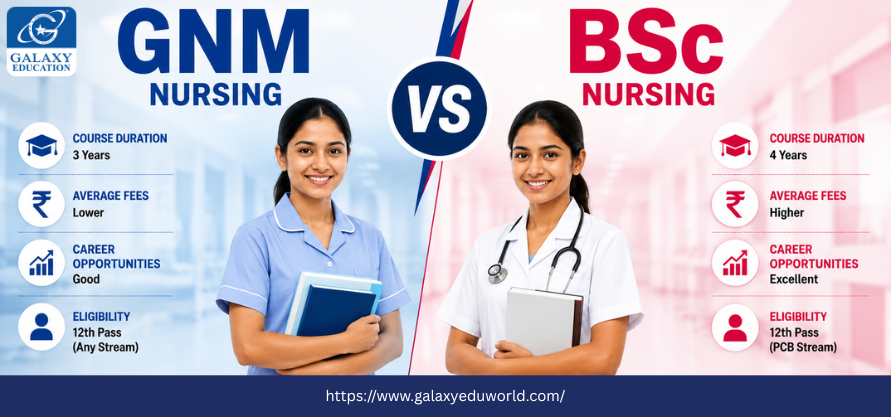
If you're unsure which course to choose, this guide will help you understand the differences between GNM and BSc Nursing so you can make the right decision for your future.
What is GNM?
General Nursing and Midwifery (GNM) is a diploma course designed to train students in patient care, nursing practices, and midwifery. The program emphasizes practical learning and clinical experience, enabling graduates to work in hospitals, clinics, nursing homes, and community healthcare centers.
GNM is a suitable option for students who wish to begin their nursing careers quickly and gain practical experience in the healthcare sector.
What is BSc Nursing?
BSc Nursing is a four-year undergraduate degree program that offers in-depth knowledge of nursing science, healthcare management, medical subjects, research, and clinical practice. The course combines classroom learning with extensive hands-on training to prepare students for advanced nursing roles.
Graduates of BSc Nursing are well-equipped for leadership positions, specialized nursing fields, and higher education.
GNM vs. BSc Nursing: Key Differences
Course Type: GNM is a diploma program, whereas BSc Nursing is a bachelor's degree.
Duration: GNM usually takes three years to complete, along with an internship where applicable. BSc Nursing is a four-year degree program.
Eligibility: GNM generally requires completion of 10+2 from a recognized board. BSc Nursing typically requires 10+2 with Physics, Chemistry, Biology, and English, depending on the institution's admission criteria.
Focus: GNM focuses primarily on practical nursing skills, patient care, and midwifery. BSc Nursing provides comprehensive education in nursing theory, clinical practice, research, and healthcare management.
Career Opportunities: GNM graduates usually begin as Staff Nurses, Community Health Nurses, or Home Care Nurses. BSc Nursing graduates can pursue roles such as Staff Nurse, Nursing Officer, ICU Nurse, Emergency Nurse, Clinical Instructor, Nurse Educator, and Healthcare Administrator.
Higher Education: After GNM, students can continue with Post Basic BSc Nursing and other nursing specializations. BSc Nursing graduates can pursue M.Sc. Nursing, Master of Public Health (MPH), MBA in Hospital Management, Ph.D., and various postgraduate programs.
Career Growth: While both courses offer rewarding careers, BSc Nursing generally provides better opportunities for promotions, specialization, leadership positions, and international employment.
Eligibility Criteria
GNM
Students applying for GNM should have completed Class 12 from a recognized board. Admission requirements may vary depending on the institution and applicable regulations.
BSc Nursing
Candidates should have completed Class 12 with Physics, Chemistry, Biology, and English. Some colleges may also conduct entrance examinations or consider merit-based admissions.
Applicants are advised to check the latest eligibility criteria of their preferred institution before applying.
Course Curriculum
GNM Curriculum
The GNM course generally includes:
Fundamentals of Nursing
Anatomy and Physiology
Community Health Nursing
Midwifery
Child Health Nursing
Mental Health Nursing
Clinical Practice
BSc Nursing Curriculum
The BSc Nursing program typically covers:
Nursing Foundation
Anatomy and Physiology
Pharmacology
Microbiology
Nutrition
Psychology
Medical-Surgical Nursing
Obstetrics and Gynecological Nursing
Child Health Nursing
Community Health Nursing
Mental Health Nursing
Nursing Research
Nursing Management
Clinical Internship
Career Opportunities
Career Options After GNM
GNM graduates can work as:
Staff Nurse
Community Health Nurse
Home Care Nurse
Clinic Nurse
Nursing Assistant
Primary Health Centre Nurse
Many professionals choose to pursue higher education later to expand their career prospects.
Career Options After BSc Nursing
BSc Nursing graduates can explore roles such as:
Staff Nurse
Nursing Officer
ICU Nurse
Emergency Nurse
Operation Theatre Nurse
Public Health Nurse
Clinical Instructor
Nurse Educator
Research Assistant
Healthcare Administrator
They can find employment in government hospitals, private hospitals, military healthcare services, educational institutions, NGOs, rehabilitation centres, and international healthcare organizations.
Salary Prospects
Salary varies depending on experience, employer, location, and specialization.
GNM graduates generally begin with entry-level nursing positions and can increase their earning potential through experience and additional qualifications.
BSc Nursing graduates often receive better starting salaries and have greater opportunities for promotions, specialized roles, and managerial positions throughout their careers.
Which Course Should You Choose?
Choose GNM if you:
Want to enter the nursing profession quickly.
Prefer practical, skill-based learning.
Plan to gain work experience before pursuing higher education.
Choose BSc Nursing if you:
Want a comprehensive nursing education.
Plan to pursue postgraduate studies or nursing specialization.
Aim for leadership roles and long-term career growth.
Wish to explore career opportunities in India and abroad.
Final Thoughts
Both GNM and BSc Nursing are excellent career options for students passionate about healthcare and patient care. Your choice should depend on your educational background, career aspirations, financial considerations, and long-term goals.
If you want to start working sooner and gain practical experience, GNM can be a suitable choice. However, if you're looking for broader career opportunities, better salary potential, higher education, and leadership roles, BSc Nursing is generally the better long-term investment.
Before applying, compare the curriculum, eligibility requirements, accreditation, faculty, clinical training, and placement opportunities offered by your preferred nursing college. Choosing the right course today can lay the foundation for a rewarding and successful career in nursing.
Comments
Log in or sign up to join the conversation.