


Image: Bigstock
General Motors (GM - Free Report) and Ford Motor (F - Free Report) have both delivered better-than-expected second-quarter results, reinforcing the resilience of Detroit's legacy automakers despite a challenging backdrop that includes tariffs, slowing EV demand, and elevated interest rates.
Better pricing, disciplined cost controls, and continued strength in trucks and SUVs helped both companies top Wall Street's expectations while raising their full-year outlooks.
Following their upbeat Q2 reports, investors may be wondering whether the recent rally in both stocks has further room to run, with GM spiking 18% this month and F up 11%.
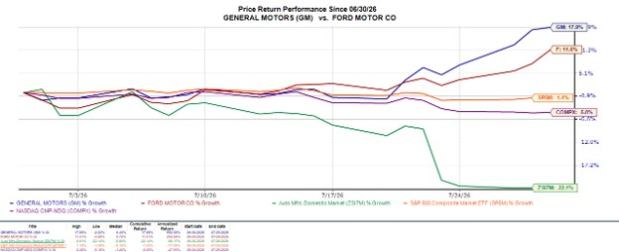
Image Source: Zacks Investment Research
GM Continues to Execute at a High Level
Reporting Q2 results last week, General Motors once again demonstrated why it has become one of the auto industry's most consistent earnings performers.
General Motors reported Q2 revenue of $48.02 billion, up nearly 2% year over year and comfortably exceeding estimates of $46.55 billion by 3%.
More impressively, Q2 adjusted EPS of $3.57 soared 41% from earnings of $2.53 per share in the prior year quarter and crushed expectations of $3.13.
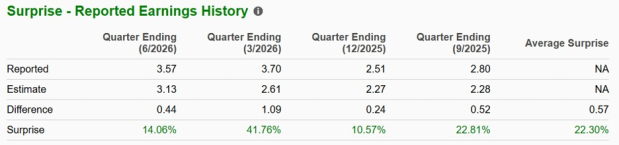
Image Source: Zacks Investment Research
GM raised its full-year guidance for the second time this year across several key metrics, increasing its adjusted EBIT (Earnings Before Interest and Taxes) outlook to a range of $14 billion to $16 billion, raising its adjusted EPS guidance to $12 to $14, and boosting its adjusted automotive free cash flow forecast to between $9.5 billion and $11.5 billion.
Operationally, North America remained the primary profit engine. GM generated an impressive 8.6% adjusted EBIT margin in the region, benefiting from continued demand for its full-size pickup trucks and SUVs, disciplined pricing, lower warranty costs, and improving EV profitability. Management also highlighted record adoption of its Super Cruise driver-assistance technology and improving efficiency across its manufacturing footprint.
These results suggest GM's strategy of balancing traditional internal combustion vehicles with a more measured EV transition is paying off. It’s also noteworthy that in the current global automotive landscape, a healthy EBIT margin for an automaker is generally considered to be in the low single digits.
Illustrating strong operational profitability and efficiency, GM’s trailing 12-month EBIT margin is at an industry-leading 5.78%, with Ford’s being roughly on par with the Zacks Automotive-Domestic Industry average of 2.81%.
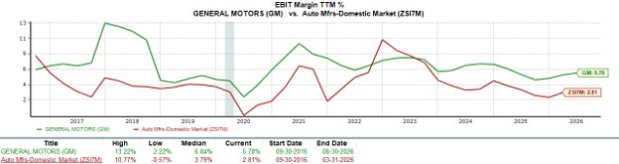
Image Source: Zacks Investment Research
Ford Delivers an Encouraging Quarter
Ford also impressed investors with an earnings beat and a higher full-year outlook after reporting Q2 results yesterday evening.
Adjusted EPS came in at $0.42, rising from $0.37 per share a year ago and beating expectations of $0.33 by 27%.
Ford's operational performance remained encouraging, as adjusted EBIT climbed 17% YoY to $2.5 billion, highlighting the benefits of stronger pricing, a favorable product mix, and improving cost discipline.
This was despite Q2 revenue of $44.89 billion falling from $46.94 billion in the prior year quarter and missing estimates of $45.71 billion. That said, the company capitalized on a richer mix of high-margin trucks and SUVs while improving cost controls amid slower volume sales, which were attributed to discontinued vehicle models such as the Ford Escape.
Ford raised its full-year adjusted EBIT forecast to $10 billion-$11 billion, up from $8.5 billion-$10.5 billion, while also increasing its free cash flow outlook by roughly $1 billion to a range of $10 billion-$11 billion. Managment cited improving U.S. vehicle pricing, recovering aluminum supplies, and expected tariff refunds as key drivers behind the stronger outlook.
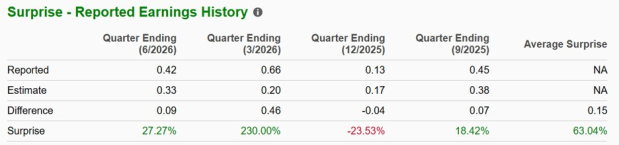
Image Source: Zacks Investment Research
GM & Ford Valuation Comparison
Despite their impressive rallies, both stocks remain inexpensive compared to the broader market.
GM continues to trade at a significant discount to the S&P 500, offering one of the lowest forward earnings multiples among large-cap industrial companies at 6X. Given General Motors improving earnings outlook, expanding margins, and strong free cash flow generation, that discount may prove difficult to justify if execution remains consistent.
Ford is also attractively valued at 9X forward earnings, although the market appears to be assigning a modest premium relative to GM because of its improving profitability and generous shareholder returns.
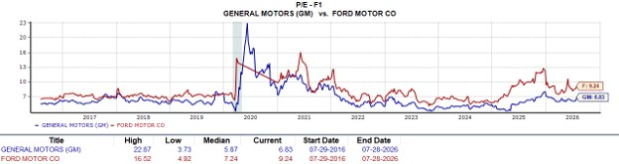
Image Source: Zacks Investment Research
To that point, Ford's dividend remains an added attraction for income-oriented investors at 4.01% compared to GM’s 0.8%. Still, GM's accelerating earnings growth and aggressive share repurchases have arguably created greater shareholder value in recent years.
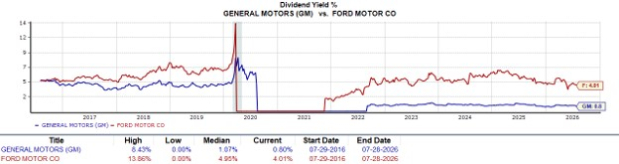
Image Source: Zacks Investment Research
Conclusion & Final Thoughts
GM and Ford both demonstrated that legacy automakers can still generate impressive earnings growth despite ongoing uncertainty surrounding tariffs, EV demand, and the broader economy.
For investors seeking the stronger combination of earnings momentum, improving profitability, and an attractive valuation, GM appears to have the edge following its impressive Q2 performance and second guidance increase of the year.
However, Ford's raised outlook, improving execution, and shareholder-friendly capital return strategy continue to make it an appealing long-term investment as well.
Supported by improving fundamentals and continued upward earnings estimate revisions, GM stock currently sports a Zacks Rank #2 (Buy), while Ford shares land a Zacks Rank #3 (Hold).



Comments
Log in or sign up to join the conversation.