


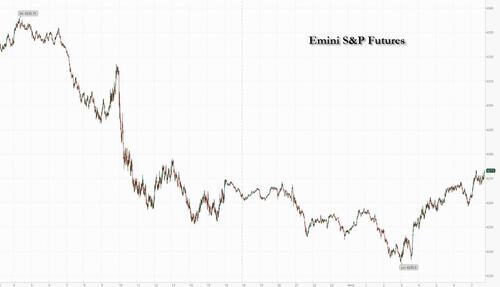
Global stocks and US futures were in freefall earlier this session, with spoos tumbling to a four month low of 4,235 and tracking the relentless drop in Treasuries tick for tick which briefly sent 30Y yields above 5.00% - the highest since Sept 2007 - around the time Europe opened...
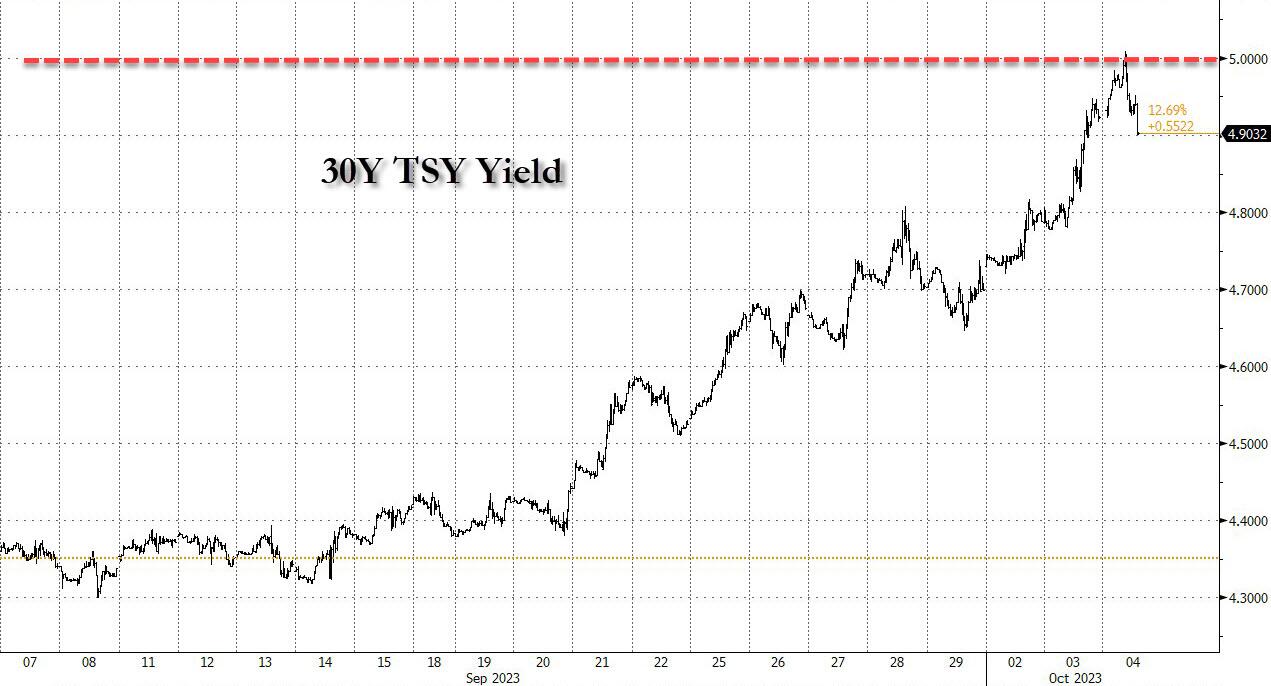
... before a bout of buying kicked in and yields dropped sharply while futures reversed all losses and as of 7:45am, S&P futures were up 0.2% to 4,273 while Nasdaq futures were up 0.1% after slumping sharply earlier.
Europe was mixed as German 10-year yields reached the highest level since 2011 too as the Treasury moves rippled across markets. Investors are now focusing on term-premium and demanding greater compensation to hold onto long-dated debt with rates set to remain higher for longer, while concerns about the ridiculous pace of Treasury issuance - US debt rose by a whopping $275 billion on the first day of October - to address rising budget deficits are also weighing. Elsewhere, the dollar also dropped, as did oil, with WTI slipping further below the $90-per-barrel mark as an OPEC+ meeting is set to announce no changes to its policy.
In premarket trading, Apple fell 1%, after the stock was downgraded at KeyBanc Capital Markets, which said shares of the iPhone maker are trading near all-time high valuation levels, though its sales growth is likely to slow, while CEO Tim Cook sold $41 million in stock after taxes, his biggest sale in more than two years. Brooge Energy rose 21% after the company confirmed receipt of an acquisition offer from Gulf Navigation Holdings in a filing. Palantir gained 2% as the data analysis firm has emerges as the top pick for a contract to overhaul the UK’s National Health Service.
The latest leg of the bond selloff was fueled by Tuesday’s grotesquely manipulated and better-than-expected US job data, one which even Goldman mocked as being ridiculously adjusted, as well as a slew of hawkish comments from Federal Reserve officials. Data on U.S. private payrolls due later from the ADP Research Institute could fan more volatility, coming on the heels of Tuesday’s JOLTS survey.
“It’s fair to say there’s going to be a volatile environment until we have more clarity” on the direction of rates, Virginie Maisonneuve, global chief investment officer for equites at Allianz Global Investors, said in an interview with Bloomberg Television. “If you have a long-term time horizon find those stocks that have very strong structural backing for growth and have quality balance sheets.”
Meanwhile, there are signs that buyers are already emerging to take advantage of the stock swoon. The S&P 500 is officially in oversold territory based on its relative strength index of below 30. Francisco Simón, European head of strategy at Santander AM, is among those eyeing cheapened assets.
“The current weakness of equities would be an opportunity to enter those sectors and companies with high sensitivity to rates,” he said. “We hope they will do a catch-up again once rates stabilize. Current yields are already at very high levels for the expected inflation and growth in the medium and long term.”
European stocks managed to squeeze out marginal gains with the Stoxx 600 adding 0.2%. In individual stock moves Wednesday, airline SAS AB fell as much as 96% after the bankrupt Scandinavian flag carrier announced plans to be taken private. Tesco shares gain as much as 3.2%, the most since March 29, after the UK grocer increased its guidance for retail adjusted operating profit for the year. Here are the most notable European movers:
- Sanofi shares rise as much as 0.9%, outperforming the Stoxx 600 Health Care Index, after the company agreed to pay Teva Pharmaceutical as much as $1.5 billion to help develop and sell a medicine for inflammatory bowel disease
- Orange rose as much as 2.5%, outperforming declining European markets, after BofA upgraded its rating by two notches and said the investment case for the French group ticked all the boxes
- Fresenius Medical falls as much as 5.4%, the most since mid-August, after attorneys general in New York, New Jersey and Georgia filed a complaint against Fresenius Vascular Care, Inc. alleging unnecessary kidney disease surgeries
- Cellnex drops as much as 3.9%, to the lowest in almost a year, after Barclays downgrades the tower operator to equal-weight, flagging overhang risks from sector M&A and some tailwinds turning into headwinds
- BW LPG shares fall as much as 14% in Oslo, the most intraday since August 2022, after an offering of 8.4m shares by holders via DNB Markets
- Spirent shares plummeted 40%, most since 2002, after the UK network testing firm said a slow summer and disappointing September meant it fell short of expectations for the third quarter
- Airline SAS falls as much as 96% after announcing plans to be taken private late on Tuesday as part of a restructuring process as it emerges from Chapter 11 bankruptcy proceeding in the US.
Earlier in the session, Asian stocks tumbled, with several local benchmarks tracking the key regional gauge toward a correction, as the risk-off mood intensified after strong US jobs data amplified concerns of higher-for-longer interest rates. The MSCI Asia Pacific Index fell 1.7%, pushing it down more than 10% from a July high. Tech stocks were the biggest drag as the 10-year Treasury yield climbed to a fresh 16-year high. South Korea’s Kospi and Japan’s Nikkei 225 were among the region’s worst performers Wednesday, also flirting with technical-correction territory. Markets had become complacent about macro concerns in recent months as excitement over artificial intelligence helped drive stocks higher globally. That rally has now all but faded in the wake of strong economic data that’s backed the case for the Federal Reserve to keep interest rates elevated.
- Hang Seng conformed to the downbeat mood amid the continued absence of mainland participants and with pressure on tech, energy and casino stocks.
- ASX 200 was dragged lower by underperformance in tech, real estate and the top-weighted financial sector with headwinds amid the continued upside in yields.
- Nikkei 225 extended on losses beneath the 31,000 level amid wide speculation of FX intervention and with Japanese officials out in force but refusing to confirm or deny whether they intervened.
- KOSPI underperformed on return from the extended holiday despite encouraging Industrial Production data which showed a surprise expansion.
- India stocks declined for a second consecutive session, tracking losses in regional peers as investors shun riskier assets on worries over interest rates staying higher for longer. The S&P BSE Sensex fell 0.4% to 65,226.04 as of 03:45 p.m. in Mumbai, the lowest since Aug. 31. The NSE Nifty 50 Index declined 0.5% to 19,436.10, the lowest since Sept. 1. BSE’s small- and mid-cap gauges also fell by more than 1% each. Foreign investors have turned sellers of Indian shares, taking out $2.3b in September, their first selloff after six straight months of purchases.
In FX, the Bloomberg Dollar Spot Index falls 0.1%. The kiwi underperforms after the RBNZ left rates on hold, falling 0.2% versus the greenback. USDJPY is down to 148.88 after Japanese officials declined to comment on speculation they intervened in the currency market on Tuesday when the pair briefly rose above 150.
In rates, Treasury yields reversed an earlier spike which extended Tuesday’s bond market rout during London trading. 10-year reached 4.76% and keeping pace with bunds, gilts in the sector, while 30-year yields briefly exceeded 5% but were down to 4.88% last. As conviction grew that US interest rates could rise further from current 22-year highs, 30-year yields touched 5% for the first time since 2007. Markets are pricing a one-in-three chance of a November. US yields from belly to long-end are little changed with front-end yields marginally richer on the day; 2s5s10s fly cheaper by ~3bp on the day as belly underperforms. Recent activity in Treasury options sees traders positioning for 10-year yield above 5%. The Dollar IG issuance slate includes Kommuninvest 2Y; all companies considering deals Tuesday stood down Tuesday.
In commodities, crude futures decline, with WTI falling almost 2% to trade around $88, at the lowest level in three weeks.
Looking to the day ahead now, the US session has heavy economic data slate, starting with ADP employment change at 8:15am New York time; it will also include the ISM services index along with factory orders for August. Elsewhere, there’s the final services and composite PMIs for September from around the world, and in the Euro Area there’s retail sales and PPI for August. Central bank speakers include ECB President Lagarde, Vice President de Guindos, and the ECB’s Centeno and Panetta, along with the Fed’s Bowman and Goolsbee.
Market Snapshot
- S&P 500 futures down 0.1% to 4,259.25
- STOXX Europe 600 little changed at 440.75
- MXAP down 1.6% to 152.35
- MXAPJ down 1.1% to 479.26
- Nikkei down 2.3% to 30,526.88
- Topix down 2.5% to 2,218.89
- Hang Seng Index down 0.8% to 17,195.84
- Shanghai Composite up 0.1% to 3,110.48
- Sensex down 0.8% to 64,971.11
- Australia S&P/ASX 200 down 0.8% to 6,890.25
- Kospi down 2.4% to 2,405.69
- Brent Futures down 0.7% to $90.32/bbl
- Gold spot down 0.1% to $1,821.18
- U.S. Dollar Index little changed at 106.93
- German 10Y yield little changed at 2.98%
- Euro up 0.2% to $1.0484
Top Overnight News
- 1) Japan’s central bank made unscheduled purchases of government debt on Wednesday as yields on benchmark bonds hit their highest mark in a decade, while a global market sell-off also continued to drive US Treasury yields to 16-year highs. FT
- 2) Softbank’s Son says AI will surpass human intelligence within the next decade as he spent an hour at the annual Softbank World event extolling the benefits of the technology. WSJ
- 3) Oil edged lower ahead of an OPEC+ market review. The group may not suggest any change in its policy, with Saudi Arabia reaffirming plans to stick with its current curbs. In the US, crude inventories fell 4.21 million barrels last week, API data is said to show. That would lower total stockpiles to the least since March 2022 if confirmed by the EIA. BBG
- 4) ECB’s Lagarde reiterates that policy rates have likely hit their peak for the cycle (but will stay elevated for an extended period). ECB
- 5) US companies probably added 150,000 jobs in September, ADP data is expected to show. That's the lowest since March, adding to signs of moderating labor demand before Friday's payrolls data. Jeffrey Gundlach warned that even a small tick up in unemployment should put markets on "recession alert." BBG
- 6) The House has voted to remove Rep. McCarthy as speaker. This has no immediate policy consequence, nor does it impact government funding, which was recently extended to Nov. 17. That said, a leadership vacuum in the House raises the odds of a government shutdown when the current funding extension expires. We continue to view a shutdown in Q4 as the base case, likely when funding expires Nov. 17. GIR
- 7) Bond slump threatens to undercut the potential for an economic soft landing while the velocity of the move could stoke disruptions in financial markets. WSJ
- 8) More than 75,000 workers are preparing for the largest health care strike in US history today after talks between Kaiser Permanente and a coalition of unions so far failed to produce a resolution. The three-day walkout may interrupt services for almost 13 million people, primarily in western states as well as the Mid-Atlantic and Washington, D.C., area. BBG
- 9) Ford offered striking workers a more than 20% wage increase and said it would halve the time it takes new employees to reach top pay. BBG
- 10) Large landlords bought 0.4% of U.S. homes in the second quarter, down from a peak of 2.4% at the end of 2021, as higher debt costs and moderating rent growth ate into investment returns...
More By This Author:
Judge Denies SEC's Plan For Quick Appeal Against Ripple RulingJuicy Jobs Data Slams Stocks, Sparks Bond Bloodbath & VIXplosion
WTI Holds Gains After API Reports Surprise Crude Draw, Cushing Build



Comments
Log in or sign up to join the conversation.