

Global financial markets slumped this week after the US imposed steel and aluminium tariffs on exports. However, markets worldwide pared the losses on Friday amid robust US jobs data.
Data from the U.S. Labor Department revealed that the nation had added 313,000 jobs last month, surpassing analyst expectations of 200,000. Construction was the biggest sector gainer, with 61,000 new job roles, followed by retail. This news meant that Wall Street posted sharp gains, with the Dow soaring over 250 points, thus making sure it ended the week in black, up 1.2%.
European stocks ended the week in red, however positive jobs data from the US helped cut losses. Among country benchmarks, the UK's FTSE was down 0.1% while Germany's DAX was down by 0.8%, and France's CAC 40 was lower by 0.9% over the week.
Back home, the BSE Sensex closed the week lower as sector indices across the board witnessed selling pressure. Taking a cue from PNB, bank stocks continued to be under pressure, while metal stocks were the top losers for the week, with the BSE Metal index down by 6.9%.
Key World Markets During the Week

On the sectoral indices front, stocks from Consumer Durables and Banking witnessed selling pressure.
BSE Indices During the Week

Key economic and industry developments last week.
Over a dozen public sector banks (PSBs) will get Rs 461 billion as part of capital infusion in the current fiscal ending this month to allot shares to the government in lieu of equity capital.
These banks, including SBI, PNB, Bank of Baroda, Central Bank, Union Bank and OBC, have called shareholders' meetings this month to pass the resolution to allot preferential shares to government so as to receive the capital.
The country's largest lender, State Bank of India (SBI), will get the largest sum of Rs 88 billion as government's capital infusion.
Meanwhile, Bank of Baroda will get Rs 53.8 billion as government equity capital; Central Bank Rs 48.5 billion; Union Bank of India Rs 45.2 billion; Oriental Bank of Commerce Rs 35.7 billion; Dena Bank Rs 30.5 billion; Syndicate Bank Rs 28.4 billion and Corporation Bank Rs 21.9 billion.
In October, the government had announced a mega-Rs 2.11 trillion capital infusion into PSBs in the course of next two years, of which Rs 800 billion are to be raised via issuance of bonds by the banks.
The intent of this huge capital infusion is aimed at strengthening the PSBs and to help them clean up their balance sheets of the bad assets they have been plagued over the last several years.
Several mechanisms like referring cases of NPA accounts to National Company Law Tribunal (NCLT) to recover dues as well as selling bad loans to asset reconstruction companies (ARCs)/banks/FIs/NBFCs are also being employed by banks to get rid of the bad assets.
In the latest development, the Union Cabinet has given its nod to a relief package for the financially-stressed telecom sector.
Reportedly, the government agreed to allow more time to the telecom operators to pay for the spectrum bought in auctions, under the new plan and also relaxed the spectrum holding limit for telecom companies to 35% from 25% at present.
These measures are expected to increase the cash flow for telecom operators immediately, providing the operators some relief. Besides, revising the limit for spectrum holding will facilitate consolidation of telecom players and may encourage their participation in future auctions, the reports noted.
Last year, the Inter Ministerial Group (IMG) was tasked to suggest policy reforms and strategic interventions for the troubled sector bruised by falling tariffs, eroding profitability and mounting debt in the face of stiff competition from new entrant Reliance Jio. The IMG, in its recommendations submitted last year, had mooted the extension of time period for the payment of spectrum bought in auctions by operators to 16 years from the current 10 years.
At present, a portion of spectrum auction amount is taken as upfront payment by Department of Telecommunications (DoT), and the rest after a two-year moratorium is paid out every year in 10 installments.
Finance Minister Arun Jaitley has stated that public sector banks (PSBs) have written-off loans worth Rs 816.8 billion in the financial year 2016-17, including Rs 203.4 billion by the State Bank of India.The Telecom Commission, which is the highest decision making body at the Department of Telecom, had also approved sectoral regulator Trai's recommendation that the ceiling on spectrum held by mobile operators within a particular band be removed. It had suggested 50% cap on combined radiowave holding in efficient bands.
Reportedly, the amount written off by nationalized banks was Rs 287.8 billion during the current fiscal (up to September, 2017). Besides, it was noted that writing-off of loans is done for tax benefit as well as capital optimization. However, borrowers of such loans continued to be liable for repayment.
As per the Reserve Bank of India (RBI) guidelines and policy approved by bank Boards, non-performing loans, including those in respect of which full provisioning has been made on completion of four years, are removed from the balance-sheet of the bank concerned by way of write-off.
The minister further stated that recovery of dues takes place on ongoing basis under legal mechanisms, which include, the Secularisation and Reconstruction of Financial Assets and Enforcement of Security Interest Act, Debts Recovery Tribunals and Lok Adalats. Therefore, a write-off does not benefit borrowers, the reports noted.
Besides, in the five-financial years since April 1, 2013, banks have reported 13,643 cases of fraud involving a total amount of Rs 527.2 billion.
While the bad loans struggle has been going on since a decade, there are other issues that have recently cropped up adding to PSUs pile of misery. Bureaucracy and a lack of autonomy have ensured the sub-optimal profitability and asset quality of these state-run banks.
In news from the GST space. The Goods and Service Tax (GST) Council, is set to meet on Saturday to consider proposals to further delay rolling out the e-way bill system by about 5-6 months and levy GST on a concentrated form of alcohol.
The 26th GST Council meeting will also try to reach a consensus on simplifying tax returns.
E-way bills will automate the paperwork for goods transportation, check instances of inflating or under-reporting the value of consignments aimed at tax evasion, create an electronic trail of goods movement and generate valuable data about goods consumption pattern across the country.
The scheme, earlier proposed to be enforced from 1 February was deferred on the same day due to technical glitches. Policymakers now do not want premature roll out of the scheme risking a trade disruption.
Once implemented, e-way bill is needed for all movement of goods valued at more than Rs 50,000. within or outside a stat.
Every coin has two sides. GST is no exception. It has had its fair share of chaos in the months immediately post its implementation from 1 July 2017. Many businesses reported depressed earnings due to the transition to GST.
Our colleague Vivek Kaul has studied the finer aspects of the GST and predicted what could go right and wrong.
Download his special report - The Good, the Sad and the Terrible (GST).
Movers and shakers during the week
| TOP GAINERS DURING THE WEEK (BSE GROUP A) | ||||
|---|---|---|---|---|
| COMPANY | 5-MAR-18 | 9-MAR-18 | CHANGE | 52-WK HIGH/LOW |
| CENTRAL BANK | 65 | 76 | 17.1% | 125/63 |
| OBEROI REALTY | 493 | 525 | 6.4% | 577/339 |
| BAYER CROPSCIENCE | 3,808 | 4,026 | 5.7% | 5,050/3,685 |
| ASHOK LEYLAND | 140 | 147 | 4.8% | 147/81 |
| ORACLE FINANCIAL SERVICES | 3,760 | 3,889 | 3.4% | 4,376/3,300 |
| TOP LOSERS DURING THE WEEK (BSE GROUP A) | ||||
| ADANI ENTERPR. | 201 | 156 | -22.3% | 223/93 |
| RELIANCE COMMUNICATIONS | 28 | 23 | -18.2% | 42/10 |
| JAIPRAKASH ASSO. | 17 | 14 | -18.2% | 30/`9 |
| GITANJALI GEMS LTD | 19 | 16 | -18.1% | 105/16 |
| ADANI POWER | 31 | 25 | -17.5% | 48/25 |
Source: Equitymaster
Key corporate developments last week
HDFC Bank Ltd has appointed arrangers, including Bank of America Corp, Morgan Stanley and Credit Suisse Group AG, for a Rs 155 billion (US$2.38 billion) planned share sale.
HDFC Bank plans to raise the bulk of the funds from international investors through a sale of American depository receipts, with the rest to come from selling stock in India. The money will be used to boost the company's capital buffers and support its growth plans for several years.
HDFC Bank approved in December a fund raising of as much as Rs 240 billion through a share sale. Parent company Housing Development Finance Corp. will invest about Rs 85 billion.
In news from airline stocks, IndiGo plans to order as many as 50 Airbus SE A330 wide-body jets as it seeks to expand beyond short-haul flights.
As per The Livemint, the deal would be worth US$13 billion at list prices for the smaller of two variants. IndiGo is developing plans for long-haul flights after building up a fleet of more than 150 Airbus A320 narrow-body planes used within the region.
Aviation stocks have had a good run in 2017. Market returns from all three listed Indian players have been robust with Spicejet amongst the top gainers in the current year. With the September quarterly results out, it looks like the upswing might continue for few stocks, for some more time, at least.
Indigo and SpiceJet have shown robust sales and operating profit growth, despite the rising crude oil prices. Meanwhile, Jet Airways has slumped because of poor growth in its international business sector.
The recent past has shown us that Indian carriers with a domestic sector focus have reaped better rewards. Jet Airways suffered due to its exposure in the Middle East.
Lower domestic capacity addition has allowed flights to pass on the fuel price increase to flyers. The long-term sustainability of this run is anyone's guess. This combination of higher crude oil prices and excess capacity is likely to reduce margins going forward.
Despite positives, the airlines industry back home is plagued by cutthroat competition and rock-bottom fares.
In related news, the Competition Commission of India (CCI) imposed a penalty of over Rs 540 million on Jet Airways, SpiceJet and IndiGo for fixing fuel surcharge.
The penalty levied on Jet Airways is Rs 398.1 million, IndiGo was fined Rs 94.5 million and SpiceJet Rs 51 million. The CCI acted on a cartelisation complaint by Express Industry Council of India against Jet, IndiGo, SpiceJet, Air India and GoAir.
In November 2015, the CCI had imposed a penalty of Rs 1.51 billion on Jet Airways, Rs 637.4 million on IndiGo and Rs 424.8 billion on SpiceJet for cartelization. The fine corresponded to 1% of the annual revenue of the companies. This time, the penalty has been brought down as the commission has considered only the relevant turnover
Moving on to the news from the healthcare sector. Zydus Cadila has entered into a definitive agreement with Medicure International Inc., a subsidiary of Medicure Inc. (Medicure) to commercialize its New Drug Application (NDA) product, pitavastatin magnesium (ZYPITAMAG) in the United States.
Reportedly, the launch of ZYPITAMAG, which is used to manage cholesterol levels, marks the first branded product launch for Zydus in the US.
Medicure is a US pharmaceutical company and has a proven track-record of successful commercialization of products in the therapeutic segments of cardiovascular and metabolic diseases.
As a part of this agreement, Zydus will hold the NDA and Medicure will be responsible for the sales and marketing of ZYPITAMAG.
In news from steel sector, Tata Steel Ltd emerged as the highest bidder to buy a controlling stake in Bhushan Steel Ltd, which is currently undergoing bankruptcy proceedings.
Reportedly, Tata Steel has offered close to Rs 348 billion as upfront payment to banks and an additional Rs 12 billion to operational creditors. In addition, Tata Steel has also offered 12% equity stake to lenders in Bhushan Steel. With this, Tata Steel has outbid rival JSW Steel Ltd.
Bhushan Steel is the largest manufacturer of auto-grade steel in India and owes close to Rs 440 billion in debt to various lenders.
The company is into manufacturing of flat products, hot rolled and cold rolled coils, besides operating a galvanised coil and sheet line. Its clients include General Motors Co., Hyundai Motors Co., Ford Motor Co., Mahindra and Mahindra Ltd and Eicher Tractors Ltd.
In the news from the IPO space, HG Infra Engineering Ltd made a tepid debut on bourses today. The scrip of the company, which recently concluded its IPO subscription offer, got listed at Rs 270, same as its issue price.
HG Infra Engineering Ltd is pre-dominantly engaged in the engineering, procurement and construction (EPC) services of road projects. Currently, more than 90% of the business comes from Maharashtra and Rajasthan.
The company's order book has grown at a phenomenal pace of 114% compounded annual growth rate (CAGR) from FY15 to FY17. With a track record of delivering projects on, the company has received bonuses for early execution of projects.
To know more about the company, you can read our IPO analysis of HG Infra Engineering Ltd. (subscription required).
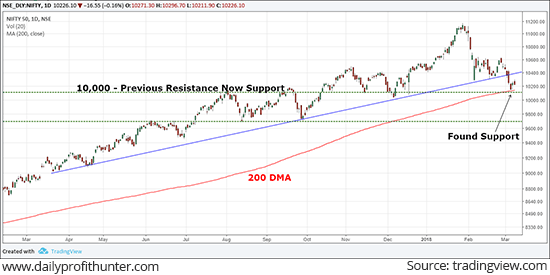
The Nifty 50 Index traded on a negative note during the week.
On Monday, it opened the session gap down and plunged 100 points. The negative momentum continued until mid-week where the index slipped to a low of 10,141. It bounced back nearly 90 points towards the end of the week. Today, the index resumed its down move and finally ended its weekly session 2.21% down.
Last week, we observed the index finding support from the rising trendline (blue line). But this week, it broke below this trendline and plunged to touch a low of 10,141.
The index has now found a strong support near this level from the horizontal line (previous resistance now support). The 200 day moving average (DMA) also acted as a good support for the stock.
So can the index resume its up move after finding support from horizontal level and 200 DMA? Or will it break this support level as well. Let's wait and watch.
Nifty 50 Index Plunges 2% for the Week

Comments
Log in or sign up to join the conversation.