

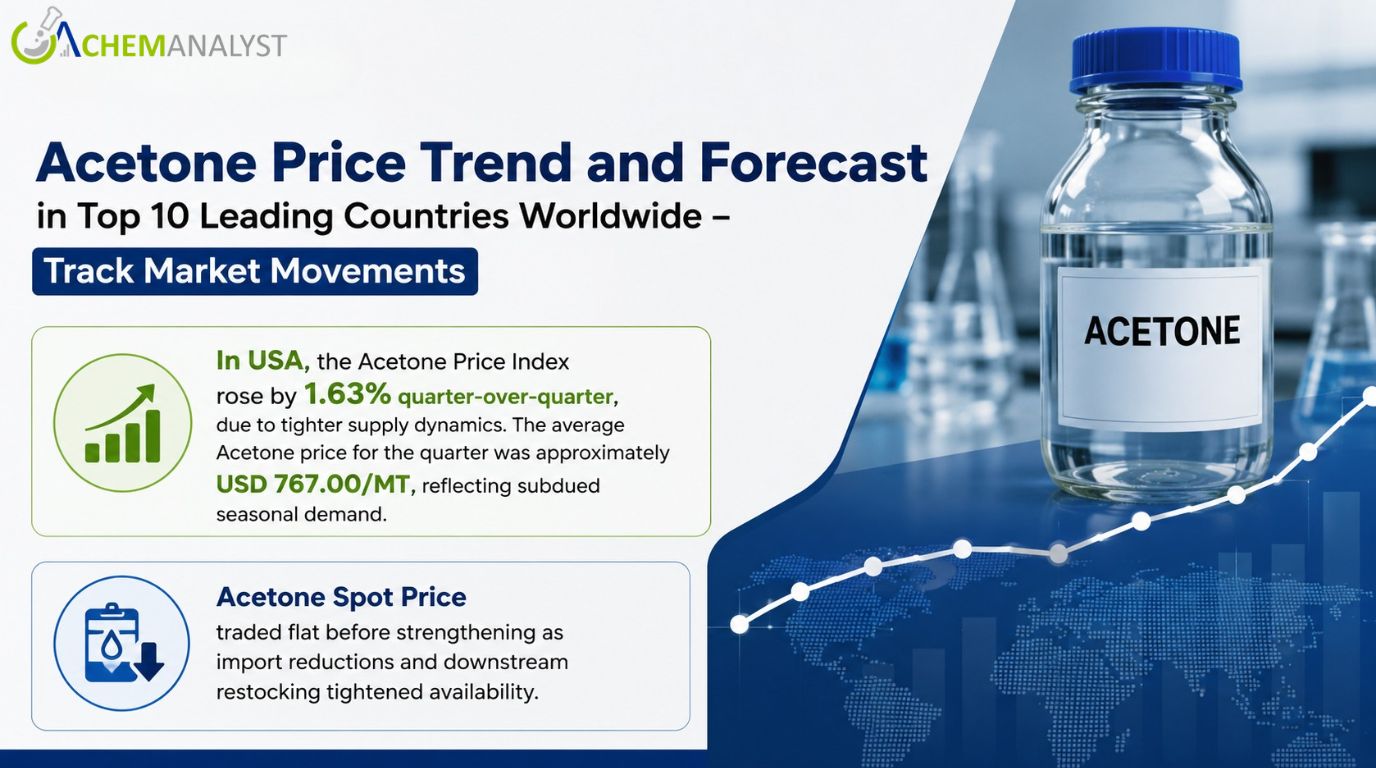
The global acetone market witnessed significant volatility during the recent quarter as regional supply-demand fundamentals, feedstock fluctuations, and inventory movements influenced pricing trends across North America, Asia-Pacific, and Europe. Acetone prices moved unevenly worldwide, with Germany reporting a sharp surge, the United States posting moderate gains, and Japan experiencing a notable decline.
According to ChemAnalyst Acetone Price: - https://www.chemanalyst.com/Pricing-data/acetone-12
Acetone remains one of the most widely used industrial solvents globally, serving critical applications in paints and coatings, pharmaceuticals, personal care products, adhesives, plastics, and chemical intermediates such as bisphenol-A (BPA) and methyl methacrylate (MMA). Because of its extensive downstream consumption, acetone price movements are closely tied to industrial production, construction activity, automotive manufacturing, and global trade conditions.
In 2026, the acetone market continues to face pressure from changing feedstock costs, tightening merchant supply, fluctuating crude oil prices, and uncertain global demand recovery. These factors have made acetone pricing a key focus for manufacturers, procurement teams, and chemical distributors worldwide.
Acetone Price Analysis in North America
USA Acetone Prices Rise Amid Tight Supply Conditions
In the United States, the Acetone Price Index increased by 1.63% quarter-over-quarter, supported primarily by tighter supply fundamentals and constrained merchant availability.
The average acetone price in the USA during the quarter stood at approximately USD 767.00 per metric ton (MT). Despite relatively subdued seasonal demand from downstream sectors, suppliers maintained firm pricing strategies due to inventory management and limited spot market availability.
Several market drivers influenced acetone pricing in North America:
Key Factors Supporting US Acetone Prices
Tight Domestic Supply
Production rates among phenol-acetone manufacturers remained cautious during the quarter. Planned maintenance turnarounds and operational balancing reduced overall merchant availability in the market.
Feedstock Cost Volatility
Acetone production economics are heavily linked to benzene and propylene markets. Fluctuations in upstream feedstock prices contributed to unstable manufacturing costs for producers.
Stable Pharmaceutical Demand
The pharmaceutical and healthcare sectors continued to support baseline acetone consumption, particularly for solvent applications and specialty chemical formulations.
Weak Seasonal Coatings Demand
Demand from paints, coatings, and construction-related sectors remained slower than expected, limiting aggressive price increases despite tighter inventories.
Market participants noted that procurement activity improved slightly toward the end of the quarter as buyers anticipated potential supply disruptions and attempted to secure forward contracts.
Acetone Prices in APAC
Japan Acetone Prices Decline Despite Feedstock Tightness
In Japan, acetone prices moved lower during the quarter, with the Acetone Price Index falling by 4.82% quarter-over-quarter.
The average acetone price in Japan reached approximately USD 1212.33/MT, according to industry market assessments.
The decline reflected weaker downstream demand conditions despite tightening feedstock fundamentals across the region.
Read the LinkedIn Article: - https://www.linkedin.com/pulse/acetone-price-trends-2026-supply-tightness-feedstock-volatility-wnh8c/
Major Drivers Behind Japan’s Acetone Market Decline
Sluggish Industrial Consumption
Demand from automotive coatings, electronics manufacturing, and consumer goods sectors remained weaker than anticipated, reducing procurement momentum.
Export Competition
Asian suppliers faced intense regional competition, especially from China and South Korea, pressuring export pricing strategies throughout the quarter.
Inventory Adjustments
Buyers across Japan adopted cautious inventory management strategies, preferring smaller-volume purchases instead of bulk procurement.
Feedstock Pressure Failed to Lift Prices
Although feedstock constraints were observed in the region, downstream demand weakness outweighed production cost increases, resulting in softer market sentiment.
Japanese market participants also highlighted slower economic recovery in certain manufacturing industries as a key contributor to reduced acetone purchasing activity.
Acetone Prices in Europe
Germany Sees Sharp Acetone Price Surge
Germany recorded the strongest acetone price movement globally during the quarter. The Acetone Price Index surged by 47.49% quarter-over-quarter, reflecting severe supply tightness and significant cost-push inflation.
The average acetone price in Germany stood at approximately USD 930.67/MT.
European acetone markets experienced exceptional volatility due to limited merchant availability, elevated energy costs, and aggressive restocking activity from downstream consumers.
Key Reasons Behind Germany’s Acetone Price Increase
Supply Constraints Across Europe
Several regional producers faced reduced operating rates due to high energy costs and production optimization measures. This sharply restricted available spot supplies.
Strong Restocking Activity
After earlier periods of conservative purchasing, buyers returned to the market to replenish inventories, driving stronger procurement activity.
Energy and Utility Cost Inflation
European chemical manufacturers continued facing elevated electricity and natural gas costs, increasing overall production expenses.
Limited Import Availability
Global logistics disruptions and reduced import competitiveness further tightened European acetone supply chains.
The combination of aggressive buyer activity and constrained production created one of the strongest quarterly price increases observed in the European solvent market.
Global Acetone Supply Chain Trends
Feedstock Market Influence on Acetone Prices
Acetone production is primarily linked to the cumene process, where benzene and propylene serve as essential feedstocks. As a result, upstream crude oil and petrochemical market conditions play a major role in determining acetone pricing trends.
During the quarter:
Propylene prices remained volatile due to fluctuating refinery operating rates.
Benzene markets experienced periodic supply tightness.
Energy cost fluctuations affected overall production economics.
Shipping and freight costs influenced regional arbitrage opportunities.
These upstream uncertainties contributed to uneven acetone price movements across different global regions.
Acetone Demand Outlook by Industry
Pharmaceuticals Continue Supporting Market Stability
The pharmaceutical industry remained one of the most stable acetone-consuming sectors globally. Acetone is widely used as a solvent in drug formulation, active pharmaceutical ingredient (API) processing, and laboratory applications.
Stable pharmaceutical production helped prevent sharper price declines in regions facing industrial demand weakness.
Construction and Coatings Sector Remain Mixed
The paints and coatings industry showed uneven recovery trends across regions.
North America experienced subdued seasonal construction activity.
Europe saw improved restocking demand.
Asia-Pacific markets continued facing slower manufacturing recovery.
This mixed demand environment created inconsistent regional acetone consumption patterns.
Electronics and Automotive Demand Remain Uncertain
Acetone consumption from electronics manufacturing and automotive coatings remained below long-term averages in several APAC countries.
Manufacturers continued monitoring export demand and global consumer spending trends before increasing procurement volumes aggressively.
Global Trade and Logistics Impact on Acetone Prices
International freight conditions and regional shipping constraints continued affecting acetone trade flows throughout the quarter.
Several factors influenced global logistics:
Higher container shipping costs in selected trade lanes
Delays at key ports
Limited vessel availability
Increased storage and warehousing expenses
These logistics-related pressures contributed to higher landed costs in multiple importing regions.
Acetone Market Forecast 2026
Will Acetone Prices Continue Rising?
The global acetone market is expected to remain volatile through 2026 as supply-side uncertainty and uneven industrial demand continue shaping regional pricing patterns.
Expected Market Trends
North America
US acetone prices may remain moderately firm if production rates stay controlled and feedstock markets remain volatile.
Europe
European markets could continue experiencing elevated pricing pressure if energy costs remain high and supply tightness persists.
Asia-Pacific
APAC acetone prices may stabilize gradually if manufacturing activity improves and export demand strengthens.
Key Risk Factors to Watch
Crude oil price fluctuations
Feedstock benzene and propylene volatility
Energy market instability
Global manufacturing recovery pace
Supply chain disruptions
Import-export policy changes
Industry analysts expect buyers to maintain cautious procurement strategies while closely monitoring inventory levels and regional supply availability.
Conclusion
Acetone prices in 2026 continue reflecting a complex balance between supply constraints, feedstock volatility, industrial demand recovery, and global logistics conditions. Regional differences remain significant, with Europe facing aggressive cost-push inflation, North America maintaining moderate gains, and Asia-Pacific markets navigating softer downstream consumption.
As acetone remains a critical industrial solvent for pharmaceuticals, coatings, chemicals, and manufacturing sectors, market participants are expected to closely monitor upstream raw material trends, production rates, and global trade flows in the coming quarters.
With supply-demand fundamentals evolving rapidly across regions, the acetone market is likely to remain highly dynamic throughout 2026, creating both challenges and opportunities for producers, distributors, and industrial buyers worldwide.
Contact US:
Email-Id: - [email protected]
Contact No: - +1 (332) 258-6602
Address: - 420 Lexington Avenue, Suite 300
New York, NY
United States, 10170
Comments
Log in or sign up to join the conversation.