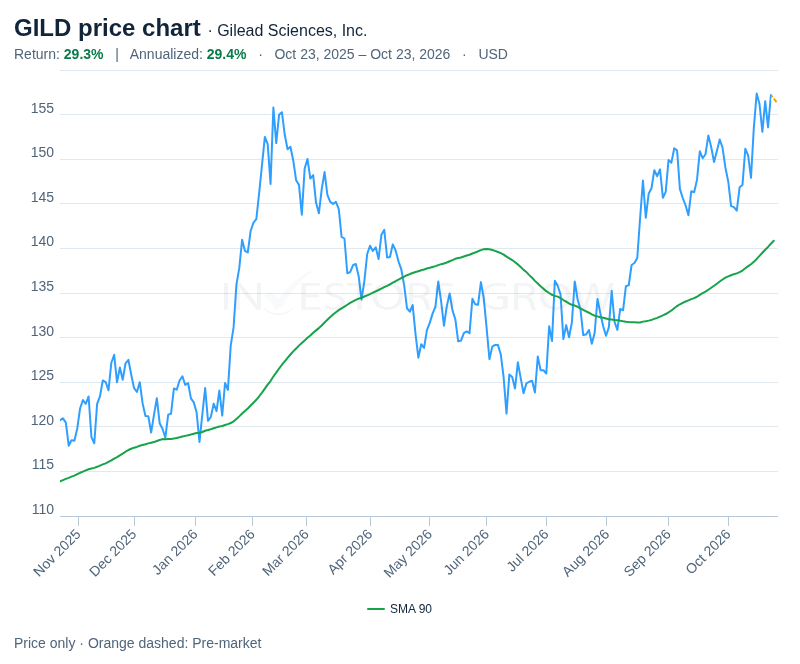
Gilead Pays $1.275 Billion For A Phase 1 Drug: Is It Worth It?

Gilead Sciences is acquiring PepStar Therapeutics’ oral IBD program for $1.275 billion upfront.

Early human testing leaves the biggest questions open

Yesterday, Gilead Sciences announced an agreement to acquire PepStar Therapeutics’ experimental oral inflammation drug program, including HCXT-2001, for $1.275 billion in upfront cash. Gilead is committing to the opportunity to develop a future medicine. HCXT-2001 is in Phase 1 clinical trials, an early stage of human testing. Its safety and effectiveness have yet to be established, and it has no regulatory approval.

The agreement covers worldwide rights to the program, rather than ownership of all of PepStar. Payment is due at closing, subject to customary adjustments. Gilead expects the transaction to close in the fourth quarter of 2026, subject to customary conditions.

The investor question is whether the medicine can eventually earn enough to justify that payment and the development spending still ahead.

What the drug is designed to do

The intended opportunity includes inflammatory bowel disease, or IBD. Its main forms are Crohn’s disease and ulcerative colitis. In these conditions, abnormal immune activity contributes to damaging inflammation in the digestive tract.

HCXT-2001 is designed to block the receptor for interleukin 23, an immune signalling protein involved in inflammation. The receptor, called IL-23R, is the receiving point for that signal. Blocking it aims to interrupt a message that helps drive inflammation.

There is a reason to investigate this approach. An approved injected treatment targeting the same inflammatory pathway already treats adults with moderately to severely active Crohn’s disease and ulcerative colitis. That gives Gilead a credible biological starting point. It also sets a competitive hurdle: the candidate needs its own evidence that it helps patients.

Convenience could help win prescriptions

An effective oral treatment could appeal to patients who would rather take medicine by mouth than receive injections or infusions. If it controls disease with acceptable side effects and manageable dosing, that convenience could help it win prescriptions. Those prescriptions would be the eventual route to revenue.

Treatment convenience depends on the whole routine, not just whether a medicine is swallowed or injected. Our discussion of how treatment convenience can affect prescribing explores that question in a different disease setting.

Gilead also sees potential to pair HCXT-2001 with another experimental medicine in its pipeline, emvistegrast. A successful combination could give the company another way to treat the disease. That remains a development idea: the acquisition announcement provides no clinical results showing that the combination works.

The commercial challenge is that patients and doctors already have treatment choices. Convenience matters, but so do disease control and side effects. An oral medicine that offers little advantage over those alternatives could struggle to win business even if it reaches the market.

The purchase price is only the starting cost

When a company buys an approved medicine with established sales, it has prescriptions and revenue to examine. Here, Gilead would make the purchase payment before HCXT-2001 has demonstrated a commercial return. It would still need to fund development, and a successful program would also require manufacturing and launch work. The $1.275 billion is the upfront consideration, not the full budget for bringing a medicine to market.

The potential payoff is a product that earns enough over its commercial life to justify the purchase and the spending that follows. The downside is committing that money without producing an approved medicine. Even clinical success leaves a business question: how much can the drug earn against the alternatives available when it launches?

The announcement gives us too little to judge whether the price is attractive. It does not provide the clinical evidence, future spending requirements or commercial assumptions needed to assess the return. The size of the payment tells us how much capital management is willing to commit, rather than how well the drug will work.

What would make the case stronger?

Start with what Phase 1 can tell us. The FDA’s explanation of drug development describes early human studies as generally focused on safety and how the body handles a drug. For this candidate, useful findings would include drug exposure at doses people can tolerate.

The larger test comes in controlled studies involving people with the disease. Does treatment improve symptoms and bowel inflammation? How long does the benefit last? Researchers also need to investigate which patients respond and how many stop treatment because of side effects. Those results would help distinguish an interesting mechanism from a useful medicine.

For an investor, each stage answers a different question. Closing would settle control of the program. Clinical results would address whether it works. Evidence of a practical advantage over other treatments would strengthen the case that it can earn a place in the market. Gilead’s agreement commits capital to that possibility; the evidence still has to follow.

STOCKS IN THIS ARTICLE

Comments