

The Euro took a serious hit last Tuesday: the German Constitutional Court ruled that some ECB actions, in regards to Asset purchases regarding the QE, are unconstitutional and thus not valid in Germany, since the ECB decisions are not backed by the EU treaty.
The court gave the ECB now a 3-month ultimatum to "fix" its QE program.
As a result of the German Constitutional Court ruling, Italian bond yields as their European counterparts spiked high while the Euro dropped.
How does the GCC ruling affect PEPP and what if the Bundesbank is out?
The main reason for the spike respectively the drop seem to be that's noteworthy that this ruling covers the PSPP program, NOT the PEPP program.
The PEPP is a 750 billion euro program that runs at least until the end of this year, and aims to counter the negative impact the Corona lockdown will have on the European economy over the coming months and years.
In fact, PEPP goes even a step further, as the ECB is also buying Greek bonds, not taking the rating of the issuing EU country into account or the "issuer limit".
(Note: the PSPP issuer limit refers to the maximum share of an issuer's outstanding securities that the ECB is prepared to buy and is set at 33%. The issuer limit of 33% is a means to safeguard market functioning and price formation as well as to mitigate the risk of the ECB becoming a dominant creditor of euro area governments.)
While the European currency could stabilise over the last days, especially after the ECB responded, saying that it has taken note of German Constitutional Court ruling and remains fully committed to its inflation mandate, the risk and uncertainties provide bearish potential for the Euro. This could be serious, since it remains unclear as to whether the ECB can really do 'whatever it takes' to save the Euro, or if we are headed to a new Euro debt crisis besides the expected massive economic downturn due to the Corona lockdown.
How to trade the EUR/USD in this environment?
When looking at the EUR/USD, the chart looks all in all very choppy and it seems to identify a clear direction.
Still, on a daily time-frame we can clearly see that the currency pair failed two times over the last weeks to regain 1.1000 and bounced quite aggressively against that level.
That said, as long as we trade below 1.1000, we'd "sell the bounce", especially on lower time-frames as H1 or H4 and expect an attack at the current yearly lows around 1.0630 and even a break lower with a minimum test of 1.0500:
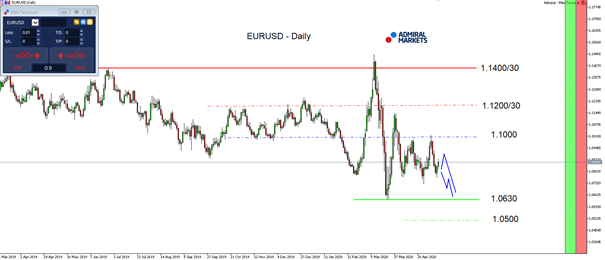
Source: Admiral Markets MT5 with MT5-SE Add-on EUR/USD Daily chart (between March 11, 2019, to May 8, 2020). Accessed: May 8, 2020, at 10:00pm GMT - Please note: Past performance is not a reliable indicator of future results, or future performance.
In 2015, the value of the EUR/USD fell by 10.2%, in 2016, it fell by 3.2%, in 2017, it increased by 13.92%, 2018, it fell by 4.4%, 2019, it fell by 2.2%, meaning that after five years, it was down by 7.3%.

Comments
Log in or sign up to join the conversation.