
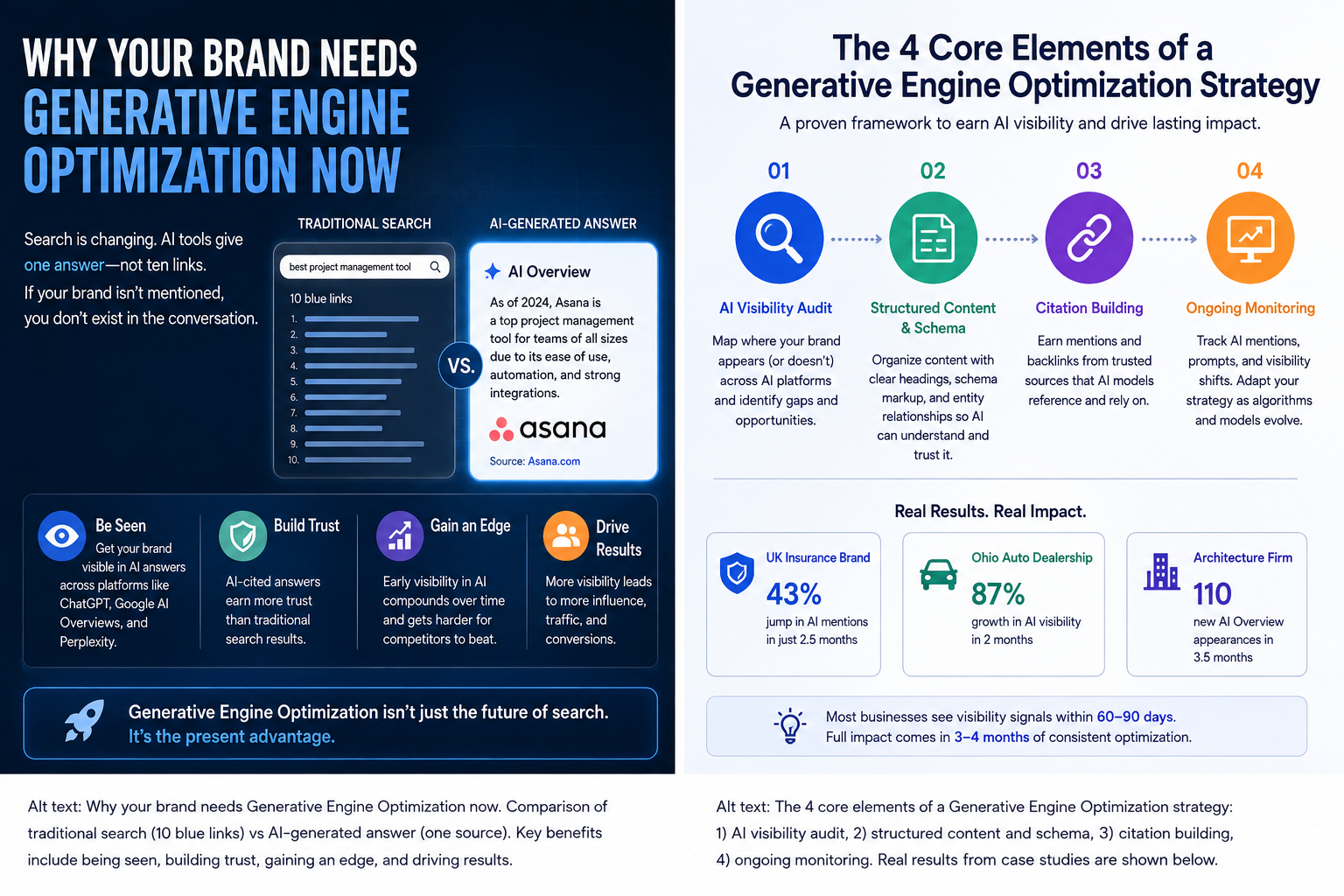
Getting started with Generative Engine Optimization can feel overwhelming if you try to tackle everything at once. The good news is that most successful strategies follow a fairly predictable sequence, one that builds naturally on itself step by step. This checklist breaks Generative Engine Optimization down into clear, ordered steps so you know exactly what to do first, second, and beyond.
Step 1: Run a Baseline AI Visibility Audit
Before changing anything, find out where you currently stand.
Search your most common customer questions directly in ChatGPT, Gemini, and Perplexity
Note whether your brand appears, and how accurately it's described
Identify which competitors are being cited instead of you
Document these findings as your baseline to measure future progress against
Skipping this step means every following action is based on guesswork rather than evidence, which usually leads to wasted time on fixes that don't move the needle.
Step 2: Fix Technical Gaps First
Some of the highest-impact fixes are also the quickest to implement.
Add FAQ schema to pages that directly answer customer questions
Add organization schema so your brand details are clearly machine-readable
Ensure your business name, description, and details are consistent across your website and all directory listings
Confirm your site loads quickly and is easy for both AI crawlers and human visitors to navigate
Step 3: Restructure Existing Content for AI Comprehension
Rather than starting from scratch, improve what you already have.
Rewrite key headings as direct, question-style phrases matching how people talk to AI assistants
Move the core answer to the first sentence or two under each heading
Break long, dense paragraphs into shorter, scannable sections
Remove outdated statistics, examples, or claims that no longer hold up
Step 4: Build New Content Around Real Customer Questions
Once your existing pages are cleaned up, expand into new territory.
Compile a list of the most common questions your customers ask, in their own natural phrasing
Create dedicated FAQ or guide pages that directly answer each one
Avoid stiff, keyword-heavy writing that reads unnaturally to both AI systems and human readers
Update this content regularly as new common questions emerge
Step 5: Strengthen Authority Signals Beyond Your Own Website
AI models trust information that's repeated consistently across multiple credible sources, not just your own claims. This step is where most businesses stop too early, even though it often has an outsized impact on how much AI systems trust your brand.
Get listed accurately across relevant industry directories and review platforms
Pursue guest content or expert quotes on established, trusted sites in your niche
Encourage genuine third-party mentions rather than relying solely on paid placements
Step 6: Track Progress and Adjust Monthly
Generative Engine Optimization isn't a one-time project, so build measurement into your routine from the start.
Review mention frequency and citation accuracy against your original baseline
Compare your visibility trend to your closest competitors
Refresh outdated content before it quietly hurts your credibility
Expand into new question areas as your customers' needs evolve
Myth vs Reality: Getting Started With GEO
Myth: "I need to fix everything before seeing any results." Reality: Even the first two steps, an audit and basic technical fixes, often produce measurable improvement on their own before deeper content work begins, so momentum builds early.
Myth: "This checklist only applies to large websites with lots of content." Reality: Small businesses with a handful of well-structured, accurate pages can build strong AI visibility just as effectively as larger sites with far more content to manage.
Myth: "Once I complete this checklist, the work is finished." Reality: Step six exists precisely because AI models and competitor content keep changing, so this checklist repeats on an ongoing basis rather than ending after one pass through it.
Myth: "Following these steps guarantees specific AI mentions." Reality: No provider or checklist can control exactly what an AI model chooses to say, but following these steps consistently improves your odds significantly over time compared to doing nothing at all.
Turning This Checklist Into Real Progress
This checklist works best when treated as a sequence rather than a list to complete all at once. Start with the audit, since it tells you exactly where your biggest gaps are, then move through technical fixes, content restructuring, and authority building in order. Revisit step six regularly, since it's what keeps the entire checklist relevant as AI models and competitors continue to evolve. Businesses that follow this sequence consistently, rather than jumping around, tend to see clearer and faster improvement in how often AI tools mention them.
Comments
Log in or sign up to join the conversation.