
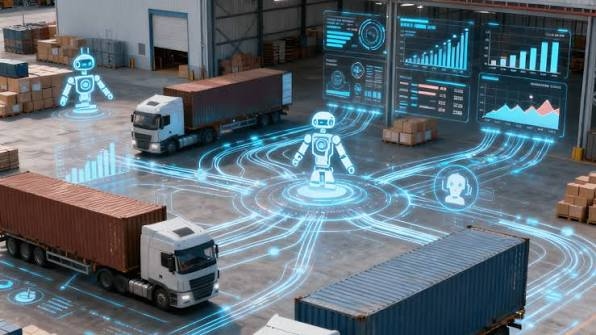
Generative AI in logistics is transforming supply chain management by improving planning, decision support, reporting, and operational automation through Enterprise logistics automation. Enterprises are adopting generative AI solutions to analyze complex logistics data, create actionable insights, automate communication, and improve supply chain visibility. Combined with machine learning, IoT, and cloud platforms, generative AI is enabling more adaptive, efficient, and intelligent logistics ecosystems.
Statistics at a Glance
Statistic | 2027 Value | Why It Matters |
|---|---|---|
Generative AI adoption in enterprises | Increasing across industries | Shows growing demand for AI-powered decision systems |
AI supply chain investment | Continuing expansion | Companies are prioritizing intelligent operations |
Logistics automation adoption | Growing globally | Reduces manual processes and improves efficiency |
AI-powered analytics usage | Increasing among enterprises | Supports faster operational decisions |
Digital supply chain platforms | Expanding adoption | Creates connected logistics environments |
AI forecasting solutions | Growing demand | Improves demand and inventory planning |
Cloud-based AI logistics systems | Increasing usage | Enables scalable implementation |
Intelligent workflow automation | Rising adoption | Improves operational productivity |
AI-based customer service tools | Expanding in logistics | Improves communication and experience |
AI governance programs | Becoming essential | Helps manage enterprise AI risks |
Key Takeaways
Generative AI is becoming a major capability in modern logistics software.
Enterprises use AI to improve planning, forecasting, and operational decision-making.
AI-powered assistants are helping logistics teams process complex information faster.
Supply chain automation is moving from simple workflows toward intelligent systems.
Data quality and governance determine AI implementation success.
Generative AI works best when integrated with existing logistics platforms.
Future logistics operations will combine AI agents, automation, and predictive intelligence.
Executive Summary
The logistics industry is entering a new phase of digital transformation where artificial intelligence is becoming central to supply chain management. Enterprises are adopting generative AI in logistics to improve operational planning, automate information processing, and create faster decision-making capabilities.
Modern supply chains generate enormous amounts of data from transportation systems, warehouses, suppliers, customers, and connected devices. Traditional software systems can store and process this information, but generative AI adds the ability to interpret complex data, generate insights, and assist operational teams.
Generative AI logistics solutions are helping organizations improve several critical areas:
Supply chain planning
Transportation management
Inventory optimization
Logistics reporting
Customer communication
Risk analysis
Unlike traditional automation, generative AI focuses on assisting decision-makers by creating summaries, recommendations, and operational intelligence. This allows logistics managers to understand complex situations faster and respond more effectively.
Enterprises are increasingly developing customized AI logistics platforms because supply chains differ significantly across industries. A global retailer, automotive manufacturer, and healthcare distributor may require different AI capabilities based on their operational models.
The future of logistics will involve highly connected systems where generative AI works alongside predictive analytics, robotics, IoT devices, and enterprise software. Organizations that integrate AI strategically can create more flexible, efficient, and resilient supply chains.
Market Overview
Generative AI is becoming an important investment area as logistics companies search for better ways to manage complexity and improve operational performance.
Key market drivers include:
Increasing supply chain complexity
Growth of global commerce
Need for faster decision-making
Rising customer expectations
Demand for operational automation
Expansion of digital supply chain initiatives
Generative AI Capability | Logistics Application |
|---|---|
Data summarization | Creates operational reports and insights |
Content generation | Automates logistics documentation |
Intelligent assistants | Supports supply chain teams |
Pattern analysis | Identifies operational trends |
Decision support | Provides recommendations for managers |
Generative AI Applications in Logistics
AI-Powered Supply Chain Planning
Planning is one of the most complex activities in logistics because companies must consider demand, inventory, transportation, and supplier conditions.
Generative AI helps teams by:
Creating planning summaries
Analyzing operational data
Identifying possible scenarios
Supporting strategic decisions
Improving communication between teams
This enables businesses to move toward more informed supply chain planning.
Intelligent Logistics Assistants
AI assistants are becoming valuable tools for logistics professionals. These systems can help employees access information and complete tasks faster.
Examples include:
Shipment status analysis
Inventory queries
Logistics recommendations
Report generation
Process guidance
AI assistants reduce the time required to search through large amounts of operational information.
Automated Logistics Documentation
Logistics operations require significant documentation, including shipment records, reports, invoices, and compliance materials.
Generative AI can support:
Document creation
Report preparation
Data summarization
Communication automation
Compliance documentation
This improves efficiency and reduces administrative workload.
Predictive Supply Chain Intelligence
Generative AI combined with predictive analytics helps organizations understand future operational conditions.
Applications include:
Demand analysis
Risk evaluation
Disruption monitoring
Inventory recommendations
Transportation planning
Businesses can make decisions based on deeper operational intelligence.
AI Customer Experience Management
Customer expectations for transparency and faster delivery continue increasing. Generative AI helps logistics companies improve customer interactions.
Capabilities include:
Automated customer responses
Delivery updates
Shipment explanations
Service recommendations
This improves communication throughout the delivery process.
AI Agents and Autonomous Logistics
The next stage of generative AI in logistics involves AI agents capable of managing complex workflows.
AI agents can support:
Shipment monitoring
Exception management
Route recommendations
Inventory alerts
Operational coordination
These systems will help companies create more autonomous logistics environments.
Benefits of Generative AI in Logistics
Faster Decision-Making
Generative AI processes large amounts of information and provides useful summaries quickly.
Improved Productivity
Automation reduces repetitive administrative activities.
Better Operational Visibility
AI helps teams understand supply chain conditions more clearly.
Enhanced Customer Experience
Improved communication and accurate information increase customer satisfaction.
Challenges of Generative AI Adoption in Logistics
Data Quality
Generative AI requires accurate and structured data to produce reliable results.
Security and Privacy
Logistics systems contain sensitive operational information that requires strong protection.
AI Accuracy
Organizations need review processes to validate AI-generated recommendations.
Integration Requirements
Generative AI must connect with logistics management systems, ERP platforms, and operational databases.
Governance and Compliance
Companies need clear rules for AI usage, monitoring, and accountability.
Future Outlook
Generative AI will become a core capability in digital supply chain management over the next several years.
Future developments include:
AI-powered logistics command centers
Autonomous supply chain assistants
Intelligent transportation planning
Advanced predictive systems
AI-driven warehouse management
Real-time decision platforms
By 2027 and beyond, logistics organizations will increasingly use generative AI not only for automation but also as a strategic intelligence layer across supply chain operations.
Frequently Asked Questions
What is generative AI in logistics?
Generative AI in logistics refers to using artificial intelligence systems that create insights, summaries, recommendations, and automated outputs for supply chain operations.
Why are logistics companies using generative AI?
Companies use generative AI to improve planning, automate workflows, analyze information, and support faster decisions.
How does generative AI improve supply chains?
It improves supply chains by analyzing data, generating insights, and helping teams respond to operational challenges.
What are the main applications of generative AI in logistics?
Applications include planning assistance, reporting, documentation, customer communication, and operational analysis.
Can generative AI automate logistics reports?
Yes, generative AI can create summaries, reports, and operational documents from logistics data.
How does generative AI support warehouse operations?
It helps analyze inventory information, create reports, and support operational decision-making.
What is the role of AI assistants in logistics?
AI assistants help employees access information, answer questions, and complete operational tasks faster.
Is generative AI secure for logistics companies?
Security depends on proper data protection, access controls, governance, and enterprise AI practices.
Which industries benefit from generative AI logistics solutions?
Manufacturing, retail, transportation, healthcare, automotive, and e-commerce industries benefit from AI logistics technology.
What is the future of generative AI in logistics?
The future includes autonomous AI agents, intelligent supply chains, predictive systems, and fully connected logistics operations.
Comments
Log in or sign up to join the conversation.