

Yet, private domestic sales suggest economic overheating.
GDP, Real Final Sales, and GDI 2026 Second Estimate
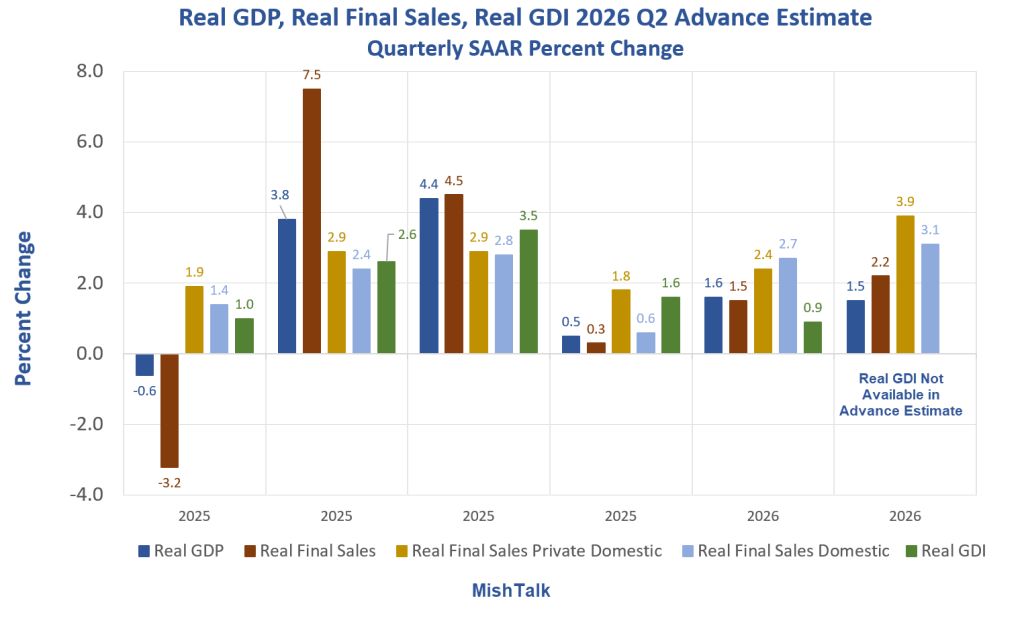
The BEA reports Real Gross Domestic Product (GDP) increased at an annual rate of 1.5 percent in the second quarter of 2026 (April, May, and June). In the first quarter, real GDP increased 2.1 percent.
Real Second-Quarter GDP and GDI
Real GDP 1.5%
Real Final Sales: 2.2%
Real Final Private Domestic Sales: 3.9%
Real Final Domestic Sales: 3.1%
Real GDI: N/A
Real Gross Domestic Income (GDI) is not available in the advance (first) release of the quarter.
The difference between real GDP and Real Final Sales is Change In Private Inventories (CIPI) that nets to zero over time.
Thus real final sales are a better measure than the topline widely reported numbers.
The Fed focuses on Real Final Private Domestic Sales which was a whopping 3.9 percent annualized.
GDP vs GDI
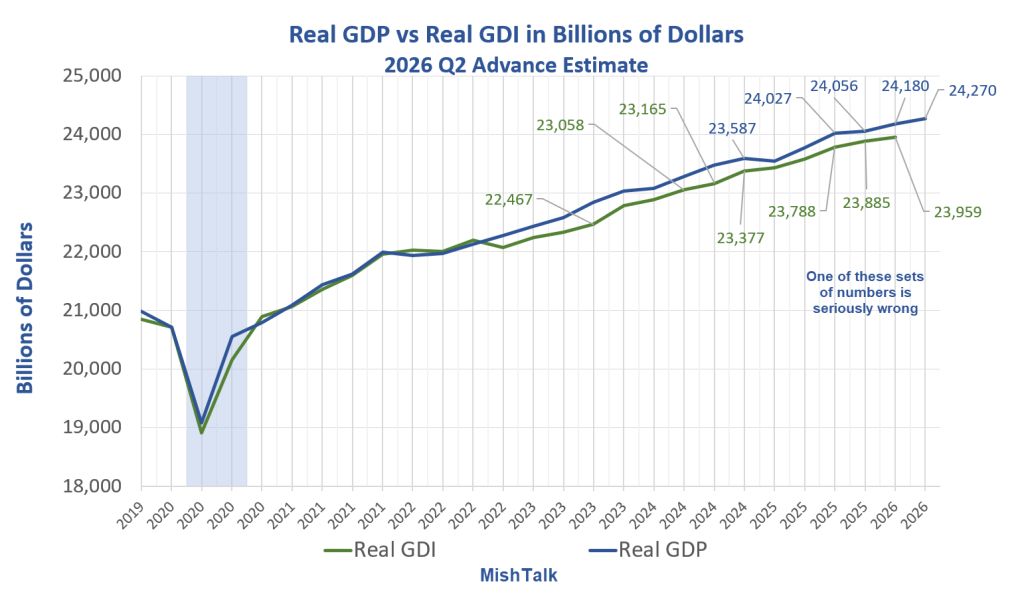
GDP and GDI are two measures of the same thing. Income from sales should match products produced.
The BEA calls the difference a “Statistical Discrepancy“.
Since the fourth quarter of 2022 GDP has been consistently above GDI.
Is income understated or is GDP overstated? It could be a little of each. It could be tax evasion and the underground economy.
Tax evasion creates unreported income (missing from GDI) and under-the-table transactions (missing from GDP).
The Philadelphia Fed GDPplus measure (and the underlying research by Aruoba, Diebold, Nalewaik et al.) gives meaningful weight to GDI. In real time, GDI has often done a better job spotting the onset and severity of recessions than the initial GDP estimates.
I side with the economists who think GDI is a better set of numbers, but not if the answer is tax evasion and unreported income.
In practice, I suspect both numbers are wrong.
The size and persistence of the post-2022 gap is large enough that future annual and comprehensive revisions are likely to move one or both series.
The safest approach is to average the numbers (or use GDPplus) rather than treat either series as the single “true” measure.
Contributions to GDP
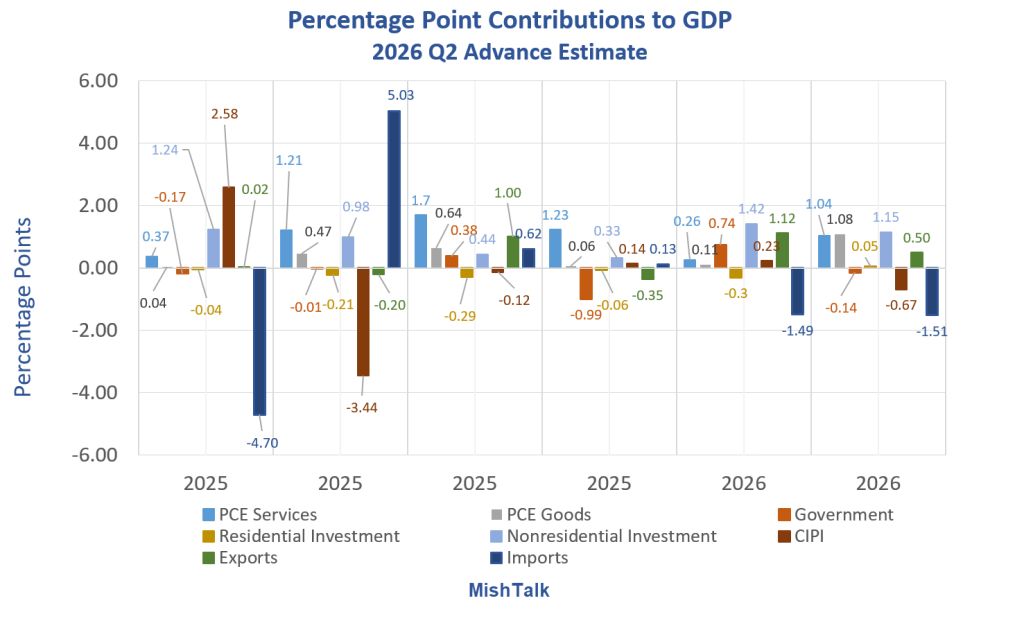
Percentage Point Contributions to 2026 Q2 GDP, Advance Estimate
Contributions to GDP Progression
PCE Services: 1.04 PP
PCE Goods: 1.08 PP
Government: -0.14 PP
Residential Investment: 0.05 PP
Nonresidential Investment: 1.15 PP
CIPI: -0.67 down
Exports: 0.50 PP
Imports -1.51 PP
Imports and Exports
Imports don’t subtract to GDP. The have no impact of GDP at all. The D in GDP explains why.
The BEA subtracts imports because its initial assumption is that all sales are domestic.
Otherwise the BEA would be trying to figure out things like “What percentage of this hammer from Home Depot is domestic?”
Reflections on the Economy
GDP is lagging, but based on private domestic sales, the economy is overheating. 3.9 percent final private domestic sales is a huge number.
The Fed is behind the curve. And that was the market reaction yesterday when the Fed paused rates instead of hiking.
Yet, consumer stress is visible and rising. It’s a stagflation-looking setup.
Related Posts
May 26, 2026: Consumer Credit Stress Is Comparable to the Great Recession
Auto delinquencies are at a new record and credit cards are near record high.
July 29, 2026: Fed Chairman Tries to Explain Why an Interest Rate Pause Isn’t a Pause
Give Warsh an A+ for question avoidance.
July 29, 2026: The Market Tells Fed Chairman Kevin Warsh “You Blew It Already”
The 30-Year Long Bond Yield Is the Highest in 19 Years.

Comments
Log in or sign up to join the conversation.